

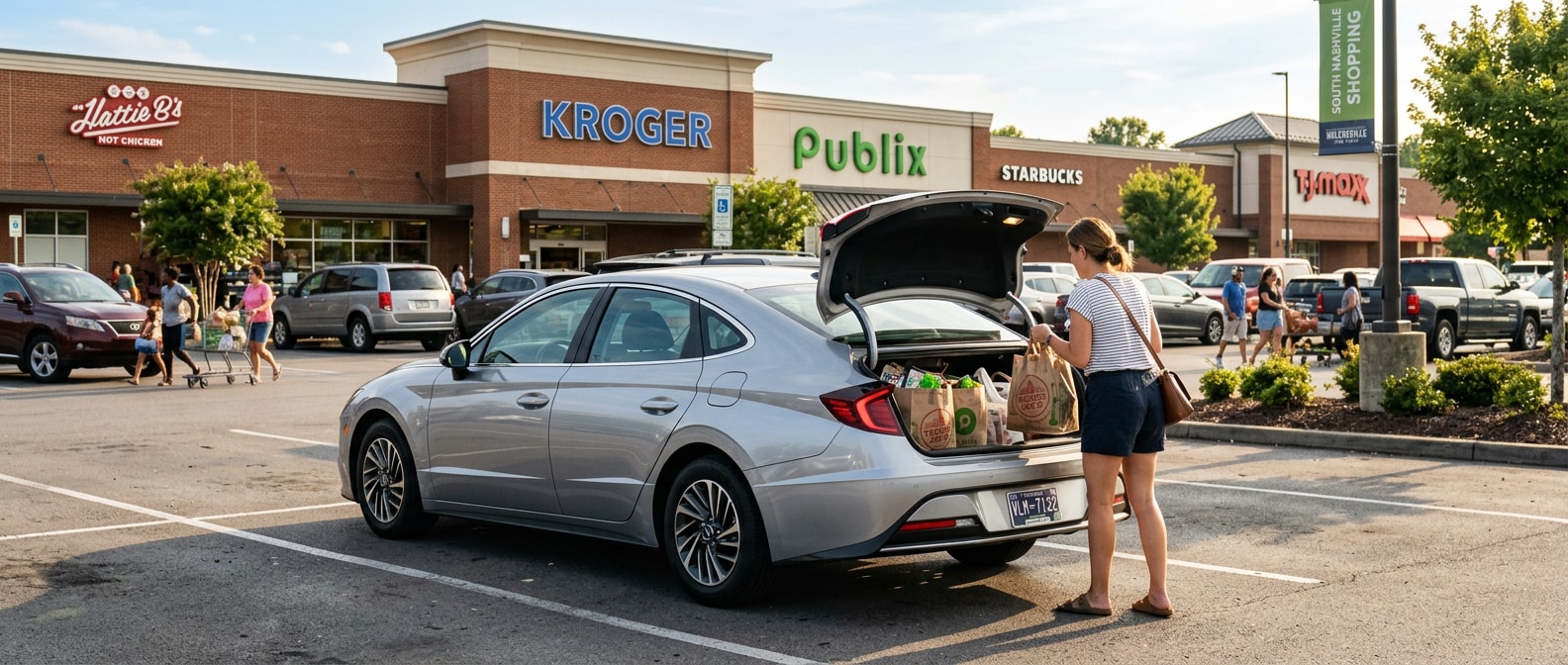
If you've been holding off on the 2026 Hyundai Sonata Hybrid because you heard the battery chews up half the trunk, you're not alone. That worry follows this car around. And it was fair criticism once. On early-generation Sonata Hybrids, the battery pack sat in the cargo area and genuinely robbed you of usable space. Today's 2026 model is a different animal. Hyundai moved the battery. The trunk didn't shrink an inch. Here's the real picture for anyone running errands up and down I-24.
- The myth: the Sonata Hybrid's battery pack cuts into trunk space.
- The reality: Hyundai repositioned the battery under the rear seats, leaving the full 15.6 cubic feet of cargo space intact.
- The rear seats fold 60/40 and create a wide pass-through for longer items.
- The trunk opening is wide with a low liftover height, so loading and unloading is genuinely easy.
- The EPA estimates 47 mpg city on the Blue trim, meaning I-24 stop-and-go traffic works in your favor.
Browse our 2026 Sonata Hybrid inventory
Does the Battery Really Eat Into the Trunk?
No, and on the 2026 Sonata Hybrid that old worry simply doesn't hold up, because Hyundai engineers moved the battery pack under the rear passenger seats rather than placing it in the cargo area, and that one move preserves the full trunk volume for you. Simple as that.
| Claim | What's Actually True |
|---|---|
| "The hybrid battery takes up trunk space" | Battery sits under the rear seats, not in the trunk (current-gen engineering, confirmed by Hyundai and independent reviewers) |
| "The Sonata Hybrid has a small trunk" | 15.6 cubic feet, competitive with the Toyota Camry Hybrid at 15.1 cu ft |
| "The rear seats don't fold down" | 60/40 split-folding rear seats are standard across all 2026 trims, with a broad cargo pass-through |
| "Loading is awkward in a sedan" | Wide trunk opening and low liftover height make heavy or bulky items manageable |
| "A hybrid can't handle real errand runs" | The EPA estimates 47 mpg city on the Blue trim; stop-and-go traffic helps rather than hurts |
That old reputation came from a real problem. Earlier Sonata Hybrid generations parked the battery directly behind the rear seats or in the trunk floor, which cost you five to six cubic feet and killed the fold-down feature entirely. Buyers who remember those cars, or who've read reviews from that period, carried the worry forward. Makes complete sense. But the current platform is a clean break from that approach.
What 15.6 Cubic Feet Means on an Actual Errand Run
Fifteen-point-six cubic feet handles a real errand week without drama, and here's the concrete version. A full week's grocery run for a family of four, say four to five standard reusable totes, fits easily. A Costco run with bulkier items, including a flat of water and a few larger boxes, works with the rear seat folded on one side. That 60/40 split earns its keep, since you keep a passenger in back and still extend the cargo floor where you'd want it.
Check the trunk opening and the liftover height before you write off a sedan on cargo. The opening is wide, the lip is low, and you're not heaving bags over a tall edge. In our experience at the lot, it's the open trunk that changes minds, because the wide mouth and low liftover make loading easy on your back (and the lid is hands-free on every 2026 Sonata Hybrid trim, by the way).
Now for the part that connects directly to I-24 life. That corridor, from Antioch and South Nashville out toward Smyrna and Murfreesboro, isn't forgiving through morning and evening peaks. The Bell Road area and the I-24/I-40 merge approaching downtown crawl reliably.
A conventional gas engine loses efficiency in that traffic. The Sonata Hybrid's setup doesn't, since it runs on electric power at low speeds and recovers energy through braking.
Stop-and-go, counterintuitively, is where this powertrain earns its rating. You're not fighting your commute. You're getting more out of it.
See how the Tucson Hybrid stacks up if you need more vertical cargo space
or consider the Santa Fe Hybrid for genuine SUV cargo room
One Honest Tradeoff Worth Knowing
Fifteen-point-six cubic feet is very competitive for a hybrid sedan, and it is not SUV territory, so a routine built around flat-pack furniture, moving boxes between apartments, or three kids' worth of sports gear will outgrow a trunk this size fast. A sedan can't do that job. We're not going to pretend otherwise.
The Sonata Hybrid fits the buyer who runs real errands efficiently and repeatedly without burning through fuel doing it. Grocery runs, pharmacy pickups, Target trips, the occasional Home Depot haul where the items actually fit a sedan trunk. That's where it earns its value. If your cargo routinely won't fit a midsize trunk, an SUV is the better conversation to start. If it does, the hybrid's city efficiency payoff on a corridor like I-24 is genuine and adds up over time.
See Current Sonata Hybrid Offers
So What Should You Actually Do Before You Decide?
The most useful move before you decide is to come open the trunk yourself, bring the mental grocery list you actually run week to week, and stack your real haul against 15.6 cubic feet instead of trusting a spec sheet or a review that's a generation out of date. Come do it. Our team at 1635 Bell Rd will walk you through it without any pressure. Buyers who make the trip and open that trunk either see right away that it fits their life, or they'll figure out just as fast that a Tucson or Santa Fe Hybrid is the better call. Neither answer is wrong. Ruling out the Sonata Hybrid over battery-in-the-trunk complaints from a version of the car that no longer exists, though, is the real waste of time.
If I-24 is part of your week, the city mpg estimate is going to matter. The math on a hybrid powertrain is real, and stop-and-go is where it works hardest for you. Come see us and we'll give you the honest version.
Check your financing options here
Frequently Asked Questions
Does the 2026 Sonata Hybrid battery take up trunk space?
No. Hyundai repositioned the hybrid battery under the rear passenger seats on the current-generation Sonata Hybrid. The trunk retains its full 15.6 cubic feet of cargo space, and the 60/40 split-folding rear seats remain fully functional. The loss of trunk space was a documented issue on older Sonata Hybrid generations, but it does not apply to the 2026 model.
Is the Sonata Hybrid fuel-efficient in Nashville's I-24 stop-and-go traffic?
Yes, and this is one of the better real-world use cases for the hybrid powertrain. The EPA rates the 2026 Sonata Hybrid Blue at 47 mpg city and 51 mpg combined. The hybrid system runs on electric power at low speeds and recovers energy through regenerative braking, which means congested conditions on the I-24 corridor through Antioch, Smyrna, and toward downtown Nashville generate efficiency rather than waste it.


