

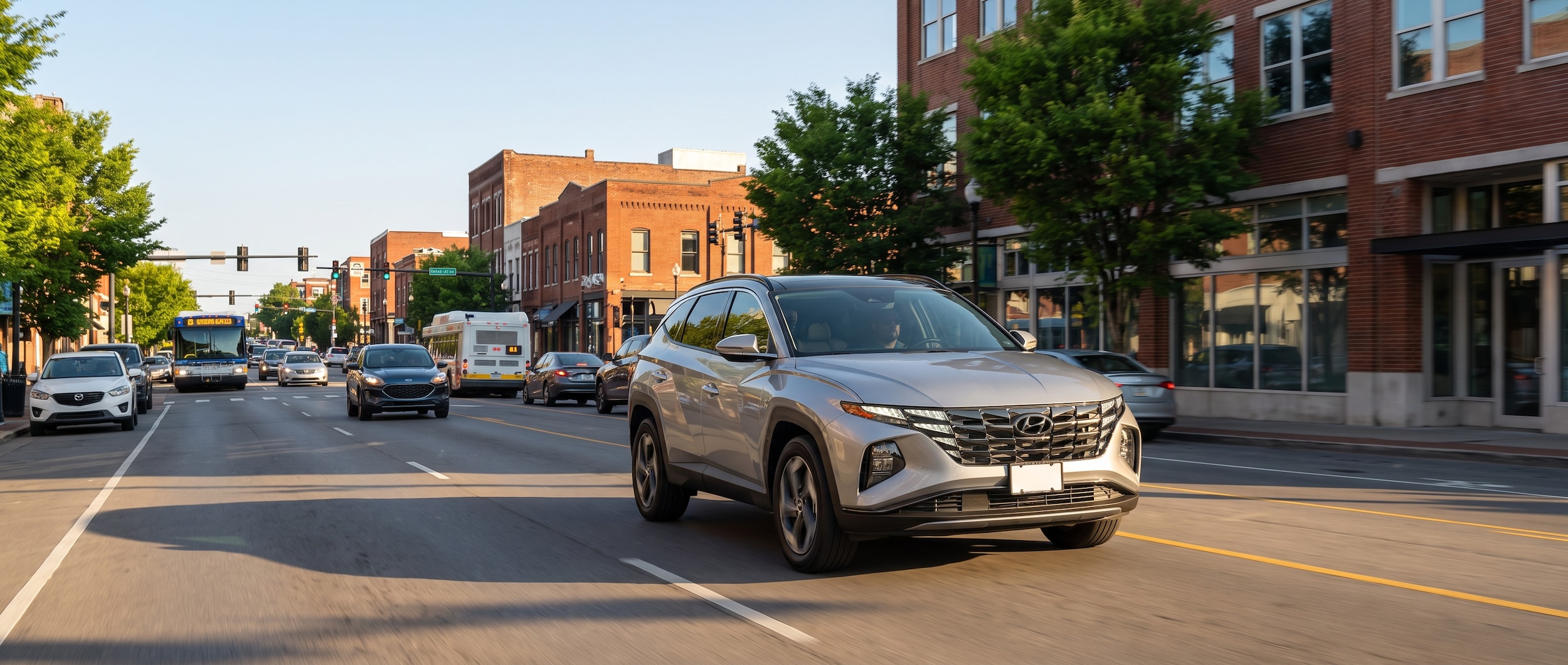
If your daily drive runs along Murfreesboro Pike and onto I-24 toward downtown Nashville, you already know the rhythm. A quick stretch of open road, a hard stop near the Bell Road interchange, then a crawl the rest of the way. For anyone cross-shopping the 2026 Tucson, the question worth asking isn't "is this a good SUV?" It's which powertrain holds up under that specific kind of stop-and-go punishment, and whether hybrid technology actually pays back on a city-heavy route or just sounds good on paper.
The short version is that the Tucson Hybrid earns more efficiency on a congested surface-street commute than on an open highway. We're not talking marketing here. Regenerative braking makes that happen, and it matters a lot when your commute looks more like a parking lot than a freeway.
Browse the 2026 Tucson lineup with Browse the 2026 Tucson lineup and read on. We'll break down exactly why below.
How Does Regenerative Braking Actually Work in the Tucson?
Regenerative braking lets the Tucson Hybrid capture the energy a gas engine throws away as heat during a stop. That's exactly why the hybrid and plug-in versions gain efficiency in stop-and-go traffic while the standard gas Tucson gains nothing there. The gas Tucson and the hybrid Tucson look nearly identical from the outside. Under the hood, though, they handle a stop sign completely differently.
In the gas model, braking converts your forward momentum into heat through the brake pads. The 2.5-liter four-cylinder (187 horsepower, paired with an 8-speed automatic) doesn't recapture any of it. That energy is just gone.
The Tucson Hybrid's 1.6-liter turbocharged engine works alongside an electric motor. When you lift off the throttle or press the brake, that electric motor switches roles and acts as a generator, feeding captured kinetic energy back into the battery pack. Hyundai pairs this with a 6-speed automatic (not a CVT), which gives the driving feel a more conventional cadence than you'd expect from a hybrid. The combined system produces 231 horsepower and 271 lb-ft of torque. That torque figure matters because electric motors deliver it right away, which translates to confident acceleration off a stoplight (the exact scenario Murfreesboro Pike puts you in repeatedly).
| Feature | Gas Tucson | Tucson Hybrid | Tucson Plug-In Hybrid (PHEV) |
|---|---|---|---|
| Engine | 2.5L I4, 187 hp | 1.6L turbo + electric, 231 hp | 1.6L turbo + electric, 231 hp |
| Torque | 178 lb-ft | 271 lb-ft | 271 lb-ft |
| Transmission | 8-speed auto | 6-speed auto | 6-speed auto |
| EPA city / hwy / combined (FWD) | 25 / 33 / 28 mpg | N/A (AWD standard) | N/A (AWD standard) |
| EPA city / hwy / combined (AWD) | 24 / 30 / 26 mpg | 38 / 38 / 38 mpg (Blue SE) | 35 mpg combined (gas mode) |
| All-electric range | None | None | EPA-estimated 32 miles |
| Regenerative braking | No | Yes | Yes |
| Drivetrain availability | FWD standard / AWD optional | AWD standard | AWD standard |
That "38 / 38 / 38" figure for the hybrid is worth pausing on. The EPA rates the Tucson Hybrid Blue SE at the same 38 mpg whether you're in the city or on the highway, which tells you exactly how much regenerative braking is contributing. The gas model's city number (25 mpg) is noticeably lower than its highway number (33 mpg) because it isn't recovering any of that stop-and-go energy.
Which Powertrain Makes More Sense for This Specific Commute?
The Tucson Hybrid makes the strongest case if your daily drive follows the Murfreesboro Pike corridor, since regenerative braking pays off every time traffic backs up. The gas model still holds its own on a steady all-freeway run with little braking to recover. Here's the honest version of that recommendation, including where it doesn't hold.
Along the Murfreesboro Pike corridor into downtown Nashville, congestion builds during morning and evening peak hours, and the I-24 Bell Road interchange is among the heavier spots in the south Nashville commute pattern. Murfreesboro Pike connects the Bell Road area to downtown Nashville. Stop-and-go driving like that is precisely where the hybrid's regenerative system earns its keep. The gas Tucson's 25 mpg city rating is respectable for its class, but the hybrid's city efficiency is meaningfully better. For a commuter doing 30-40 miles a day, that difference compounds over a year of fill-ups.
The tradeoff is worth weighing. The Tucson Hybrid costs more up front than the gas model, and every Hybrid and PHEV trim comes standard with AWD (no FWD option). You're getting AWD whether you want it or not. If your commute is almost entirely freeway miles at steady speed (say, an I-24 run that stays clear), the gas FWD model's 33 mpg highway figure is competitive and the premium for hybrid tech takes longer to recoup. But on Murfreesboro Pike? The hybrid is working for you every time traffic backs up.
The PHEV adds a third layer. The EPA estimates 32 miles of all-electric range. If your round trip is inside that number and you can charge at home overnight, the PHEV can cover a week of commutes on electricity alone, using the 1.6-liter gas engine only as a backup. When the battery depletes, it runs as a standard hybrid at an EPA-estimated 35 mpg combined. That's a real scenario for south Nashville commuters (not a stretch).
| Your commute profile | Best Tucson powertrain |
|---|---|
| Mostly surface streets, stop-and-go | Tucson Hybrid (AWD standard) |
| Mostly freeway, steady speeds, value-focused | Gas Tucson FWD |
| Short round trip (under 32 miles), home charging available | Tucson PHEV |
| Frequent rain or occasional winter ice on the Pike | Gas AWD or any hybrid trim (all come AWD) |
Check which trims and powertrains we have on the lot right now with See what's in our current Tucson inventory.
Quick Glossary: Terms Worth Knowing
| Term | What it means in plain language |
|---|---|
| Regenerative braking | The electric motor runs in reverse during deceleration, capturing kinetic energy and feeding it back to the battery instead of losing it as heat |
| HTRAC AWD | Hyundai's all-wheel-drive system; standard on every Tucson Hybrid and PHEV trim, optional on gas trims |
| MPGe | Miles per gallon equivalent; how the EPA measures PHEV efficiency when running on electricity, for apples-to-apples comparison with gas |
| EPA combined mpg | A weighted average of 55% city driving and 45% highway driving; a useful benchmark but real-world results vary with your actual mix |
What This Means for Your Next Vehicle
Knowing how the drivetrain works changes how you shop, because the hybrid's advantage lives in the city miles and not on the highway loop most test drives use, so a quick freeway spin tells you almost nothing about the payoff. The commuter who tests a gas Tucson on a highway loop and a hybrid Tucson on the same loop won't feel a dramatic difference. Our team keeps both powertrain versions on the lot because south Nashville buyers have such different commute profiles. Some are running a hard I-24 stretch where the gas model's 33 mpg highway holds up fine, and others are grinding through surface streets near the Bell Road corridor where the hybrid's regenerative system is doing real work every day.
All three versions come standard with Hyundai's SmartSense safety suite, which covers Forward Collision-Avoidance Assist with pedestrian and cyclist detection, Lane Keeping Assist, and Driver Attention Warning. Those aren't optional add-ons on higher trims. They're on every 2026 Tucson from the base SE up. On a stop-and-go commute where attention lapses in heavy traffic, that matters. The 12.3-inch touchscreen with wireless Apple CarPlay and Android Auto is also standard across the lineup, so you're not trading tech for a lower trim price.
The version that makes the most financial sense depends on your actual commute, meaning how many miles you drive, how much is surface streets versus freeway, and whether home charging is realistic. We're happy to walk through the math on any specific scenario.
Explore financing options with Explore financing options and then stop by when you're ready to take any version of the Tucson on your actual commute route.
Frequently Asked Questions
Does the Hyundai Tucson Hybrid get better mileage in city traffic than on the highway?
For the 2026 Tucson Hybrid, the EPA rates it at 38 mpg in both city and highway cycles for the Blue SE trim (and 36 mpg combined for other hybrid trims). That equivalence (or near-equivalence) between city and highway efficiency is a direct result of regenerative braking recovering energy during deceleration and stops. Most gas vehicles, including the standard Tucson, show a meaningful city/highway gap (25 city vs. 33 highway) because they can't recapture that braking energy. On a stop-and-go commute like Murfreesboro Pike, the hybrid powertrain is working in its element, not fighting against the conditions.
Does the 2026 Tucson come with safety features on the base trim, or only on higher trims?
Every 2026 Tucson trim (including the base SE) comes standard with Hyundai's SmartSense suite: Forward Collision-Avoidance Assist with pedestrian and cyclist detection, Lane Keeping Assist, and Driver Attention Warning. The 12.3-inch touchscreen and wireless Apple CarPlay and Android Auto are also standard across all trims. You don't need to step up to a higher trim level to get the core safety and tech package.
Is the Tucson Hybrid worth the extra cost if I mostly drive the highway?
If your commute is almost entirely freeway miles at steady speed (like a clear I-24 run), the gas FWD model's 33 mpg highway figure is competitive and the premium for hybrid tech takes longer to recoup through fuel savings. The hybrid shines on stop-and-go routes like Murfreesboro Pike, where regenerative braking works constantly. Highway driving doesn't give the hybrid system much to recover.


