

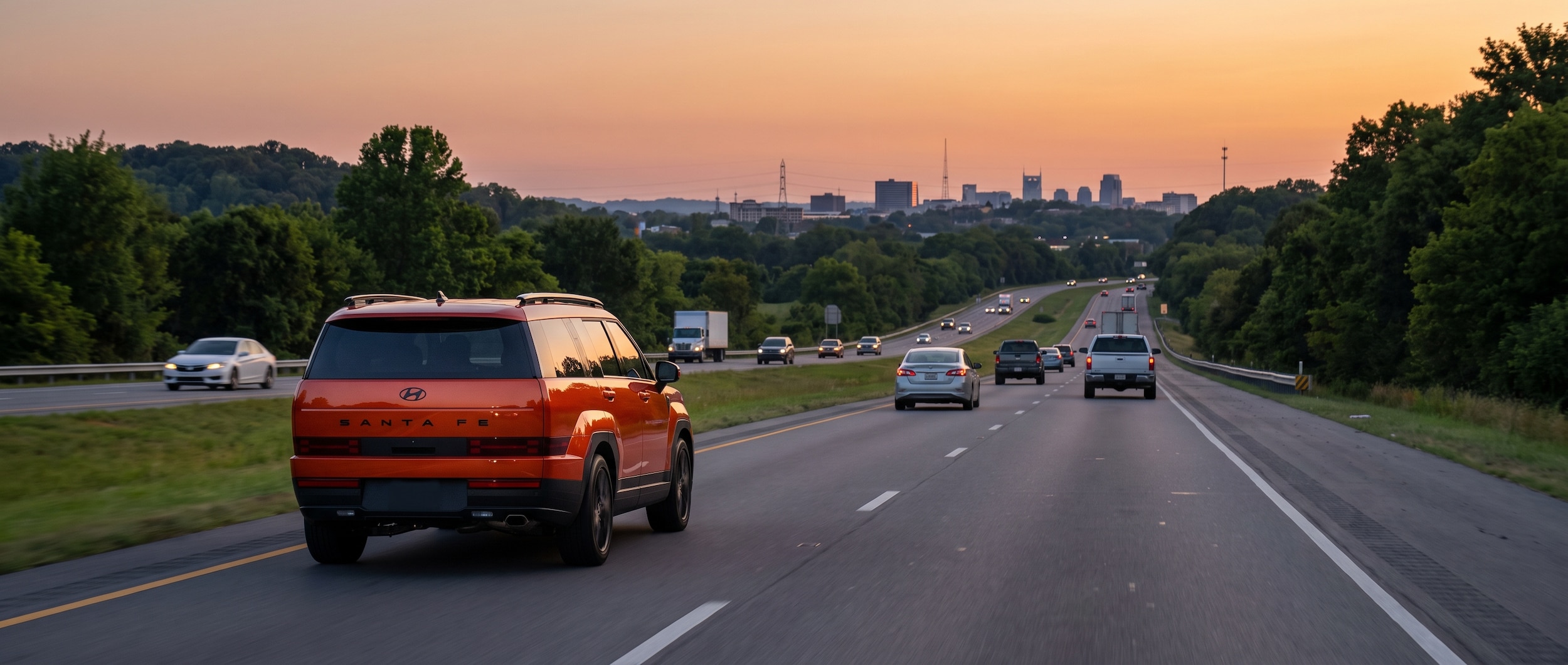
If you're driving between Nashville and Murfreesboro on a regular basis, you already know what I-24 looks like at 7:30 in the morning. The morning run isn't a highway drive. Picture 32 miles of intermittent rolling stops, brake lights stacking up near Antioch, and the occasional standstill that stretches a 40-minute trip into 80 or 90. So when folks ask us whether the 2026 Santa Fe Hybrid is worth it for fuel savings on that specific corridor, our straight answer is that the commute might be the strongest argument for the Hybrid there is. Let us walk through why the tech works in your favor on exactly that kind of drive.
More efficient in traffic? Yes, and it runs against instinct. The mechanism behind that is the core of what we want to explain here.
How Does the Hybrid System Actually Work?
Yes, the Santa Fe Hybrid genuinely saves fuel on this drive, since it runs a gas engine and an electric motor together and recovers braking energy that a plain gas SUV throws away as heat, with the biggest payoff on drives that mix slowing and stopping rather than steady cruising. So the how-to matters here. Under the hood, Hyundai pairs a 1.6-liter turbocharged four-cylinder gasoline engine with a 44.2-kilowatt electric motor.
The EPA rates the FWD 2026 Santa Fe Hybrid at 37 city / 36 highway / 36 combined MPG. Now compare the non-hybrid Santa Fe with its 2.5-liter turbo. The EPA rates that one at 20 city / 29 highway / 24 combined MPG in FWD form. Do the subtraction and you get a 13-MPG gap on city driving. Thirteen. And this corridor is mostly city driving in practice.
The mechanism behind that gap comes down to a handful of factors.
| Factor | 2026 Santa Fe (Gas) | 2026 Santa Fe Hybrid |
|---|---|---|
| City MPG (FWD, EPA-estimated) | 20 mpg | 37 mpg |
| Highway MPG (FWD, EPA-estimated) | 29 mpg | 36 mpg |
| Combined MPG (FWD, EPA-estimated) | 24 mpg | 36 mpg |
| City vs Highway efficiency | Highway wins | City is competitive with highway |
| Slow-speed power source | Gas engine only | Electric motor handles low-speed load |
| Braking energy | Lost as heat | Captured and stored via regenerative braking |
| Engine at a full stop in traffic | Idling, burning fuel | Auto stop-start cuts engine, preserves charge |
| Fuel tank | 15.9 gallons (gas) | 17.7 gallons |
Two hybrid advantages matter most for the I-24 corridor, and they're the electric motor at low speeds and regenerative braking. Every time traffic forces you to slow or brake, the system captures that kinetic energy and feeds it back into the battery. When traffic opens up and you press the accelerator, the electric motor takes a real share of the work at low and moderate speeds, so the gas engine isn't the only thing hauling the SUV back up to speed. On a free-flowing interstate, that cycle barely happens. On stop-and-go I-24 at 7:30, it happens over and over. The drive that feels like the worst part of your day is the one that plays to the Hybrid's strengths.
The auto stop-start system also cuts the gasoline engine when the vehicle is at a complete standstill and the battery has adequate charge, so those long red lights near Murfreesboro Road or the construction slowdowns near Antioch aren't burning fuel you'll never get back.
See Current Santa Fe Hybrid Offers
Which Configuration Makes Sense for Drives Around Murfreesboro?
For most drives around Murfreesboro, the FWD Santa Fe Hybrid is the configuration we'd steer you toward, since the I-24 crawl rewards its low-speed electric assist, though the answer flips toward the gas model if your typical week is mostly open highway with little of the stop-and-go that the hybrid feeds on. So the mix you drive decides it. The non-hybrid Santa Fe is genuinely capable on Tennessee roads, and it's a strong option if your driving mix leans open highway. On the Murfreesboro corridor, though, I-24 traffic during peak hours shrinks that highway MPG advantage into a much smaller number in practice. The U.S. Department of Energy notes that aggressive driving (which includes hard acceleration and hard braking, both common when traffic patterns compress and release on a busy interstate) can reduce fuel economy by 10 to 40 percent in stop-and-go conditions.
In that environment, the Hybrid's architecture stops being theoretical and starts being measurable at the pump.
Between FWD and AWD, the drivetrain math is small but real. The EPA rates the FWD Santa Fe Hybrid at 37 city / 36 highway. The AWD version (Hyundai's HTRAC system) comes in at 35 city / 34 highway. For most Middle Tennessee commuters, FWD handles the I-24 pavement fine year-round. Tennessee does see occasional winter events where the extra grip of AWD earns its keep, and for drivers who tack on weekend trips into the Smoky Mountains or two-lane state roads when conditions get slick, the 2-MPG city tradeoff is a fair one.
The Tucson Hybrid is worth a look if you want a smaller footprint. As a compact against the Santa Fe's midsize frame, it matters if Nashville parking or a tighter garage is part of your daily life. The Santa Fe Hybrid adds a third row and a 17.7-gallon tank that, at 36 combined MPG, gives you a long range before the next fill-up. Longer Murfreesboro runs, weekend family road trips to Chattanooga, summer drives to the lake. The bigger tank handles all of it without you doing mental math on stops.
Quick Glossary: Hybrid Tech Terms Worth Knowing
| Term | What It Actually Means |
|---|---|
| Regenerative braking | A system that converts slowing-down energy into electricity, stored in the battery instead of lost as brake heat |
| HTRAC AWD | Hyundai's torque-vectoring all-wheel-drive system that distributes power front-to-rear based on traction demand |
| Auto stop-start | The engine shuts off automatically at a complete stop and restarts instantly when you lift off the brake, cutting idle fuel consumption |
| Electric motor assist | The hybrid's electric motor shares the workload with the gas engine at low-to-moderate speeds, reducing how hard the gas engine has to work |
| EPA-estimated MPG | The fuel economy figure produced under EPA standardized testing; real-world results vary based on speed, climate, driving style, and load |
What This Means for Your Next Vehicle
For your next vehicle the tradeoff is real and we'll name it plainly, because the Santa Fe Hybrid costs more up front than the non-hybrid Santa Fe, yet the I-24 commute between Nashville and Murfreesboro is one of the better use cases a hybrid powertrain can ask for. Payback depends on how many miles a year you actually drive and what fuel costs look like when you buy. The structural case is simpler. You're doing consistent daily mileage on a corridor that alternates between stop-and-go and rolling highway speeds, which is close to the ideal mix for a system built to recover braking energy and lean on the electric motor at low speeds. Murfreesboro sits in Rutherford County, southeast of Nashville along I-24.
On our lot, the spec that changes the conversation is that city/highway comparison set side by side. The 17-MPG gap on city driving is the figure that lands hardest, and it stops being abstract when you're covering 30-plus miles each direction, five days a week.
If you want to see current Santa Fe Hybrid inventory and talk through which trim fits your commute, we're straightforward about what makes sense for your situation and what doesn't.
Frequently Asked Questions
Does the Santa Fe Hybrid get better mileage in city driving than on the highway?
Yes, and it's intentional. The 2026 Santa Fe Hybrid in FWD form is EPA-estimated at 37 MPG city versus 36 MPG highway. At lower city speeds, the electric motor handles a greater share of the workload, and regenerative braking replenishes the battery every time you slow down. On the open highway where you're rarely braking, the gas engine carries more of the load and that constant regen cycle happens far less.
Is the Santa Fe Hybrid a good fit if my drive to Murfreesboro involves mostly highway miles?
Yes, though the gap versus the gas Santa Fe narrows on pure highway. The EPA rates the Hybrid at 36 highway MPG versus the gas Santa Fe's 29 highway MPG in FWD form, so there's still a meaningful 7-MPG advantage at highway speeds. The U.S. Department of Energy notes that aggressive acceleration and braking can reduce real-world highway fuel economy significantly, so even on open roads, the Hybrid's smoother electric assist off the line can help.


