

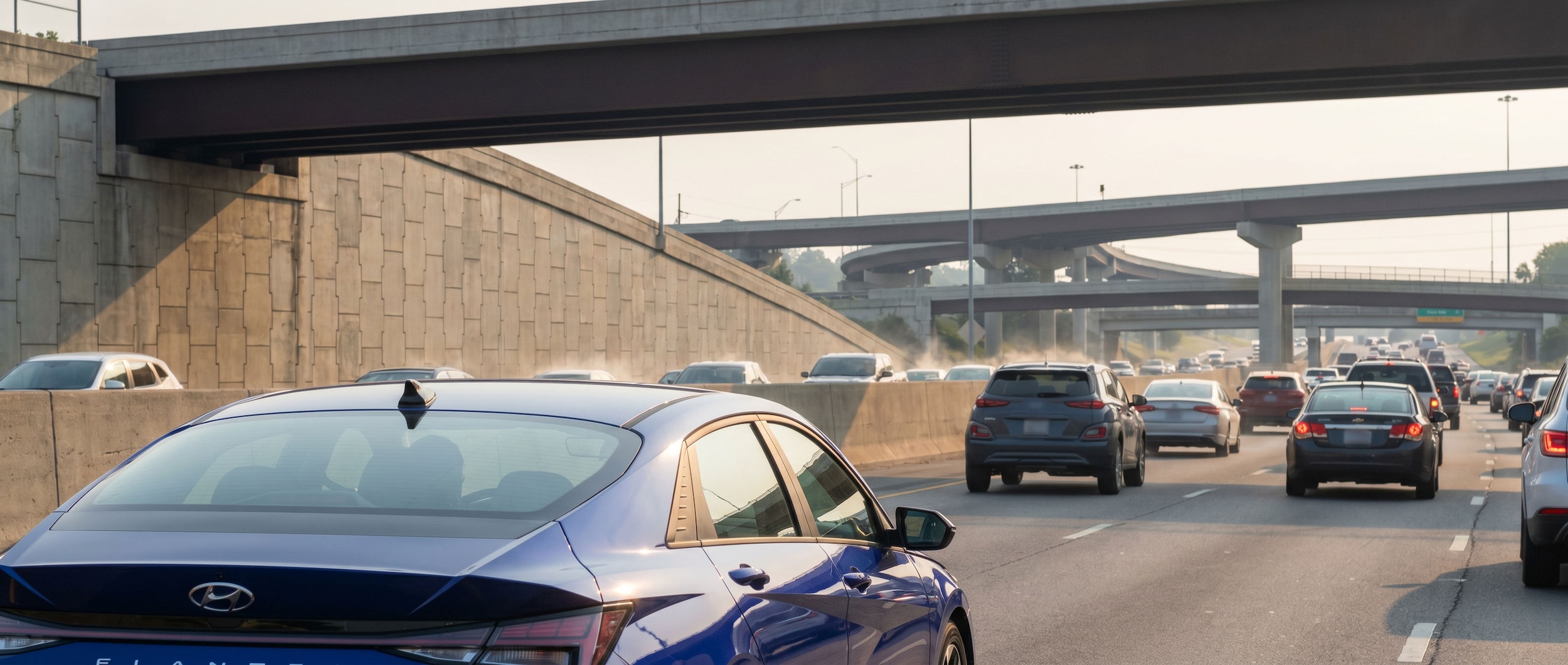
Nashville's I-24 corridor serves commuters from Murfreesboro, Smyrna, and South Nashville who grind into downtown each morning, often through stop-and-go slowdowns under a July sun that pushes the thermometer past 89 degrees. Most cars treat that traffic as pure waste. The 2026 Elantra Hybrid treats it as a charging opportunity.
That single mechanical fact changes the math of a Middle Tennessee commute in ways a quick spec-sheet comparison rarely captures. Here is what it means in practice.
What Do the 2026 Elantra Hybrid's Specs Actually Mean for a Nashville Driver?
The numbers on a spec sheet only tell the story once you understand what is behind them. The 2026 Elantra Hybrid pairs a 1.6-liter four-cylinder engine with an electric assist motor, producing a combined 139 horsepower and routing power through a six-speed dual-clutch automatic transmission, according to Hyundai. That powertrain is self-charging -- no plug, no charging station, nothing to plan around.
| Spec | 2026 Elantra Hybrid Blue | 2026 Elantra Hybrid SEL Sport / Limited |
|---|---|---|
| City MPG (EPA-estimated) | 51 | 49 |
| Highway MPG (EPA-estimated) | 58 | 52 |
| Combined MPG (EPA-estimated) | 54 | 50 |
| Engine | 1.6L 4-cyl + electric motor | 1.6L 4-cyl + electric motor |
| Combined system horsepower | 139 hp | 139 hp |
| Transmission | 6-speed dual-clutch auto | 6-speed dual-clutch auto |
| Fuel tank | 11.0 gal | 11.0 gal |
| Trunk space | 14.2 cu ft | 14.2 cu ft |
| NHTSA overall safety rating | 5-star | 5-star |
The 51 city MPG figure is the one that matters most for the I-24 run. Nashville ranked among the 12th most congested cities in the United States in 2026, per INRIX data, and the southeastern I-24 corridor -- connecting Murfreesboro and Smyrna to downtown -- is one of the heavier-traffic stretches. Every time you lift off the accelerator in that traffic, the Elantra Hybrid's regenerative braking system captures kinetic energy and routes it back to the battery. A conventional gasoline sedan turns the same scenario into brake dust and idling fuel burn.
The 11.0-gallon tank, combined with the Blue trim's 54 MPG combined figure, means the EPA projects a highway range of over 630 miles on a full fill. For an I-24 commuter, that can translate to one or two fill-ups a month instead of weekly stops -- a meaningful difference when Nashville summers also push air conditioning demand higher.
How Nashville's July Heat Shapes the Case for a Hybrid Powertrain
Nashville's July average high sits at 89.1 degrees Fahrenheit, with humidity that peaks around 68.7 percent, making it one of the genuinely demanding warm-weather commute environments in the South. That heat does two things that matter for your choice of car.
First, it loads the air conditioning system hard. A conventional engine burning extra fuel to run the AC in stop-and-go traffic compounds the fuel penalty from idling. The Elantra Hybrid's system draws on battery power to support cabin cooling demands during low-speed phases, reducing the direct hit to fuel economy that a gasoline-only car takes when the AC is working overtime in July.
Second, parked cars in Nashville's summer sun build up substantial cabin heat. The 2026 Elantra Hybrid's available dual-zone automatic climate control (standard on the Blue trim) and ventilated front seats (on the Limited) let you pre-condition the cabin, though the real comfort payoff is the quieter, smoother electric-assist character at low speeds -- the point in a commute when heat and stop-and-go traffic overlap and cabin noise compounds fatigue.
Browse the current Elantra Hybrid inventory at Hyundai of South Nashville to see which trims and colors are in stock right now.
The southeast corridor off I-24 -- through the Antioch area and into South Nashville -- sees consistent peak-hour congestion that adds unpredictable time to the commute. Driver Attention Warning, part of the standard Hyundai SmartSense suite on every 2026 Elantra Hybrid trim, monitors driving behavior and provides an alert when it detects signs of fatigue or inattention. On a late-July afternoon commute, that feature is less of a safety footnote and more of a genuine asset.
If you need more cargo room for the same commute, the Tucson Hybrid is another option in the lineup worth comparing -- but for a single driver or a couple without bulky gear, the Elantra Hybrid's 14.2 cubic feet of trunk space handles the workload without the trade-off in fuel economy.
Driving it cooler: a few practices that improve real-world MPG on the I-24 run
- Use Eco mode during the southbound I-24 grind -- it softens throttle response and extends regenerative braking recovery
- Leave more following distance in stop-and-go traffic so you can coast and regen rather than brake hard
- Park in shade or a garage when possible; a cooler cabin means less AC load during the first few miles
- Keep tires at the recommended pressure; Middle Tennessee summer heat can shift pressure by several PSI, and underinflation reduces efficiency
The Standard Safety Suite That Makes I-24 Traffic Less Draining
Every trim of the 2026 Elantra Hybrid includes Hyundai SmartSense -- no package upgrade required, no extra cost. On a congested interstate, that means Lane Following Assist keeps the car centered in its lane with gentle steering inputs, Forward Collision-Avoidance Assist can apply the brakes automatically if a collision risk is detected ahead, and Blind-Spot Collision Warning flags vehicles that have moved into your blind spot during a lane change. Those are not luxury features on this car. They come on the Blue trim.
The IIHS awarded the 2026 Elantra the TOP SAFETY PICK designation under the stricter 2026 criteria, which for the first time required a "Good" rating in a moderate front overlap test that includes a rear-seat dummy -- a tougher bar than prior years, per the IIHS.
For an I-24 commuter who covers this stretch twice a day, five days a week, that combination of ADAS features and a verified crash-test record is practical rather than abstract. Heavy summer traffic raises collision risk; having the car actively assist with fatigue detection and following-distance management reduces that risk meaningfully.
Who the 2026 Elantra Hybrid Actually Fits
The Elantra Hybrid makes the most sense for a specific Nashville driver profile: someone who commutes regularly on I-24 or the surrounding corridors in South Nashville, puts enough miles on the car that fuel economy is a real line item in the household budget, and does not want to manage a plug or plan around charging infrastructure.
The Blue trim suits drivers who want maximum efficiency and do not need every tech feature -- it leads the lineup at 54 MPG combined and still includes dual-zone climate, proximity keyless entry, and remote start. The Limited adds ventilated front seats, a dual 10.25-inch screen setup under one piece of glass, and memory driver's seat settings -- features worth considering if the commute is long enough that cabin comfort becomes a daily quality-of-life factor.
Where the Elantra Hybrid is less of a fit: drivers who frequently haul large loads or need all-wheel drive. Front-wheel drive is the only available layout. For those situations, the Tucson Hybrid offers more cargo volume and is worth exploring for your needs.
For the solo commuter or household that runs one car hard through Nashville's summers and wants to spend less time at the pump and more time arriving with a cool cabin and a calm demeanor, the Elantra Hybrid is the Hyundai that earns its place in the driveway.
Frequently Asked Questions
Does Nashville's summer heat hurt the Elantra Hybrid's fuel economy?
Heat does affect any car's efficiency, primarily because of increased air conditioning demand and tire pressure fluctuation. The 2026 Elantra Hybrid manages the AC load with battery support during low-speed phases, which partially offsets the heat penalty compared to a gasoline-only car running full AC in the same stop-and-go conditions. The EPA-estimated figures of 51 city / 54 combined MPG are tested under standardized conditions; real-world results in a Nashville July will vary based on how hard the AC runs, your speed, and driving habits -- but the hybrid system's ability to recover energy from braking remains active regardless of ambient temperature.
Does the Elantra Hybrid need to be plugged in?
No. The 2026 Elantra Hybrid is a self-charging hybrid that recharges its battery through regenerative braking and the gasoline engine. There is no external charging port and no need to find a charging station. For Nashville drivers who are curious about hybrids but not ready to manage a charging routine, this is a relevant distinction -- you drive it exactly like a conventional car, and the system handles its own energy recovery.


