

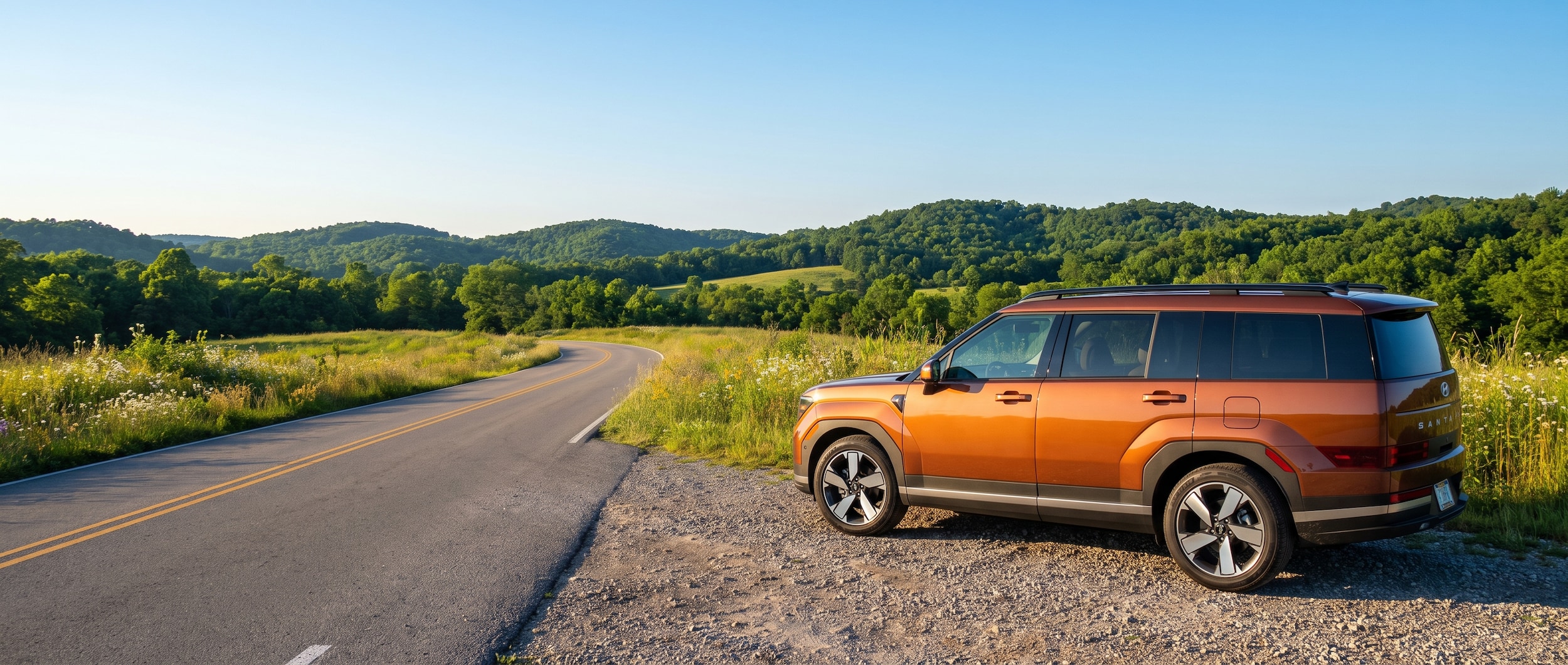
The 2026 Santa Fe Hybrid tends to get pegged as a vehicle that shines around town and turns mediocre on the highway. Hybrid efficiency really does lean on stop-and-go driving, so we get why the worry sticks around. But for a South Nashville family planning a weekend run down Nolensville Pike to the Farmers Market, Nolensville Park, or a long lunch at Martin's Bar-B-Que Joint, the numbers tell a different story than the assumption.
The EPA rates the 2026 Santa Fe Hybrid at 37 mpg city and 36 mpg highway in front-wheel-drive form. One mpg separates them. The highway doesn't gut the efficiency, it barely touches it. We built this whole post around that core reality, and everything below unpacks what it means for your actual weekend.
- Myth: hybrids lose their fuel-economy advantage on highway stretches.
- Reality: the EPA rates the 2026 Santa Fe Hybrid at 37 mpg city / 36 mpg highway (FWD), essentially flat across both.
- The AWD version drops to 35/34 mpg, still strong for a three-row SUV.
- The standard tow rating is 2,000 lbs; the XRT trim raises that to 4,500 lbs (enough for a utility trailer or small boat).
- A 17.7-gallon tank means you can do the Nolensville run and back without stopping for fuel.
Is the Santa Fe Hybrid Really Inefficient on the Highway?
No, the highway doesn't wreck it, and the EPA estimates are what back that up. Plenty of hybrid SUVs show a real gap between their city and highway numbers because the electric motor does less work at sustained speed, but the Santa Fe Hybrid keeps that gap unusually tight. The numbers don't support the worry.
The 1.6-liter turbocharged engine and integrated electric motor work together to hold that spread down. The EPA rates the FWD version at 36 mpg highway, one mpg below city, which is a surprisingly small spread for a three-row hybrid SUV.
Line the common assumptions up against what the specs actually say, and the picture clears up fast.
| Claim | What's Actually True | Source |
|---|---|---|
| "Hybrids get great city MPG but drop badly on the highway" | FWD: 37 city / 36 hwy (1 mpg gap). AWD: 35 city / 34 hwy. The drop is minimal. | EPA, per Hyundai's official specs |
| "It won't hold 36 mpg on Nolensville Pike at highway speeds" | EPA test cycles include sustained speeds up to 80 mph, so freeway driving is factored in | EPA five-cycle test methodology |
| "AWD kills hybrid efficiency" | AWD costs about 2 mpg (34 combined vs 36 combined). Still strong for a three-row. | EPA, per Hyundai's official specs |
| "The hybrid is underpowered for a loaded family trip" | 231 hp and 271 lb-ft of torque from the hybrid system; more torque than many non-hybrid compact SUVs | Hyundai official specs |
| "Hybrids can't tow anything useful" | Standard tow rating is 2,000 lbs; XRT trim is rated to 4,500 lbs | Hyundai official specs |
Browse our current Santa Fe Hybrid inventory to see which trims are available right now.
Why the Nolensville Run Is a Good Real-World Test
Nolensville Pike works as a fair test because it blends exactly the driving conditions the EPA cycle is built to model. The corridor mixes stop-and-go at the lights, stretches of 45-55 mph, and brief highway-speed sections running south toward Williamson County, so it never settles into one steady speed. TDOT is widening it specifically because traffic volumes are projected to nearly double over the next 20 years.
The mix of driving (partial highway, partial suburban stop-and-go, a little parking-lot crawl near the Historic District or Nolensville Farmers Market) actually lands close to what the EPA's combined cycle models. A 36 mpg combined rating on a 17.7-gallon tank puts the theoretical range around 637 miles. Run the math and it plays out simply, you drive down to Nolensville and back, load the kids, grab a cooler at the market, and you never stop for gas on the way home.
Nolensville Pike can feel like highway driving, which makes it tempting to assume you need a non-hybrid for that stretch. The sustained speed on that corridor sits, on average, well within the range the hybrid powertrain is designed for. The electric assist doesn't vanish at 55 mph. It just contributes differently, and the EPA figures already account for that.
See Current Santa Fe Hybrid Offers
So What Should You Actually Do Before Buying?
Start with the honest tradeoff before anything else. If you're regularly pulling a boat trailer heavier than 2,000 lbs, the standard Santa Fe Hybrid's tow rating won't cut it, and you'd want the XRT trim (rated at 4,500 lbs) or the non-hybrid Santa Fe's 5,000-lb rating instead. That's a real difference worth knowing. And if you're taking on sustained mountain grades (not really a Middle Tennessee concern, but relevant if you're driving to the Smokies), you'll feel the 231 hp combined versus the 277 hp in the non-hybrid on steep climbs.
For a Nolensville weekend (or frankly any South Nashville errand day that turns into a spontaneous trip south), the hybrid's case holds up:
- The efficiency is nearly highway-proof at 36 mpg (FWD)
- Three-row seating fits the whole crew without renting a larger vehicle
- 271 lb-ft of torque handles a loaded car without drama
- The Nolensville Pike stop-and-go? The hybrid recaptures that energy
If the third row matters for you but Nolensville trips would occasionally include a heavier trailer, look at the Hyundai Palisade Hybrid as a larger alternative. A different size class, but worth knowing it exists. For buyers who mainly want efficiency on short weekend routes and don't need serious towing, the Santa Fe Hybrid's numbers hold up better on those trips than conventional wisdom suggests.
Our team is glad to walk you through all your options. No pressure, just a real conversation about what your weekends actually look like.
Explore financing options when you're ready to take the next step.
By the Hyundai of South Nashville Team | July 2026
Frequently Asked Questions
Does the 2026 Santa Fe Hybrid get worse gas mileage on the highway than in the city?
Barely, and the spread proves it. The EPA rates the front-wheel-drive 2026 Santa Fe Hybrid at 37 mpg city and 36 mpg highway, a one-mpg difference. That ranks among the tightest city-to-highway spreads in the midsize hybrid SUV segment. The AWD version comes in at 35 city / 34 highway, still a small gap. For a run down Nolensville Pike from South Nashville, you won't see your efficiency collapse the way older hybrid assumptions might lead you to expect.
Can the Santa Fe Hybrid tow anything useful for a weekend trip?
It depends on the trim. The standard Santa Fe Hybrid is rated to tow 2,000 lbs, which handles a small utility trailer or a lightweight kayak trailer. If you need more, the XRT trim is rated to 4,500 lbs, enough for a larger boat trailer or a loaded cargo trailer. The non-hybrid Santa Fe tops out at 5,000 lbs. So "hybrids can't tow" is an oversimplification, the real answer is trim-dependent.


