

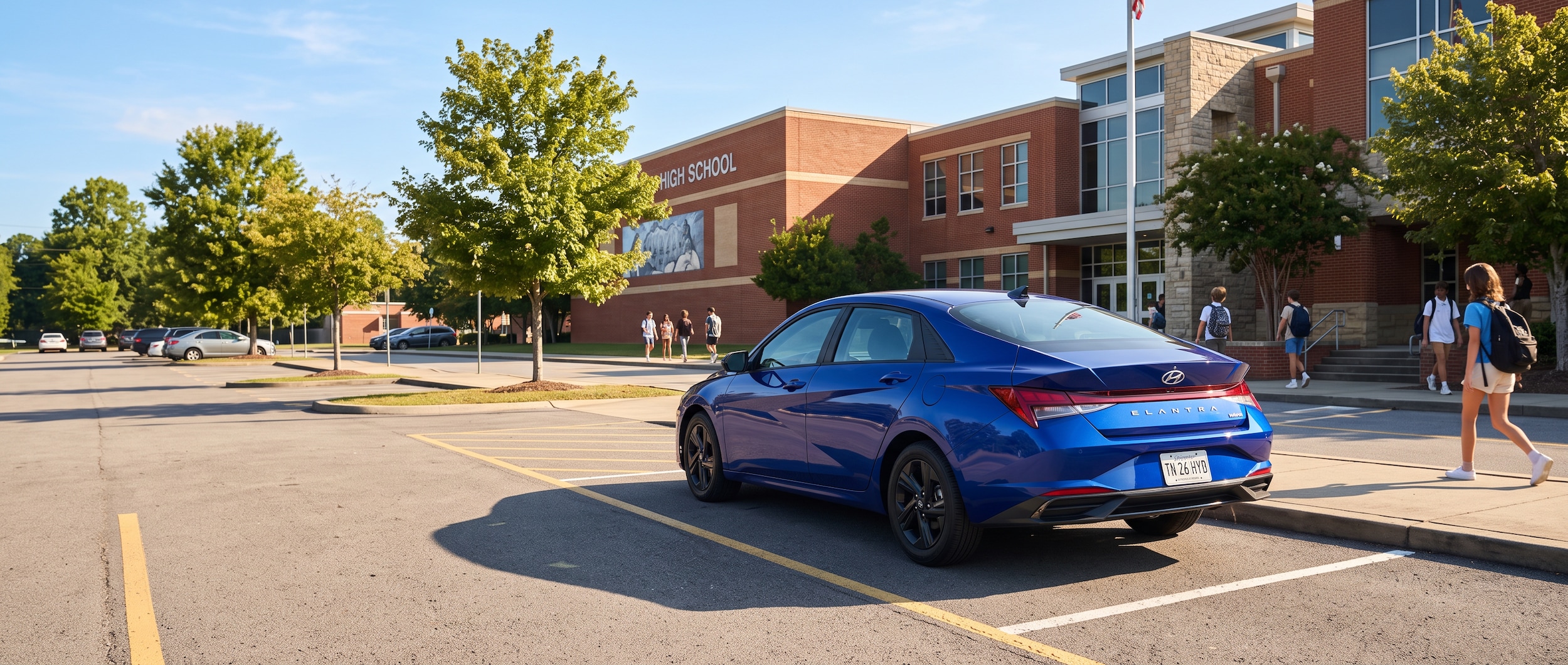
Metro Nashville Public Schools sends students back on August 11. Once that happens, Nolensville Pike and the I-65 corridor through South Nashville shift from summer-slow to stop-and-crawl almost overnight, and every household in the mix starts doing the math on what they're driving.
We ranked four Hyundai models for this exact window. We weighed city fuel efficiency, cargo utility, tech-forward safety, and the ability to haul a carpool without losing your mind. The Elantra Hybrid is our top pick for the solo commuter or first-time driver. Keep reading and you'll see where every model lands and why.
How We Ranked These Models
| Rank | Model | Best For | Standout Spec |
|---|---|---|---|
| 1 | Elantra Hybrid | Solo commuter / new driver | EPA-estimated 54 mpg combined (Blue trim) |
| 2 | Kona | Single parent / campus errand runner | 25.5 cu ft cargo, 12.3-in touchscreen standard |
| 3 | Tucson Hybrid | Family carpool, Nolensville Pike stop-and-go | EPA-estimated 38 mpg city and highway |
| 4 | Palisade Hybrid | Multi-kid household, gear-hauling season | 86.7 cu ft cargo, 3-row seating for 7 or 8 |
No. 1: Elantra Hybrid: The Smart Pick for Daily Nashville Driving
The Elantra Hybrid takes our top spot for daily Nashville driving because stop-and-go traffic is exactly where a hybrid earns its keep, and while you'll trade away crossover cargo room to get it, the fuel math on a school-run commute is hard to argue with. Nolensville Pike logs more than 40,000 vehicle trips per day according to Metro Nashville's own traffic data, and that number climbs sharply once school resumes. The EPA rates the 2026 Elantra Hybrid Blue trim at 51 city, 58 highway, and 54 combined mpg, which makes it one of the most fuel-efficient compact sedans on sale right now. The SEL Sport and Limited trims still return an EPA-estimated 49 city and 52 highway. On the Blue trim, that 11.0-gallon tank stretches to an estimated highway range of more than 630 miles before a fill-up.
There's a real tradeoff here. It's a sedan, so cargo room is limited next to any crossover on this list, and a guitar or a dorm move won't fit easily. But for a new driver handling daily school runs, or a commuter logging meaningful miles on I-65, this is the efficiency story of the Hyundai lineup right now. The 2026 model earned an NHTSA overall five-star safety rating, and every trim comes with Hyundai SmartSense driver-assist technology standard. In city traffic, it sips fuel.
No. 2: Kona: The Compact SUV That Handles the Chaos
The Kona lands second because it swallows the August supply-run chaos better than any sedan here, and though the base engine won't thrill you, the cargo flexibility and standard tech make it a genuinely practical school-zone vehicle. August in Nashville means supply runs. School supplies, dorm hauls, after-school pickups with a trunk full of cleats or an instrument case. The 2026 Kona starts at 25.5 cubic feet of cargo space behind the rear seats and opens to 63.7 cubic feet with the 60/40 split folded flat. The Kona brings serious utility in a tight school-zone loop. It still parks easy.
Every trim gets a 12.3-inch infotainment touchscreen with wireless Apple CarPlay and Android Auto, which matters for a teenager who's going to connect their phone regardless.
Check the trim before you decide the Kona feels underpowered. The base 2.0-liter FWD configuration earns an EPA-estimated 29 city and 34 highway, and at 147 horsepower it's adequate but not spirited, so Nashville's on-ramps reward a little more pull than it provides. If that bothers you, the turbo SEL Premium and Limited trims bump output to 190 horsepower with an eight-speed automatic and still return a respectable EPA-estimated 28 combined mpg in FWD. AWD is available across all trims if you want extra grip for the occasional ice event Middle Tennessee throws in January.
No. 3: Tucson Hybrid: The Carpool Vehicle Nolensville Pike Actually Rewards
The Tucson Hybrid earns third because it holds the same fuel economy in town as on the highway, and that steady number is exactly what the endless light cycles on Nolensville Pike reward, even if the cargo hold gives up ground to the Kona. The EPA rates its Blue SE trim at 38 mpg city and 38 mpg highway. Most hybrids do better on the highway than in town. The Tucson Hybrid splits the difference evenly, so the crawl on Nolensville Pike doesn't punish your fuel economy the way it would a conventional crossover. Upper trims, the SEL, SEL Convenience, and Limited, come in at 36 city and 37 highway, per the EPA.
The Tucson Hybrid uses one powertrain across the lineup. You won't find engine options.
The powertrain is a 1.6-liter turbocharged four-cylinder paired with an electric motor, producing 231 horsepower and 271 lb-ft of torque. AWD is standard across all hybrid trims through Hyundai's HTRAC system. For a household running school carpool on the Nolensville corridor, that pairing of steady city efficiency and confident all-weather traction is the argument. Say the tradeoff plainly. Cargo space behind the rear seats is smaller than the Kona's when you look at the numbers (roughly a school-backpack difference you'll notice on a big grocery run). If you're hauling bulky gear regularly, the Kona or Palisade Hybrid serves that better.
Pros and Cons Snapshot
| Pros | Cons |
|---|---|
| Elantra Hybrid returns EPA-estimated 54 mpg combined in Blue trim | Sedan trunk limits cargo for move-in or activity hauls |
| Kona's 63.7 cu ft folded cargo rivals much larger SUVs | Base engine is modest at 147 hp on Nashville on-ramps |
| Tucson Hybrid holds 38 mpg city AND highway (EPA, Blue SE) | Cargo space behind rear seats is tighter than the Kona |
| Palisade Hybrid seats 7 or 8 with 86.7 cu ft all-seats-folded | Three-row size means tighter turns in crowded school pickup lanes |
No. 4: Palisade Hybrid: When the Family Needs All of It
The 2026 Palisade Hybrid rounds out the list as the only three-row option here, and while its size makes tight pickup lanes a chore, it's the one vehicle that turns a multi-child, multi-activity Nashville morning into something you can actually manage without a fuel stop every few days. It seats 7 or 8 passengers depending on configuration, opens to 86.7 cubic feet of cargo space with all seats folded, and delivers 329 horsepower from a 2.5-liter turbocharged hybrid powertrain. The EPA rates it at 29 city and 30 highway. That's not the efficiency headline the Elantra Hybrid writes, but it beats a non-hybrid three-row by a comfortable margin.
New for 2026 are a factory-integrated tow hitch, third-row seatbelt pre-tensioners, additional airbags, and upgraded USB-C ports throughout the cabin. The dual-camera dash cam is available as a trim option and works as real-world documentation on Nashville's busy corridors. Its footprint means school carpool pickup lanes designed for sedans feel tight, so you'll want to budget an extra minute. But if your household runs three kids in separate directions every school morning, the Palisade Hybrid is the vehicle that makes those mornings work without a gas station stop every three days.


