

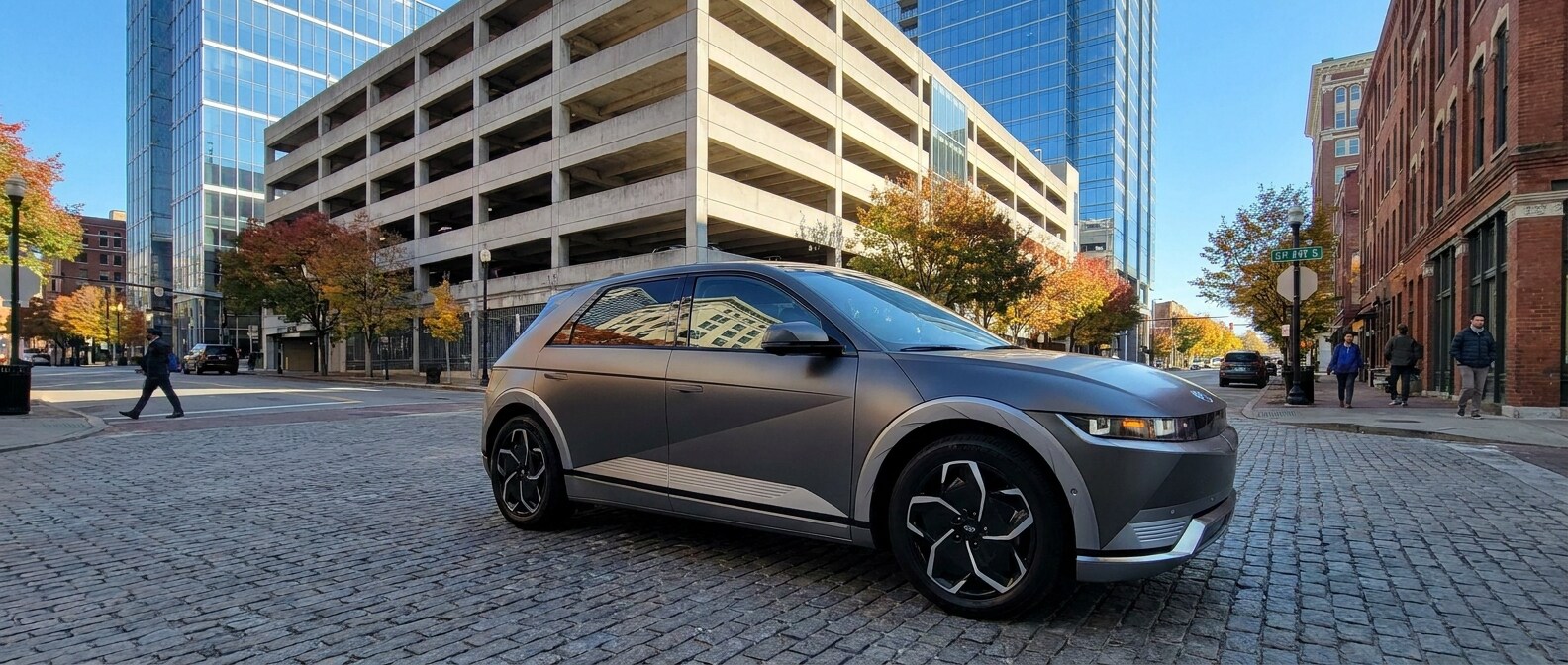
The Gulch runs on structured garages, tight turns into concrete decks, and the kind of daily stop-and-go that makes a gas engine feel like a tax. If your commute touches I-65 or I-24, you've already felt what that traffic does to your fuel gauge. The 2026 Hyundai IONIQ 5 was built for exactly this pattern, and not in a vague marketing sense. Its 800-volt charging architecture, regenerative braking that recaptures energy in bumper-to-bumper crawl, and native NACS port that connects to Tesla Superchargers without an adapter all map straight onto what a Gulch-area commuter handles every weekday.
There's a real tradeoff we'll get to. But the fit here is specific enough to walk through.
Does the IONIQ 5 Actually Fit a Gulch Commuter's Life?
Yes for the everyday case, with battery size being the one piece to think about, since the garage-friendly height, the way it manages stop-and-go, and the native charging port all line up with the Gulch commute pattern you're driving. The breakdown goes condition by condition.
| Local Condition or Use | The Feature That Handles It | Why It Matters Here |
|---|---|---|
| I-65/I-24 stop-and-go during peak hours | One-pedal driving + regenerative braking | You recoup energy precisely when gas cars burn the most |
| Structured garages in The Gulch | 63.0-inch vehicle height | Fits standard Nashville parking decks without special clearance |
| Long-distance Nashville metro commutes | 84 kWh battery, up to 318 mi EPA-estimated range | A week-plus of Gulch commuting on a single home charge |
| Public EV charging in Gulch-area garages | Native NACS port (Tesla Supercharger access, no adapter) | Plug into the growing Supercharger and Level 2 network already in the district |
| Heavy highway corridor driving (I-65, I-24) | Highway Driving Assist 2 (SEL and above) | Manages speed, lane centering, and lane-change assists on divided highways |
| Cold Nashville winter mornings | Standard battery preconditioning and heating system | Protects range in the temperature swings Middle Tennessee does actually get |
Stop-and-Go Traffic Is Where This Car Earns Its Keep
City driving treats an electric car better than highway driving does, which runs backward from how range reads on a spec sheet, so your worst-case traffic on I-65 is where the IONIQ 5 quietly claws energy back instead of wasting it. When you're crawling southbound on I-65 toward the I-440 interchange at 7:45 AM, the IONIQ 5's regenerative braking is converting that deceleration back into usable charge. Gas engines just burn fuel in the same situation. Five days a week, it adds up.
The one-pedal driving mode takes this further. Browse our current IONIQ 5 inventory to see which trims are on the lot now, but the feature is available across the lineup. Set your regeneration level high, and in dense traffic you'll rarely touch the brake pedal. For anyone threading down Demonbreun Street toward a Gulch garage, that means genuinely lower fatigue across a commuting week.
The Charging Reality for a Gulch Commuter
Charging a Gulch commute is more routine than range anxiety makes it sound, and we'd rather be straight with you than offer vague reassurance, because once you pick a battery the daily math is simple and the district's own charging footprint carries a lot of the load.
The 2026 IONIQ 5 comes in two battery sizes. Standard Range (63 kWh) carries an EPA-estimated 245 miles of range, while the Long Range (84 kWh) goes up to an EPA-estimated 318 miles. If you're driving a 35-mile round-trip, the Standard Range covers roughly seven commute days between charges. The Long Range covers nine or more, give or take your right foot.
Will you ever get stranded on a Gulch commute? Not on this math, since even the Standard Range buys about a week of driving before you're back on the plug.
- Home charging handles the everyday routine.
- Public DC fast charging is what you'll lean on for longer trips.
What makes The Gulch workable for EV ownership is the charging infrastructure already embedded in the district. Our financing team can walk you through Federal tax credit eligibility as part of the full ownership picture, but the day-to-day charging math is straightforward. The IONIQ 5's native NACS port means you can plug directly into Tesla Superchargers appearing across Nashville, and the included CCS adapter extends your reach to Electrify America, ChargePoint, and other public networks. When you're not hunting a public charger, a home Level 2 setup charges the 84 kWh pack overnight in roughly seven hours, per Hyundai's published specifications.
In our experience, home charging settles into the default routine fast. You'll plug in when you park, the same way you plug in a phone, and the public network ends up as backup only.
Highway Driving Assist 2 and What It Actually Does on Nashville Interstates
Highway Driving Assist 2 pulls real weight on Nashville's divided highways, easing the sustained attention a congested commute demands, though it stays a support system and not self-driving, so the distinction is worth spelling out before anyone leans on it too hard.
On the SEL trim and above, the 2026 IONIQ 5 includes Highway Driving Assist 2 (HDA 2). On Nashville's divided highway corridors, that system manages your speed relative to the car ahead, keeps the vehicle centered in its lane, and when you tap the turn signal it can assist with the lane change itself, monitoring adjacent lanes and steering through the maneuver. Per Hyundai's published system documentation, it's an SAE Level 2 system, so the driver stays in control, hands on or near the wheel, eyes on the road. It is not autonomous driving.
What it is, in practice, is a fatigue-management tool for a commute that runs 20 to 40 minutes of dense highway traffic each direction. The I-24 corridor between southeast Nashville and downtown is officially described by the Tennessee Department of Transportation as the most congested highway stretch in the state. HDA 2 doesn't make that easier to look at, but it does take some of the sustained micro-attention load off the driver.
For a commuter who's covering predictable daily miles from The Gulch or a nearby South Nashville neighborhood, the full-electric IONIQ 5 argument is strong.
The Honest Tradeoff
The headline range holds up for everyday driving, but it softens once you're sustained at interstate speed or starting a cold January morning, which is the tradeoff worth naming before you commit to a battery size. The EPA-estimated 318-mile range applies to the Long Range RWD under standardized test conditions. Real-world highway driving, sustained at interstate speeds, runs 15-20% below that figure.
Add a cold Nashville morning in January, when temperatures drop into the 20s and 30s, and range drops further until the battery reaches operating temperature. Hyundai includes standard battery preconditioning on the 2026 IONIQ 5 to manage this, but the physics don't disappear.
Precondition the cabin while you're still plugged in on those cold mornings, and you'll pull less from the pack once you're rolling to the garage.
For a Gulch commuter whose daily round-trip is under 60 miles, this doesn't create a problem. You'll never come close to depleting the battery in a single day. For someone doing a longer suburban haul into the city, the Standard Range trim and a home charger become a more careful calculation. Have that conversation before you settle on a battery pack.
The IONIQ 5 isn't a perfect car for every Nashville driver. But it's a genuinely good fit for the specific pattern of an urban or near-urban commuter who charges at home, drives predictable daily distances, and wants to stop paying for gas on the daily grind. Find out what your current vehicle is worth as a first step toward making the numbers work.


