

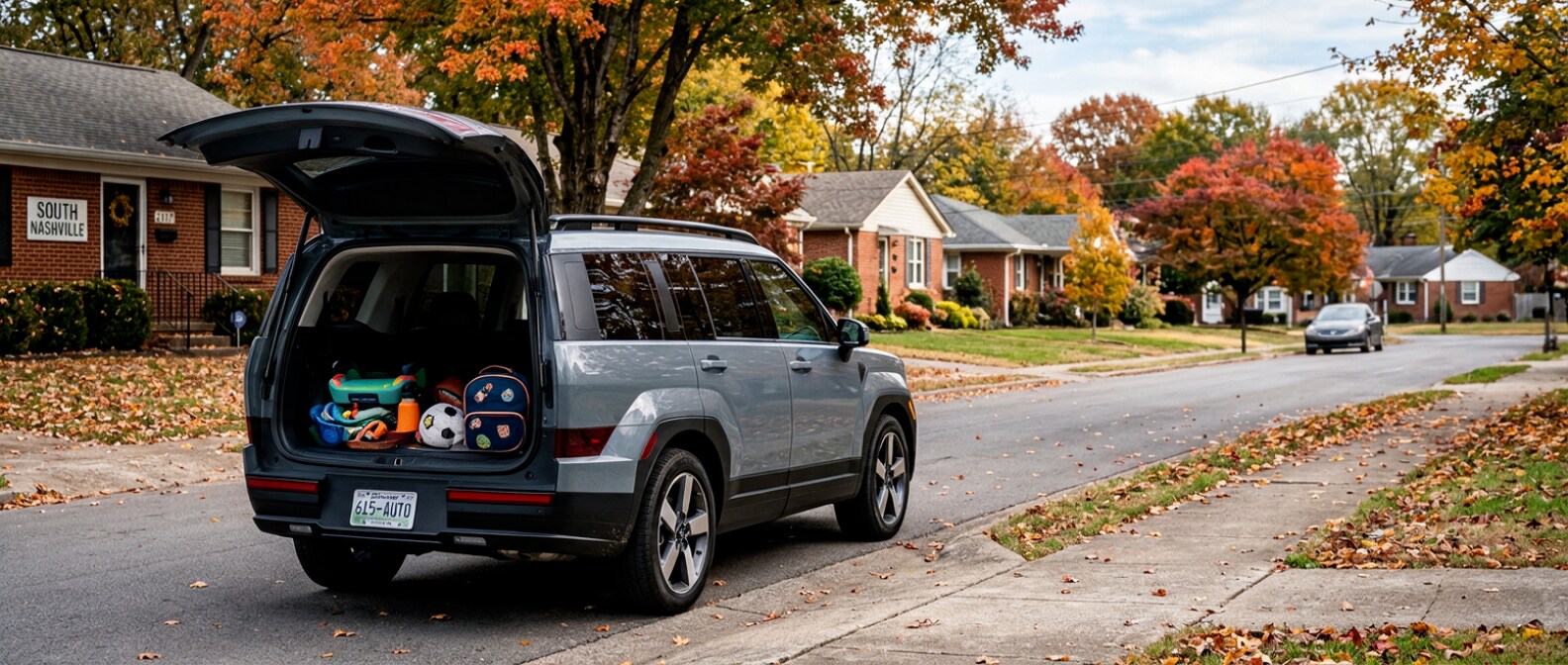
Around Hickory Hollow, the driving isn't highway driving. You'll crawl a school zone, loop a big-box parking lot, and merge onto the I-24 on-ramp, sometimes all three before 8:30 a.m. If you're shopping a three-row Hyundai here, the question isn't which one is bigger. We'd ask which one fits what your family actually does in a week. We've lined all three up side by side so you can stop guessing.
Up front, the tradeoff runs like this. The 2027 Santa Fe is the most compact of the three-row options, and that matters because its third-row legroom measures 30 inches. Fine for children, tight for adults. The Santa Fe Hybrid adds serious fuel economy on top of that same footprint. The Palisade gives you a genuinely roomier third row and more passenger volume, though it's a bigger vehicle in every direction and costs noticeably more. None of those facts are hidden. They just rarely show up together.
- The 2027 Santa Fe (gas) is the pick if you want three rows on a budget, kids in row three, and a relatively nimble footprint for suburban driving.
- The 2027 Santa Fe Hybrid is the pick if the same three-row layout plus an estimated 36 MPG combined matters to your monthly fuel spend, and in Hickory Hollow's stop-and-go pattern, it does.
- The 2027 Palisade is the pick if you have adults (or tall teens) who regularly need to sit in row three, or if you're regularly moving more than five people.
- Don't confuse the Tucson for a three-row option. It seats five, full stop.
- All three carry standard Hyundai SmartSense safety technology, so you're not trading safety for size.
Browse the 2027 Santa Fe on our lot to see which trim fits your situation.
How Do the Santa Fe, Santa Fe Hybrid, and Palisade Actually Compare?
These three split cleanly along size and efficiency, so the comparison comes down to fit instead of a single winner, with the two Santa Fe trims sharing one compact three-row footprint and the Palisade trading a larger body and higher price for genuinely more room. The matrix below lays out verified numbers rather than estimates, and you'll see the story clearly.
| 2027 Santa Fe (Gas) | 2027 Santa Fe Hybrid | 2027 Palisade | |
|---|---|---|---|
| Powertrain | 2.5L Turbo I4, 277 hp | 1.6L Turbo I4 Hybrid, 231 hp | 2.5L Turbo I4 |
| Fuel Economy (FWD, combined est.) | 24 MPG | 36 MPG | n/a |
| Fuel Economy (AWD, combined est.) | 23 MPG | 35 MPG | Available |
| Seating | Up to 7 | Up to 7 | Up to 8 |
| 3rd-row legroom | 30 in | 30 in | More usable for adults |
| Cargo behind 3rd row | 14.6 cu ft | 14.6 cu ft | 19 cu ft |
| Cargo behind 2nd row | 40.5 cu ft | 40.5 cu ft | Larger |
| Max cargo (all rows folded) | 79.6 cu ft | 79.6 cu ft | Larger |
| Standard wireless smartphone | Yes | Yes | Yes |
| Power liftgate | Standard | Standard | Standard |
| Best for | Budget-conscious 3-row families | Fuel-focused families, stop-and-go commutes | Larger families, adult third-row riders |
One number here jumps out above the rest. The Santa Fe Hybrid's fuel economy runs 50 percent better than the gas Santa Fe in combined driving. For a family covering 15,000 miles a year with meaningful city mileage, that gap adds up in ways you'll feel across three years of ownership.
See available Santa Fe Hybrid trims in our new inventory.
Which Engine Makes More Sense for Hickory Hollow's Daily Pattern?
For Hickory Hollow's stop-and-go pattern the Hybrid makes the stronger case, recapturing energy during braking and coasting on exactly the surface streets these mornings are built from, and the gas engine stays a fair pick mainly for drivers whose weekly miles lean toward loaded I-24 merges. Braking and coasting like that dominates Hickory Hollow Parkway and the surrounding school-zone streets, worst during the morning drop-off window and the afternoon pickup rush. The gas Santa Fe rates at 20 MPG in the city, and the Hybrid comes in at an estimated 37 MPG city. The difference isn't marginal. You end up with a fundamentally different relationship with the fuel pump.
The gas version isn't a wrong answer at all. Its 277 horsepower edges out the Hybrid's 231 (a gap that shows up under load), so a heavy-loaded merge onto I-24 feels more confident with the gas engine under you. You'll also find it the easier path to a lower entry point in the trim ladder.
Compare the Palisade if adult third-row seating is on your list.
Pros and Cons: 2027 Santa Fe Hybrid vs 2027 Palisade
| Pros (Santa Fe Hybrid) | Cons (Santa Fe Hybrid) |
|---|---|
| Estimated 36 MPG combined, 37 city | 231 hp vs 277 hp (gas Santa Fe) |
| Three rows in a compact footprint | Third row best suited for children, not adults |
| 14.6 cu ft behind third row | Less total cargo volume than Palisade |
| Available HTRAC AWD | Smaller overall interior than Palisade |
| Wireless charging, dual 12.3-in displays (SEL+) | Hybrid adds to entry cost vs base gas Santa Fe |
| Pros (Palisade) | Cons (Palisade) |
|---|---|
| More usable third row for adults and taller teens | Larger footprint, harder in tight parking |
| Seats up to 8 (bench config) | Lower fuel economy |
| More cargo space in every configuration | Higher price point |
| Refined interior, near-premium materials |
Which One Is Right for Your Family's Situation?
The right pick depends on who actually rides in your third row and how much of your week you'll spend in city driving, which means three clean answers emerge, with kids-and-fuel-costs pointing to the Hybrid, regular adult third-row use pointing to the Palisade, and budget-minded highway driving keeping the gas Santa Fe firmly in play. Each one shakes out a bit differently.
You have kids under 12 and prioritize fuel costs. Go with the Santa Fe Hybrid here. The third row holds children comfortably, the 14.6 cubic feet behind it swallows a school bag and a sports duffel, and the hybrid powertrain hands you the most efficient daily driver in this group. On the weekend, that compact footprint means you're not threading a large vehicle through the Hickory Hollow parking lots.
You need to seat adults in row three regularly. Needing adults back there changes the recommendation. At 30 inches of third-row legroom, the Santa Fe's back row works for a small adult on a short hop, though it isn't where you want teenagers or grown passengers past about 20 minutes. The Palisade's third row runs meaningfully larger. If your household truly seats adults back there on a routine basis, carpooling other parents or hosting weekly family dinners with grandparents, the Palisade is the real recommendation and not a size upgrade for its own sake.
You want three rows but hybrid efficiency isn't the priority. The gas Santa Fe hands you the same three-row layout and 277 horsepower at a lower cost of entry than the Hybrid trim. You'll give up roughly 12 MPG combined against the Hybrid, and you pick up a bit more low-end urgency on highway on-ramps in return. It fits best when your driving leans predominantly highway, where the efficiency gap between the two narrows anyway. Highway miles blunt the Hybrid's edge.
One clarification on the Tucson, because the lineup names can blur together. The Tucson is a two-row, five-passenger SUV. As a vehicle in that category it's strong, though it has no third row and won't seat seven. If your search starts with three rows, the Tucson isn't part of that conversation.
Browse our current Hyundai inventory to check availability on all three models.
Frequently Asked Questions
Does the 2027 Hyundai Santa Fe actually have three rows?
Yes. The 2027 Santa Fe has three rows of seating and accommodates up to seven passengers. The third row is a real, foldable seat, not a jump seat, but its 30 inches of legroom make it most comfortable for children and shorter adults. If you regularly seat tall adults or teenagers in row three, the Palisade's larger third row is worth considering.
Is the Santa Fe Hybrid worth the upgrade over the gas Santa Fe?
For families who do a significant share of their driving in suburban stop-and-go conditions. School runs, errand loops, neighborhood routes. Yes. The Hybrid's estimated fuel economy is around 50 percent better than the gas Santa Fe in city driving (37 MPG city vs 20 MPG city). The gas Santa Fe has slightly more horsepower and a lower entry cost, so if your family's miles are mostly highway or you're prioritizing a lower starting point in the trim ladder, the gas version is a reasonable choice. The Hybrid makes the most financial sense over time for high-city-mile drivers.


