

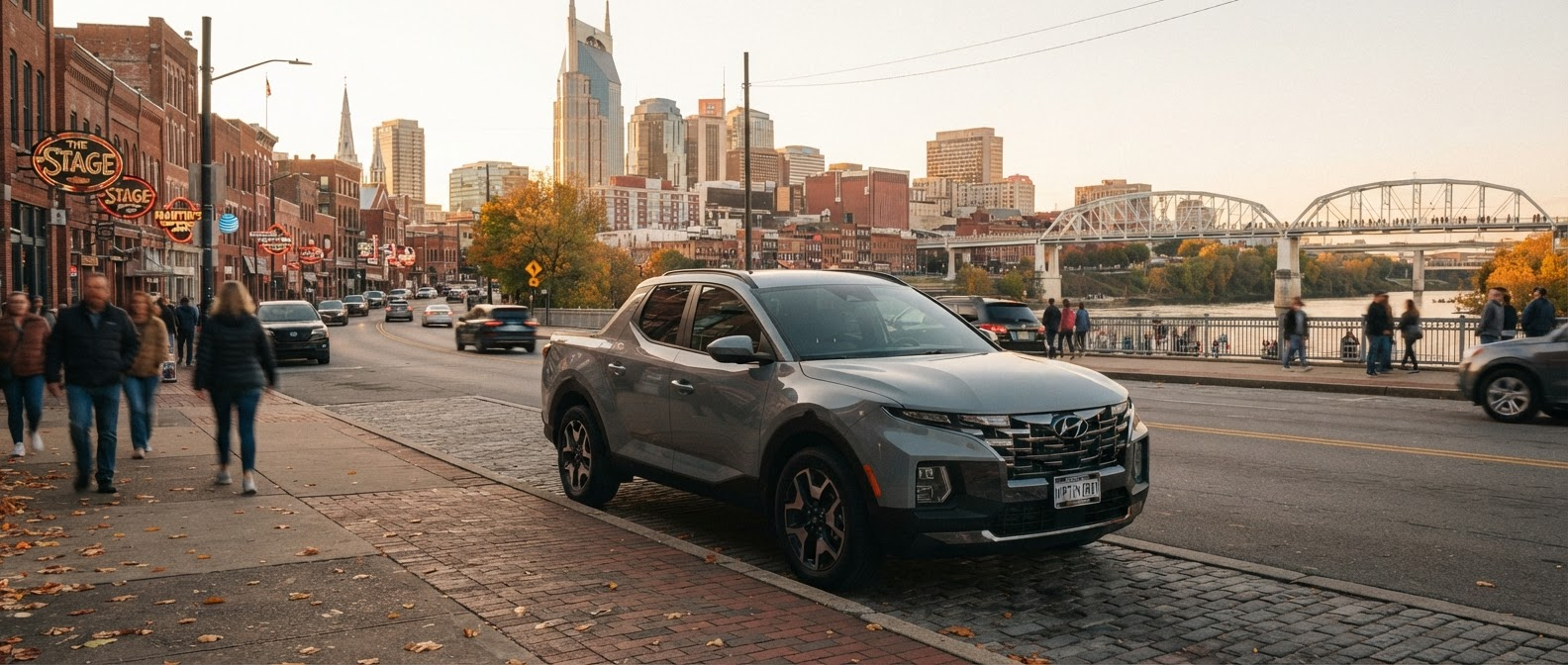
The right answer here comes fast. If you want an open cargo bed without paying the downtown-parking tax of a full-size truck, start your test drive on the Santa Cruz SE with front-wheel drive. It's the one we see pull the most weight in this city, figuratively speaking. But the trim you should actually buy depends on how hard you'll use that bed, and that's what this guide is for.
the Santa Cruz shares its platform with the Tucson but arrives with a composite cargo bed and a footprint short enough (195.7 inches overall) to slide into the same street-parking spots you'd take a crossover into. It matters in a city where parallel parking on Broadway or finding a space near Vanderbilt has become a contact sport.
The 2027 Santa Cruz Lineup at a Glance
The 2027 lineup runs just three trims, because Hyundai streamlined it and dropped the SEL and Limited, which leaves you a genuinely simple decision whether you want a daily commuter, a weekend gear-hauler, or a turbocharged tow rig. Three trims, no overthinking.
| Rank | Trim | Best For | Standout Spec |
|---|---|---|---|
| 1 | SE (FWD or AWD) | Daily Nashville commuter who hauls occasionally | 22 city / 30 hwy EPA-estimated (FWD); 191 hp; 3,500 lb tow |
| 2 | SEL Activity (FWD or AWD) | Active-lifestyle buyer: kayaks, camping, weekend gear | Same NA engine; adds roof rails, power seat, tech upgrades |
| 3 | XRT (AWD standard) | Buyer who needs turbo power + tow capacity | 281 hp turbo; 5,000 lb tow; 18 city / 25 hwy EPA-estimated |
The SE: Proof That the Base Trim Isn't a Penalty Box
Start with the SE if your thinking runs toward something smaller than a Tacoma and smarter than a plain crossover, because the 2027 version loads in enough standard equipment that calling it a base trim undersells it, though you'll give up a couple of cold-weather comforts to the trims above it. The SE gets synthetic H-Tex leatherette standard (Hyundai made that a lineup-wide change for 2027), a 12.3-inch touchscreen with wireless Apple CarPlay and Android Auto, and the full Hyundai SmartSense suite including automatic emergency braking with pedestrian detection, blind-spot monitoring with safe exit assist, and rear cross-traffic alert. You won't call it basic.
The naturally aspirated 2.5-liter four-cylinder makes 191 horsepower and 181 lb-ft of torque. The EPA rates the FWD version at 22 city and 30 highway. Paired with the now-conventional 8-speed automatic (Hyundai replaced the turbo's old dual-clutch for 2026 and carried that smoother unit forward), the SE handles Nolensville Pike commutes and I-65 merges without drama, and you'll barely register the shifts.
A point we keep coming back to is that you don't need AWD in Nashville for most of the year. We get real ice events, but they're not weekly. If you're mainly commuting south toward Brentwood or Franklin, FWD SE is the smart configuration. Browse our current Santa Cruz inventory to see what's on the lot right now.
The tradeoff is real. The SE's 52.1-inch composite bed (about 4.3 feet with the tailgate closed) won't haul a full sheet of plywood flat. It will haul mulch bags, a kayak with the tailgate down (the bed extends to roughly 75 inches that way), camping gear for Percy Warner Park overnight trips, and a weekend's worth of Home Depot runs. For most Nashville buyers doing occasional hauling, that is enough.
The SEL Activity: The Trim for Nashville's Weekend-Errand Life
The SEL Activity sits in the sweet spot for most weekend-errand drivers, adding heated front seats, dual-zone automatic climate, a power-adjustable driver seat, and roof rails that let the Santa Cruz work as a crossover four days a week and a gear-hauler on the fifth, though it asks a bit more than the SE.
The roof rails matter. Strap a bike rack on top, load a kayak in the bed with the tailgate down, and you've got a full recreational rig that still slides into a standard parking garage.
It runs the same 191-hp naturally aspirated engine as the SE, so the EPA estimates match (22 city / 30 highway with FWD, or 21 city / 29 highway if you add the optional HTRAC all-wheel drive). The bed is identical too, with 52.1 inches of length, 27 cubic feet of volume, and the lockable underfloor storage tub that doubles as a weatherproof gear box. Towing stays capped at 3,500 pounds with the NA engine, which handles a small Jon boat or a utility trailer for weekend projects comfortably.
For buyers weighing the step up from SE to SEL Activity, the payment gap is often the sticking point. Our financing team can walk you through trim-to-trim payment differences so the math is clear before you decide.
If you park near downtown regularly, the length is the detail worth checking. The Santa Cruz SEL Activity measures 195.7 inches long. A standard parking space in Nashville's garages runs 18 feet (216 inches). You have real room to work with.
A Buying Caution Worth Reading Before You Decide
| Pros | Cons |
|---|---|
| Compact 195.7-in length fits urban parking | 52.1-in bed won't take a full 4x8 sheet flat |
| Car-like unibody ride on Nashville's varied roads | Unibody design limits serious off-road use |
| H-Tex leatherette standard on all 2027 trims | No hybrid option in the Santa Cruz lineup |
| 12.3-inch touchscreen + wireless CarPlay standard | XRT's turbo drops to 18 city / 25 hwy EPA-estimated |
| SmartSense safety suite standard across all trims | Rear seat space is tighter than a midsize SUV |
| Up to 5,000 lb tow (XRT turbo) | AWD adds to the total investment on SE/SEL Activity |
The XRT: When You Actually Need the Turbo
The XRT earns its place if towing is a real part of your life rather than a hypothetical, pairing a turbocharged 2.5-liter with standard all-wheel drive for serious capability, though the trade shows up at the pump with lower fuel economy than the naturally aspirated trims. The turbocharged 2.5-liter produces 281 horsepower and 311 lb-ft of torque. The EPA estimates 18 city and 25 highway. Hyundai pairs it with the same 8-speed conventional automatic (the swap from the old dual-clutch, which had a reputation for low-speed hesitation, is one of the best things that's happened to this truck). HTRAC all-wheel drive is standard on the XRT.
That's a jet ski, a small horse trailer, or a decent utility trailer loaded for a weekend renovation project, since tow capacity jumps to 5,000 pounds properly equipped.
The XRT also comes with the sport-tuned suspension, more aggressive exterior styling, and the full comfort and tech package. It's the most capable configuration in the 2027 lineup, full stop.
Find out what your current vehicle is worth before you commit to a configuration, especially if you're stepping up from an SUV.
We'll say this plainly. For a Nashville buyer who doesn't tow regularly and mostly wants the bed for occasional hauling, the XRT is more truck than the use case demands. The turbo's lower fuel economy is real. If hauling is monthly rather than weekly, the SE or SEL Activity is the smarter buy.


