

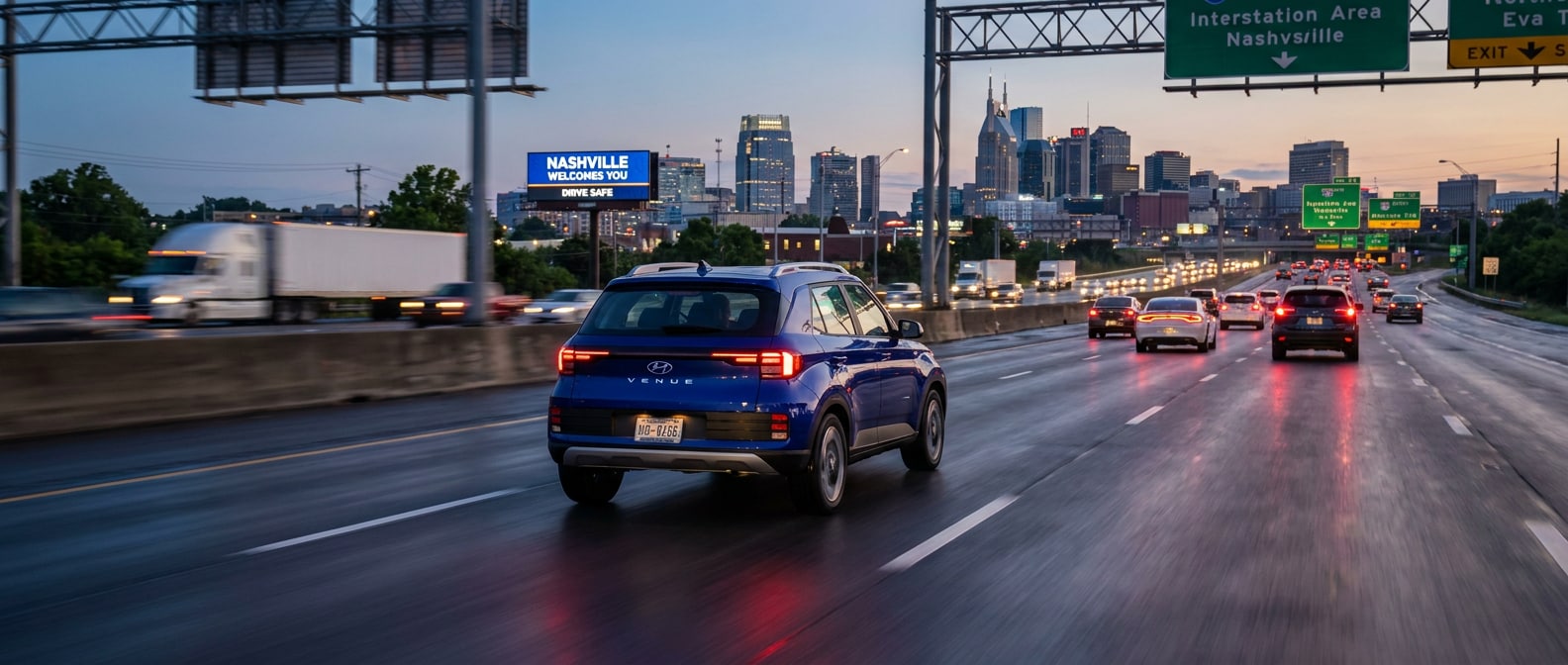
Picture a Tuesday afternoon in mid-August. You're merging onto I-24 westbound near Haywood Lane in Antioch, traffic is stacking, and a pickup drifts left without signaling. You don't have to guess whether your car is paying attention. The 2026 Hyundai Venue is.
The Venue carries a genuinely capable safety suite, and most of it is standard equipment on every single trim. The catch worth flagging, and it shapes how you drive these roads, is that blind-spot monitoring and rear cross-traffic warning are SEL-only. If your daily drive involves I-24 or backing out of a packed lot on Bell Road, that trim distinction is worth understanding before you sign anything.
See the 2026 Venue in our current inventory and you'll find both SE and SEL ready to go.
Which Safety Features Does the 2026 Venue Actually Give You?
Every 2026 Venue, whether SE or SEL, ships with Hyundai SmartSense as standard equipment, so the core collision-avoidance systems need no options package at all, though two of the lateral-monitoring features stay reserved for the SEL. The full safety payload and where each feature lands follows below.
| Safety Feature | SE | SEL | What It Does in Real Driving |
|---|---|---|---|
| Forward Collision-Avoidance Assist w/ Pedestrian Detection | Standard | Standard | Monitors ahead for vehicles and pedestrians; applies brakes automatically if you don't react in time |
| Lane Keeping Assist (LKA) | Standard | Standard | Detects unintended lane drift and applies a gentle steering correction |
| Driver Attention Warning (DAW) | Standard | Standard | Reads your driving patterns for signs of fatigue; issues an alert before you drift |
| Rear View Camera | Standard | Standard | Wide-angle reverse view with on-screen guidelines |
| Electronic Stability Control | Standard | Standard | Maintains directional control during sudden swerves or low-traction moments |
| Blind-Spot Collision Warning (BCW) | Not included | Standard | Lights up the mirror indicator when a vehicle enters your blind zone |
| Rear Cross-Traffic Collision Warning (RCCW) | Not included | Standard | Warns of approaching traffic while you're reversing out of a space |
| Heated Front Seats | Not included | Standard | Practical in Nashville winters when rushing out in the cold is its own distraction |
*Hyundai publishes the full SmartSense feature breakdown and trim availability on the official hyundaiusa.com 2026 Venue compare-specs page.*
NHTSA awarded the 2026 Venue a 4-star overall safety rating. It scored a 5-star result in the side crash test specifically, and no individual category fell below four stars. You can verify that grounded result on nhtsa.gov. No marketing line required.
Loading the Right Trim for Your Antioch Commute
The SE hands you the core collision-avoidance and lane-keeping stack, a stronger baseline than this class offered even a few years back, so it covers the critical scenarios on its own. The Antioch stretch of I-24 is where the SEL's extra monitoring starts to pull ahead.
Check how your week actually breaks down on the road. The I-24 corridor compresses fast-moving traffic into a tight merge zone. Lane changes come fast. Backing out of a spot at a busy commercial lot on Bell Road means trusting your mirrors against a wall of taller crossovers and pickups. Blind-Spot Collision Warning and Rear Cross-Traffic Collision Warning earn their keep right there. Both are standard on the SEL, and both are the kind of feature you notice every single day, not just in emergencies.
There's a genuine tradeoff worth weighing. If your commute runs mostly on clear I-65 lanes with predictable merges, the SE's standard SmartSense package handles the critical scenarios. If you're threading through Antioch's denser commercial traffic often, the SEL's lateral-monitoring features become a meaningful quality-of-life upgrade.
Our team at Hyundai of South Nashville makes this point on the lot because it shapes how you'll actually live with the car:
- On the Venue, Hyundai kept the SmartSense hardware consistent between trims.
- The SE isn't running a stripped-down version of the system.
- The same sensors and cameras are there.
- The SEL simply activates the additional monitoring zones.
Some brands reduce the system's capability on lower trims, so this consistency matters when you're evaluating the SE on its own terms.
The Kona steps up to a wider body and more cargo room if the Venue's compact dimensions feel limiting, but on the safety-tech scorecard the Venue holds its own for the segment.
Want AWD with your safety suite? The Tucson is the right conversation, since the Venue is front-wheel drive only, full stop. Nashville gets real ice events in January and February, and it's worth naming plainly rather than glossing over.
Four Steps to Matching the Venue Trim to Your Route
Matching the trim to your route comes down to four quick checks, and none of them require a spec sheet, just an honest look at where you actually drive and how often you change lanes or reverse out of tight spots. Walk through these before you decide.
- Trace your actual daily route. Count the lane changes and parking-lot reversals a typical week involves on I-24 or around Bell Road. That number tells you how much daily exposure you'd have to the scenarios BCW and RCCW address.
- Spend ten minutes in both trims. The SE and SEL feel the same to drive. But sit in a parking lot and watch the SEL's mirror-mounted BCW indicator light up when a car passes. It makes the comparison concrete in a way that a spec sheet doesn't.
- Note what else the SEL gained for 2026. Hyundai dropped the Limited trim this year and moved wireless charging, heated front seats, auto climate control, and push-button start into the SEL. So stepping up buys you more than just the safety monitors.
- Work the financing piece before you commit. The SE-to-SEL jump is real. Our team can run the numbers so the upgrade actually makes sense for your situation rather than stretching a budget you weren't planning to stretch.
Talk through your financing options with our team
The Job's Done: What the 2026 Venue Brings Home Every Day
Whichever trim leaves our lot with you, it has forward collision avoidance with pedestrian detection, lane keeping assist, driver attention monitoring, electronic stability control, and a rear camera as a standard package. Every one of those sits at the SmartSense floor. No trim charge, no options box.
The 2026 Venue is EPA-rated at 29 city / 33 highway / 31 combined MPG across both SE and SEL. With an 11.9-gallon tank, Hyundai rates the total range at approximately 369 miles. For an Antioch driver on a daily I-24 loop, that's roughly a week of commuting on one fill-up.
Cargo is 18.7 cubic feet behind the rear seats, expanding to 31.9 cubic feet with the rear seats folded. Both figures are solid for a compact package, useful for a Costco run but not a weekend lumber haul. Know what you need it for and it won't disappoint.
The FWD-only setup is the one area where the Venue asks for realistic expectations. On the two or three ice events Nashville typically sees in a given winter, careful tire choice and patient driving matter more than the car's footprint. The Venue handles the other 350-plus days of the year with confidence, and the safety systems stay active all year long regardless of the weather.
The load's carried, then. Safety features accounted for, trim difference explained, local driving conditions named.
By the Hyundai of South Nashville Team | August 2026


