

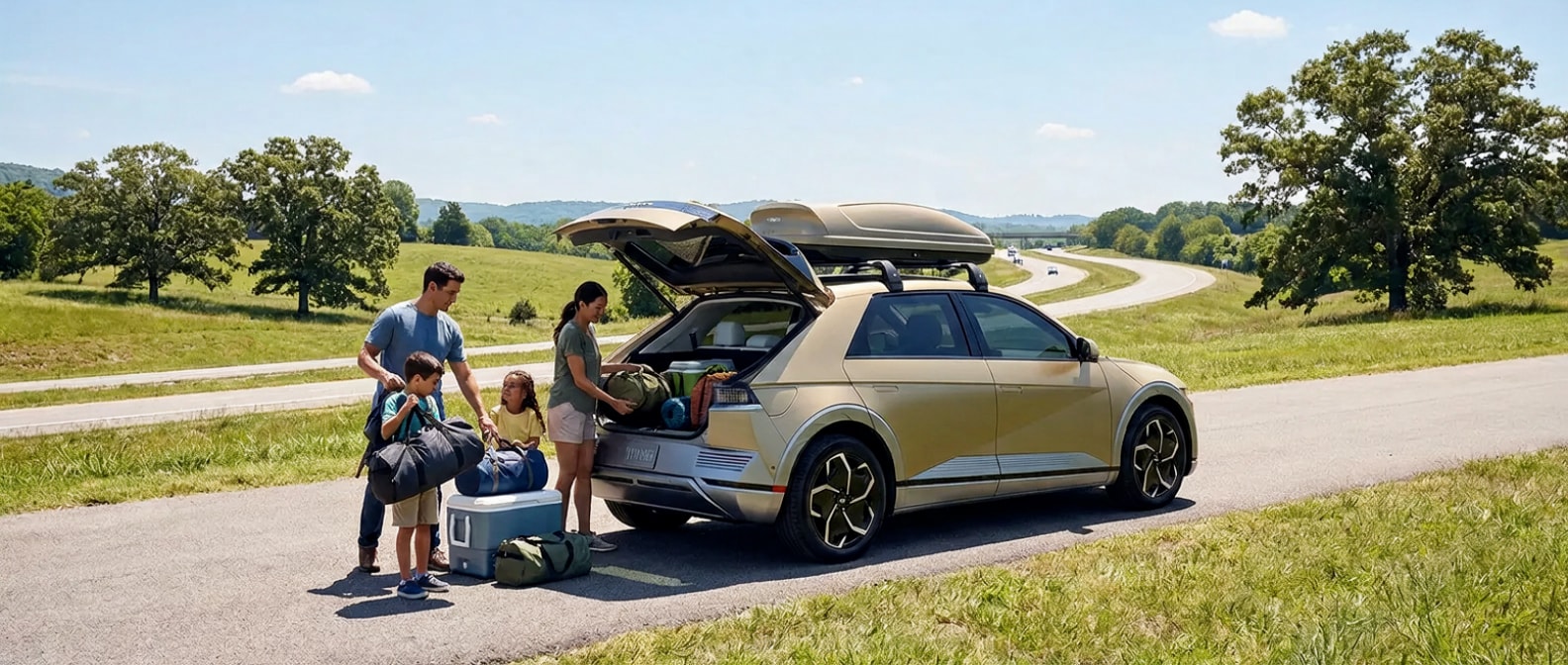
A summer road trip in an electric vehicle2026 Hyundai IONIQ 5 loaded for a summer road trip near Nashville, Tennessee sounds complicated until you realize Hyundai genuinely designed the IONIQ 5 around it. The moves are simple. Get the cabin cold before you leave, know your one fast-charge stop, and turn on the comfort features your trim actually includes. Do those three things and the drive handles itself.
Browse available IONIQ 5 inventory to see current trim options and which comfort features come standard on each.
How hard does a Middle Tennessee summer hit? Hard enough that the air feels heavy before 9 a.m., with 90-plus degrees as the baseline. From Cane Ridge, I-24 puts you on the path to Chattanooga, the Smoky Mountains corridor, or practically anywhere in the southeast inside of two hours. The IONIQ 5's 800V charging architecture and flat-floor cabin are more than talking points on a spec sheet. They're the reason this car handles a southern summer road trip without the stress most EV coverage fixates on.
So the prep is light, and most of it happens before you turn a wheel. Run through the list below before you pull out of the driveway.
What Goes on the Checklist?
Eleven items make up this checklist, and running through them the night before and the morning of your departure is what keeps that first leg smooth, though none of them takes more than a couple of minutes on its own. We've put them in the order you'd actually do them, following how the trip unfolds.
Night Before
- [ ] Plug in and set a departure charge target. Use the in-car scheduling feature to reach 80-90% by your planned leave time. Hyundai lists the 2026 IONIQ 5 SE/SEL/Limited RWD at up to 318 miles EPA-estimated on a full charge, and the standard-range SE at 245 miles EPA-estimated. Know which you have.
- [ ] Pre-set your charging stops in the nav system. The built-in navigation calculates real-time charging station availability. Plug in your destination the night before so the system can optimize routing while you sleep.
- [ ] Check tire pressure. Underinflated tires are the quietest range killer in hot weather. A quick visual and gauge check takes two minutes.
- [ ] Load cargo strategically. The IONIQ 5 offers 26.3 cubic feet of cargo space behind the rear seats. Heavy items low, soft bags on top. Rear seats slide and recline 60:40, so you can gain extra cargo depth if passengers don't need full leg room.
Morning Of
- [ ] Pre-condition the cabin remotely. The Hyundai app lets you cool the interior while still plugged in, so the battery isn't powering the AC from the first mile. In a Nashville August, skip this at your own risk. Nothing else protects first-leg range as well.
- [ ] Activate your preferred regenerative braking paddle setting. The steering-column paddles let you dial in the brake regen level. A slightly higher setting on highway driving helps recover charge on long gradual declines.
- [ ] Set the driver's seat and steering column position. The power-adjustable driver seat includes lumbar support standard on the SE. The Limited adds a power-extendable leg rest (the relaxation seat) so you can fully recline at charge stops. Set it before you go, not while merging onto I-24.
- [ ] Sync your phone and download offline maps. Wireless Apple CarPlay and Android Auto are standard on the 2026 IONIQ 5. Download a stretch of offline map coverage for areas outside metro Nashville where cell signal drops.
- [ ] Confirm rear-seat comfort for passengers. The second row has dedicated rear vents. For a drive to Chattanooga or the Smokies with kids in back, make sure those vents are set and the headrests are adjusted before departure.
- [ ] Check V2L adapter location (Limited and XRT trims). Vehicle-to-Load, available on the Limited and XRT, provides a 1.9 kW/120V outlet inside the cabin. Know where the adapter is stored before you need it at a campsite or picnic stop.
- [ ] Quick walk-around. Lights, mirrors, and the rear wiper. The 2026 model added a rear wiper, and on a summer trip through Tennessee's afternoon thunderstorm window, you want it working before you need it.
Why These Items Actually Matter on a Tennessee Drive
Every item on that list ties back to a real pattern we see with IONIQ 5 ownership in this climate and on these roads, so none of it is filler, even if a couple of steps look minor on paper. The heat, the grades on I-24, and the afternoon storms all pull at range and comfort in ways worth planning around.
Pre-conditioning is a heat-range math problem. When your cabin is already at temperature before you unplug, the battery handles the first 30-40 miles of driving without the full draw of climate control spinning up from a 90-degree interior. That adds up on a Middle Tennessee August day. The IONIQ 5 includes a battery heating and thermal management system that protects pack efficiency in temperature extremes, and getting a pre-trip service check ensures the coolant and thermal systems are working as designed before a long drive.
The 800V charging architecture changes the stop math. Hyundai lists the 2026 IONIQ 5 at approximately 20 minutes for a 10-80% charge via a 250 kW-capable DC fast charger. That's enough time for a bathroom break and a coffee. On a run from Cane Ridge to Chattanooga (roughly 140 miles on I-24), you likely don't need a fast-charge stop at all on the Long Range RWD trim. On the AWD SE, rated at 290 miles EPA-estimated, you're in the same position. Understanding your trim's range means you plan one real stop, nothing frantic.
The relaxation seat pulls its weight. On the Limited trim, the driver's seat leg rest extends fully with power controls. Reviewers note it's specifically useful during charging stops. You've stopped, the car is pulling charge at up to 250 kW, and you can actually stretch out for 18-20 minutes instead of awkwardly wandering a parking lot. It beats what a conventional car offers you at a gas station.
Regenerative braking and cruise control work as a system on I-24. The IONIQ 5's Highway Driving Assist (HDA) is standard on the SE trim and up. On long flat stretches of I-24 south of Nashville, HDA handles adaptive cruise and lane centering. Using it at a steady highway speed, in place of manual acceleration bursts, is one of the most consistent ways drivers report recovering efficiency on longer trips.
Explore financing options if you're still deciding between trims and want to understand what the full feature set looks like at each level.
| Item | Why It Matters on a Southern Summer Trip |
|---|---|
| Remote pre-conditioning | Cools cabin while plugged in; protects first-leg range from AC load |
| 800V fast charge (approx. 20 min to 80%) | One stop fits easily into a bathroom and coffee break |
| Tire pressure check | Heat expands tire air, but underinflation cuts range before you notice |
| Regenerative braking setting | Recovers energy on I-24 grades and stop-and-go near Chattanooga |
| V2L outlet (Limited/XRT) | Powers devices, fans, or small appliances at campsites or Percy Priest Lake |
| HDA highway assist | Reduces fatigue on long I-24 stretches; holds speed more efficiently than manual pedal |
| Rear-seat vent check | Keeps back-seat passengers comfortable before complaints start |
Print-and-Go: Your Pre-Departure Recap
You've done the homework, and this recap strips the whole routine down to what you handle the night before and what you handle the morning you leave, ready to tape to the fridge or save to your phone. Keep it simple.
The night before:
- Plug in, schedule charge to 80-90% by departure time
- Set nav destination and charging stops
- Check tire pressure
- Load cargo (26.3 cu ft available, rear seats slide 60:40)
Morning of:
- Pre-condition cabin via Hyundai app while still plugged in
- Set regen braking paddle preference
- Confirm seat, lumbar, and (Limited) leg rest position
- Sync phone, confirm wireless CarPlay/Android Auto
- Set rear vents for passengers
- Locate V2L adapter if on Limited or XRT
- Walk-around: lights, mirrors, rear wiper
On the Long Range RWD with its 318-mile EPA-estimated range, most Cane Ridge-to-Chattanooga runs clear without a planned fast-charge stop. If you're on the AWD SE (290 miles EPA-estimated) or the standard range (245 miles), plan one 20-minute DC fast-charge stop and treat it as a built-in break instead of a delay.
See what your current vehicle is worth if you're trading into a new IONIQ 5 and want to know where you stand before you visit us.
Our team at Hyundai of South Nashville is at 1635 Bell Rd, just a few minutes from the Cane Ridge area, so if you want to sit in one, talk through trims, or walk through the charging setup on an actual unit on the lot, come see us.
By the Hyundai of South Nashville Team | August 2026
Frequently Asked Questions
Does the 2026 IONIQ 5 support fast charging at public stations along I-24?
Yes. The 2026 IONIQ 5 uses an 800V battery architecture that accepts DC fast charging at rates up to 250 kW when paired with a compatible station. Hyundai rates the charge time from 10 to 80% at approximately 20 minutes under those conditions. All 2026 IONIQ 5 models also ship with a dual-voltage Level 1/Level 2 combo cable as standard equipment, so you're covered for slower overnight top-ups at hotels or campgrounds as well.
Which 2026 IONIQ 5 trim makes the most sense for regular Tennessee road trips?
The SE with the Long Range battery (318 miles EPA-estimated) handles most Middle Tennessee routes without a mandatory charging stop. If you prioritize cabin comfort on longer drives, the Limited trim adds the power relaxation seat with extendable leg rest, ventilated front seats, heated rear seats, and V2L power output, which are features that show up meaningfully on a two-hour-plus summer run. The AWD SE and SEL at 290 miles EPA-estimated are strong options if you want dual-motor traction and still cover regional destinations comfortably.


