

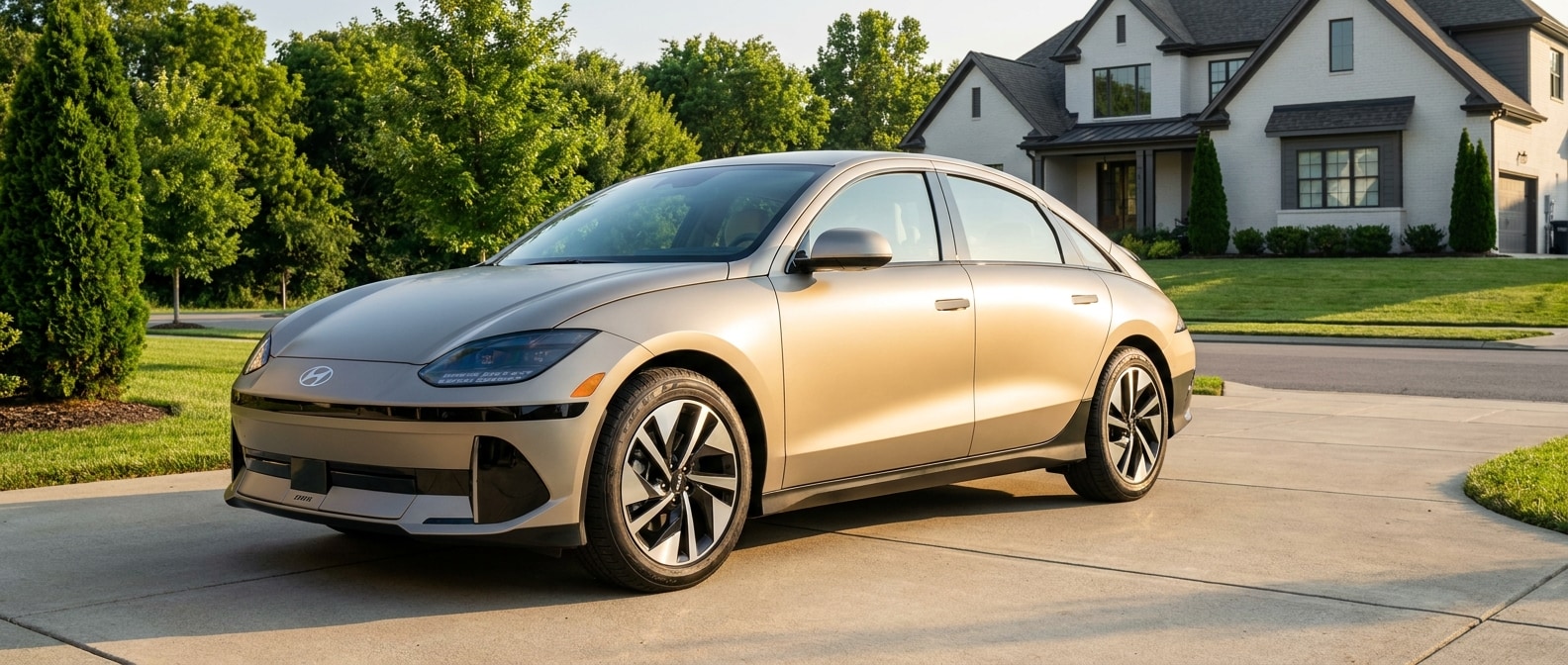
Hyundai confirmed earlier this year that the standard IONIQ 6 lineup (the SE, SEL, and Limited trims that made this sedan one of the most talked-about EVs since 2023) is discontinued for the U.S. market. There's no 2026 version coming. So here's what that means for you, right now, in Brentwood. The remaining units are final-year inventory, the selection is thin nationally, and we think this is a buying moment worth taking seriously. But only if you pick the right trim for how you actually drive.
This guide breaks down what you get at each tier, where the real tradeoffs live, and which setup makes sense whether you're a Nashville-area commuter or a road-tripper.
Browse available IONIQ 6 inventory at Hyundai of South Nashville
What Does "Value" Actually Mean in a Final-Year EV?
Value in a final-year EV comes down to how much real-world capability you're buying at each tier, and whether the features you pay for will matter on I-65 five days a week, well beyond a comparison chart. It's not only about the sticker you don't see.
The 2025 IONIQ 6 was built on Hyundai's E-GMP platform, and its defining advantage (800-volt electrical architecture) comes standard on every single trim, including the base SE Standard Range. You won't find that on the luxury tier alone. Any IONIQ 6 on our lot can charge from 10 to 80 percent in approximately 18 minutes on a 350 kW DC fast charger, per Hyundai's published specs. On a road trip to Knoxville or Memphis, that single feature changes the calculus more than almost any other.
There's a genuine tradeoff with final-year inventory. Supply is limited, so you may not find every trim in every color, and you may need to move quickly. The upside is that Hyundai has been offering meaningful incentives on remaining 2025 units, and a discontinued model with strong fundamentals has historically been a solid buy. We'll be straight with you here.
What Do You Actually Get at Each Tier?
The four trims split cleanly into two battery groups and then a feature climb, and what each one delivers day to day matters more than what the brochure promises. We'll walk the table row by row so you can see where the money goes and where it doesn't.
| Trim | Battery / Range (EPA-est.) | Power | Key Add vs. Previous | Best For |
|---|---|---|---|---|
| SE Standard Range RWD | 53 kWh / 240 mi | 149 hp | Entry point; dual 12.3" screens, HDA II, adaptive cruise, heated front seats | Short-range commuters; households with a second car |
| SE Long Range RWD | 77.4 kWh / 342 mi | 225 hp | 102 miles more range on 18-in wheels | Primary car; Brentwood to downtown and road-trip capable |
| SEL Long Range RWD | 77.4 kWh / 291 mi | 225 hp | 20-in wheels, synthetic leather, wireless charging, enhanced safety suite | Daily drivers who want comfort upgrades; 51 mi range trade |
| SEL Long Range AWD | 77.4 kWh / 270 mi | 320 hp | Dual-motor all-wheel drive; 21 mi less range than SEL RWD | Buyers who want the power; occasional ice-weather traction |
| Limited Long Range RWD | 77.4 kWh / 291 mi | 225 hp | Bose audio, panoramic sunroof, surround-view camera, ventilated seats | Comfort-priority buyers; same range as SEL RWD |
| Limited Long Range AWD | 77.4 kWh / 270 mi | 320 hp | Full feature set plus dual-motor traction | All-in buyers; no range compromises beyond AWD penalty |
A couple of things on this table deserve plain talk, so let's dig in.
The 20-inch wheels on the SEL and Limited trims reduce EPA-estimated range compared with the SE Long Range's 18-inch setup, dropping from 342 miles to 291 on the same battery. The gap is 51 miles. On a Nashville-to-Memphis run (roughly 210 miles), the SE Long Range handles it on one charge with room to spare, while the SEL and Limited AWD get tighter. Not impossible, but you'll want to know it before you pick the bigger wheels for looks.
In Tennessee, AWD is a real but modest consideration. Middle Tennessee isn't a mountain region with regular snowpack. Ice events do happen in our winters, and AWD gives you genuine confidence when they hit. Still, most Brentwood drivers running I-65 daily will find RWD plenty for nine months out of twelve. We'd only steer you toward AWD if you're making regular winter trips into the Cumberland Plateau, or if the power upgrade (320 hp versus 225) is what you're after.
The Smart-Buy Case for the SE Long Range
Our finance team can walk you through current available options on remaining inventory
After working with buyers on this car, we're convinced the SE Long Range RWD makes the most sense for the widest range of Brentwood shoppers, and the reason is range paired with the tech you actually use every day. You get the full 77.4-kWh battery and 342 EPA-estimated miles on 18-inch wheels, the highest range in the lineup. You keep the 800-volt fast-charging capability that every IONIQ 6 has. You get dual 12.3-inch displays, Highway Driving Assist II, blind-spot monitoring, stop-and-go adaptive cruise with machine learning, heated front seats, and Apple CarPlay/Android Auto as standard equipment. The interior is simpler than an SEL. But the tech list is not thin.
What you give up is a short list. Wireless phone charging, the synthetic leather seating surfaces, and a few driver-assistance upgrades that come on the SEL. Meaningful? Yes, if they're features you care about. Dealbreakers for most commuters? Rarely, in our experience.
See what your current vehicle is worth toward the trade
The SEL Long Range, by comparison, is the most feature-complete trim if you want the comfort upgrades and don't mind the 18-percent range reduction from those larger wheels. The Limited adds the Bose system, sunroof, and ventilated seats on top of that. If those are must-haves, the Limited is worth it. Just know you're trading 51 miles of EPA-estimated range for them on the RWD version.
The Honest Case for Moving Now
Check current IONIQ 6 availability on our lot
Timing is worth a real conversation here, because the standard IONIQ 6 is not coming back in the U.S. and the window on remaining stock is closing faster than most model-year runouts. As of mid-2026, national inventory is scarce. Fewer than 100 units were reported available nationally earlier this summer per CarsDirect's inventory analysis. That's no sales tactic, just a supply fact.
We see two buyer profiles who should act sooner rather than later. First, shoppers who specifically want a long-range EV sedan (not a crossover) with an aerodynamic profile designed for highway efficiency. The IONIQ 6's Cd of 0.21 was one of the lowest in production when it launched, and that's a big part of why its highway range stays so competitive. Second, buyers who want Hyundai's EV platform in a car form factor before the lineup shifts entirely toward SUVs and the performance-only IONIQ 6 N.
The buyer who should wait is easy to name. Someone who really wants an SUV and is only considering the IONIQ 6 because it's discounted. The sedan form factor is real. Rear headroom is tighter than an SUV, and trunk access is through a narrower lift gate opening. Don't talk yourself into the wrong body style because of a good price on remaining stock.
For the right buyer, this is one of the strongest EV buys you'll find right now. A 342-mile EPA-estimated range sedan with 18-minute fast charging and Hyundai's full suite of standard safety tech, in a final-year model with Hyundai standing behind it fully.
Frequently Asked Questions
Is the 2025 Hyundai IONIQ 6 still worth buying even though it's discontinued?
Yes, for the right buyer it still makes sense. Discontinuation affects future model-year availability, not the quality or support for cars already built. Hyundai is still selling 2025 units, and the car's fundamentals (800-volt charging, up to 342 EPA-estimated miles of range, and a full safety-tech suite) haven't changed. The one practical catch is limited remaining inventory, which narrows your trim and color choices compared with prior years. If the sedan form factor and long range fit your needs, waiting for a future version doesn't make sense right now, because none is planned for the standard lineup in the U.S.
Does the IONIQ 6 need all-wheel drive in the Nashville area?
For most Nashville-area drivers, the answer is no. Tennessee winters do bring occasional ice events, but regular snowpack on metro roads is uncommon. The RWD configurations deliver more EPA-estimated range (up to 342 miles on the SE Long Range versus 270 miles on the AWD version of the same battery), and both use the same 800-volt fast-charging architecture. AWD adds 95 horsepower (320 hp versus 225 hp on long-range models) and meaningful traction confidence in slick conditions. If you're regularly driving into the Cumberland Plateau or the Smoky Mountain foothills in winter, AWD earns its keep. For most I-65 and I-24 commuters, RWD is the practical choice and it preserves the best range in the lineup.


