

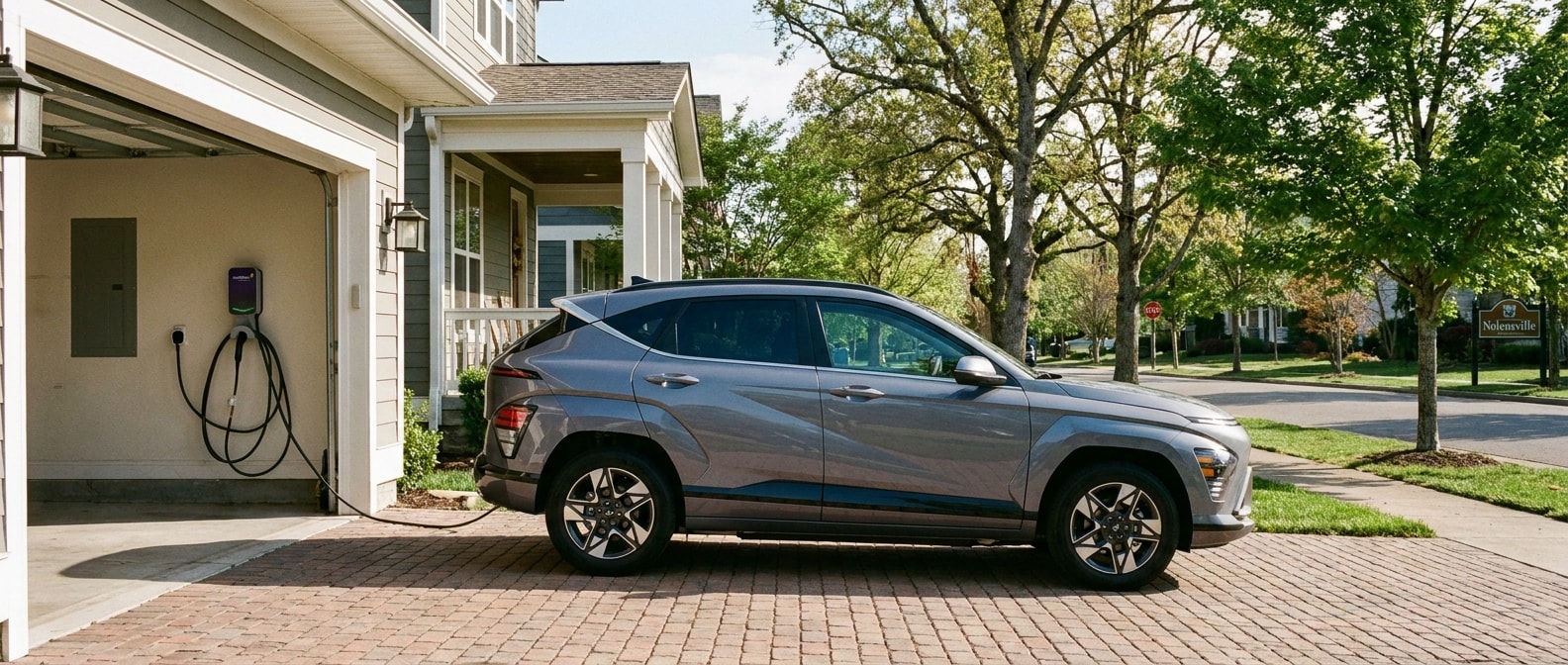
Most range anxiety is borrowed from someone else's driving. People picture a road trip to the Smokies and decide an electric SUV won't work, when what they actually do five days a week is drive 22 miles into Nashville and 22 miles home. Those are completely different problems. The second one is the easy one, and it's the one the Hyundai Kona Electric is built around.
So the useful conversation isn't whether the range is enough. It's which battery you need, how you'll refill it, and one timing wrinkle in the model year that's worth understanding before you shop.
How much range does the commute actually use?
Two batteries, two answers. Both are comfortable for this drive.
| Configuration | Battery | EPA-estimated range | Round trips before a charge |
|---|---|---|---|
| SE, Standard Range | 48.6 kWh | 200 miles | about 4 |
| SEL / N Line / Limited, 17-inch wheels | 64.8 kWh | 261 miles | about 5 to 6 |
| Long Range, 19-inch wheels | 64.8 kWh | 230 miles | about 5 |
A 44-mile round trip against 200 EPA-estimated miles leaves a lot of margin. And the shape of this particular drive helps rather than hurts. Nolensville Pike into town is signals, merges, and stop-and-go through the 7-to-9 window, which is exactly where an electric drivetrain recovers energy instead of burning it. Highway speed is what drains a battery quickly, not traffic.
Two things do shrink the number, and we'd rather say them than let you discover them in August. Sustained speeds above 70 mph cut into range noticeably. So does a Tennessee summer, when the climate system is pulling a hot cabin down from triple digits. Plan on real-world figures landing something like 10 to 20 percent under the EPA estimate on the worst days.
Where does it get plugged in?
For a commute this size, the honest answer is almost always "at home, overnight, and you stop thinking about it."
- Level 2 at home is the backbone. A 240-volt circuit takes either battery from 10 percent to full in roughly 5 to 7 hours, so a car plugged in after dinner is full long before the alarm goes off.
- DC fast charging is the road-trip tool, not the daily one. On a 100 kW station the Kona Electric runs 10 to 80 percent in about 43 minutes. That is slower than Hyundai's newer E-GMP vehicles, which is worth knowing if you were expecting Ioniq-style charging speed.
- Public Level 2 around South Nashville and Brentwood covers the occasional gap, though you'll rarely need it on this commute.
Browse the Kona Electric Inventory
The model-year gap, explained plainly
Here's the part that confuses people shopping right now. There is no 2026 Kona Electric in the United States. Hyundai paused production and skipped the model year entirely, with a redesigned version returning as a 2027. That's not a quality problem or a recall, it's an inventory and product-cycle decision.
What it means practically is that the newest Kona Electric you can buy new today is a 2025, in SE, SEL, N Line, or Limited trim. That's the final model year of this generation. If you'd rather have the redesign, waiting is a real option. If you want an electric commuter now, the 2025 is a known, settled car rather than a first-year design.
Where a Kona Electric stops being the right answer
Two situations, said out loud.
- You regularly drive east on weekends. Nolensville to the Smokies and back in a day is a charging stop, not a straight shot. That's simple math against a 200-mile battery, not a flaw. If that's a normal weekend for you, the Long Range battery helps, and the Tucson Hybrid removes the question entirely.
- You can't charge where you sleep. Everything above assumes a home outlet. Without one, an electric car becomes a chore of planning public sessions, and we'd rather tell you that now than sell you into it.
What this means for a Nolensville driver
If your week is the Nolensville Pike run into Nashville and back, the Standard Range battery covers it with room to spare, and a home charger turns refueling into something you do while asleep. If your weekends stretch east, step up to the Long Range or look at a hybrid. Either way, the 22-mile commute is not the deciding factor. How you spend Saturday is.
Come drive one on the roads you actually use. We're on Bell Road, and there's usually a Kona Electric on the ground along with the rest of the new inventory if you want to compare it against a hybrid back to back.
Common questions about the Kona Electric commute
Is 200 miles of range enough to commute from Nolensville to Nashville?
Comfortably, yes. The round trip runs about 44 miles, so the Standard Range battery covers roughly four of those before needing a charge. Even allowing 10 to 20 percent for summer heat and highway speed, a normal work week fits with margin. An overnight Level 2 session at home resets it completely.
Why is there no 2026 Kona Electric?
Hyundai paused U.S. production of the Kona Electric and skipped the 2026 model year, with the redesigned version scheduled to return as a 2027. The 2025 is the final model year of the current generation and is still available new in SE, SEL, N Line, and Limited trims.


