

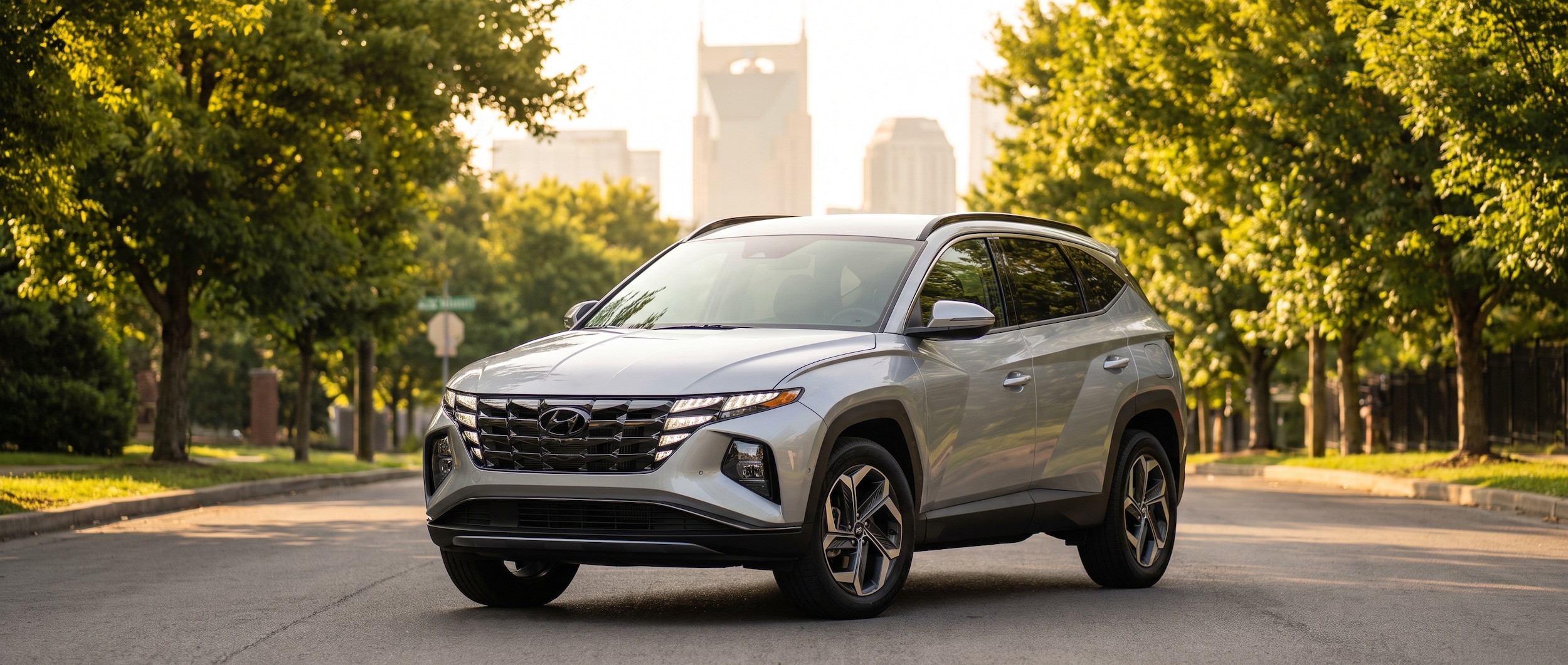
Nashville's stop-and-go traffic is genuinely good news if you drive a hybrid. Every time you brake on I-65 or crawl down Nolensville Pike during the afternoon rush, the Tucson Hybrid's regenerative system recovers energy that a gas-only engine simply wastes. The EPA rates the 2026 Hyundai Tucson Hybrid Blue SE at 38 mpg city and 38 mpg highway -- a figure that stays essentially flat whether you are creeping through a downtown construction zone or running a clear stretch of I-65 South. That kind of consistency is unusual in this segment and it is directly relevant to how Nashville commuters actually drive.
Value here is not about finding the cheapest option. It is about identifying which trim's feature set matches your daily life, so you are not paying for things you will not use -- or skipping things you will wish you had after 90 days on the road.
See the 2026 Tucson Hybrid in inventory at Hyundai of South Nashville
What Do You Actually Get at Each Trim Level?
All four 2026 Tucson Hybrid trims share the same core: a 1.6-liter turbocharged four-cylinder paired with an electric motor for a combined 231 horsepower and 271 lb-ft of torque, mated to a six-speed automatic. Hyundai's HTRAC all-wheel drive comes standard across every hybrid trim -- you are not choosing between efficiency and traction here. The split in the lineup is about how much comfort, technology, and convenience you layer on top of that powertrain.
| Trim | EPA-Estimated MPG (Combined) | What You Actually Get | Who It Is For |
|---|---|---|---|
| Blue SE | 38 mpg | 12.3" touchscreen, wireless Apple CarPlay / Android Auto, SmartSense safety suite (forward collision warning, lane centering, adaptive cruise with Stop & Go), AWD standard | Commuter who wants maximum fuel savings and a full safety suite without extra weight |
| SEL | 36 mpg | All of the above plus heated front seats, power-adjustable driver seat, hands-free smart power liftgate, 18" alloy wheels | Driver who needs everyday comfort and will use the liftgate for groceries and gear |
| SEL Convenience | 36 mpg | All SEL features plus panoramic sunroof, ventilated front seats, wireless smartphone charging, 12.3" digital instrument cluster, surround-view monitor, interior ambient lighting | Family hauler or anyone doing frequent urban parking who wants the camera and sunroof |
| Limited | 36 mpg | All SEL Convenience features plus Bose 8-speaker audio, premium Nappa leather seating, head-up display, Highway Driving Assist, Safe Exit Assist, heated rear seats | Driver who spends significant time on I-65 or I-24 and wants the full-featured cabin on longer stints |
One honest note on MPG: the Blue SE earns those 38 combined mpg partly because it runs without the added weight of the upper trims' features. The SEL and above land at 36 mpg combined (EPA-estimated). In real-world Nashville stop-and-go, both figures look better in practice than they do on highway routes, because regenerative braking is doing the most work in urban traffic patterns.
How Nashville's Traffic Pattern Specifically Rewards This Powertrain
Compare the non-hybrid Tucson and decide which powertrain fits your commute
The gas-only 2026 Tucson earns an EPA-estimated 28 mpg combined with front-wheel drive. The Tucson Hybrid closes that gap to 38 mpg combined (Blue SE) or 36 mpg combined (SEL and above). That 8-to-10 mpg difference is real money over a Nashville commuting year -- and it is larger in stop-and-go conditions than on the highway, because hybrid systems harvest kinetic energy on deceleration that conventional engines release as heat.
INRIX data ranks Nashville the 12th most congested city in the United States in 2026, with commuters losing an average of 65 hours a year to traffic. Nolensville Pike, I-65, and I-24 are the corridors where most South Nashville residents spend those hours. Slow, stop-and-go movement is precisely where a hybrid's electric motor carries the most load and where the gasoline engine shuts down the most frequently.
The Tucson Hybrid also uses a six-speed automatic transmission rather than the continuously variable transmissions most competitors use. That choice produces a smoother, more conventional driving feel -- particularly noticeable in the gradual acceleration patterns of city traffic. Hyundai's Smart Cruise Control with Stop & Go, standard on every hybrid trim, handles start-stop patterns without driver fatigue in slow-moving corridors. That feature alone makes a material difference on a commute that regularly stalls between exits.
The Smart-Choice Framework for South Nashville Buyers
Browse current 2026 Tucson Hybrid inventory at Hyundai of South Nashville
Picking the right Tucson Hybrid trim comes down to three questions: how much time do you spend in the car per day, what do you load and unload most often, and how much of your driving is city versus highway? If your commute is under 30 minutes each way on mostly surface streets, the Blue SE delivers the highest EPA-estimated fuel economy and the full safety suite. You will not notice the absence of heated seats on a July morning, but you will notice the savings at the pump over a year of Nolensville Pike driving.
If your commute stretches past that, or if family schedules mean your SUV also handles school runs, sports gear, and weekend hauls, the SEL Convenience tier is where the practical features start to compound in daily life. The surround-view monitor is specifically useful for parallel parking near downtown Nashville, where street parking on Broadway-adjacent blocks requires maneuvering in tight spaces. The Limited is the trim for drivers who log serious miles on I-65 or I-24 and want Highway Driving Assist reducing fatigue on those longer Nashville-to-Brentwood-and-back stints. The Bose audio and Nappa leather make the cabin feel significantly more elevated for buyers who spend 45 to 60 minutes per direction in traffic.
All 2026 Tucson Hybrid trims come with Hyundai's full SmartSense driver-assistance package as standard -- forward collision warning, lane centering, adaptive cruise control, rear automatic braking, and blind-spot warning. That is not a trim-specific upgrade; it is the floor for every version of this vehicle. The 2026 Tucson Hybrid's fuel economy is strong for a compact SUV with AWD standard, but some competitors achieve higher combined ratings. The tradeoff is that the Tucson Hybrid packs more power (231 hp) and a smoother transmission feel than most. For a Nashville buyer whose priority is fuel savings on a daily commute rather than a road-trip efficiency record, that combination is well-matched to local conditions.
Frequently Asked Questions
Does the 2026 Tucson Hybrid actually save fuel in stop-and-go Nashville traffic, or mainly on the highway?
Stop-and-go traffic is where the Tucson Hybrid earns its efficiency advantage most clearly. The regenerative braking system captures kinetic energy during deceleration and feeds it back to the battery, which in turn powers the electric motor for low-speed movement. In bumper-to-bumper conditions on Nolensville Pike or at the I-65 merge points, the gasoline engine shuts off frequently and the electric motor handles load. The EPA rates the Blue SE at 38 mpg city and 38 mpg highway, meaning city and highway returns are essentially equal -- an unusual characteristic that reflects how well the hybrid system is tuned for urban use.
Is the fuel savings worth the step up from the gas-only Tucson?
The gas-only 2026 Tucson with front-wheel drive earns an EPA-estimated 28 mpg combined. The Tucson Hybrid Blue SE earns 38 mpg combined. Over a Nashville commuting year at average driving distances, that 10 mpg difference adds up to a meaningful reduction in fill-up frequency. The hybrid also comes with standard AWD across all trims, while AWD on the gas Tucson reduces that model's combined rating to 26 mpg. The step up also delivers the full SmartSense safety suite as standard and a more powerful engine. For a driver focused on fuel savings over multiple years of South Nashville commuting, the case for the hybrid is practical rather than aspirational.


