

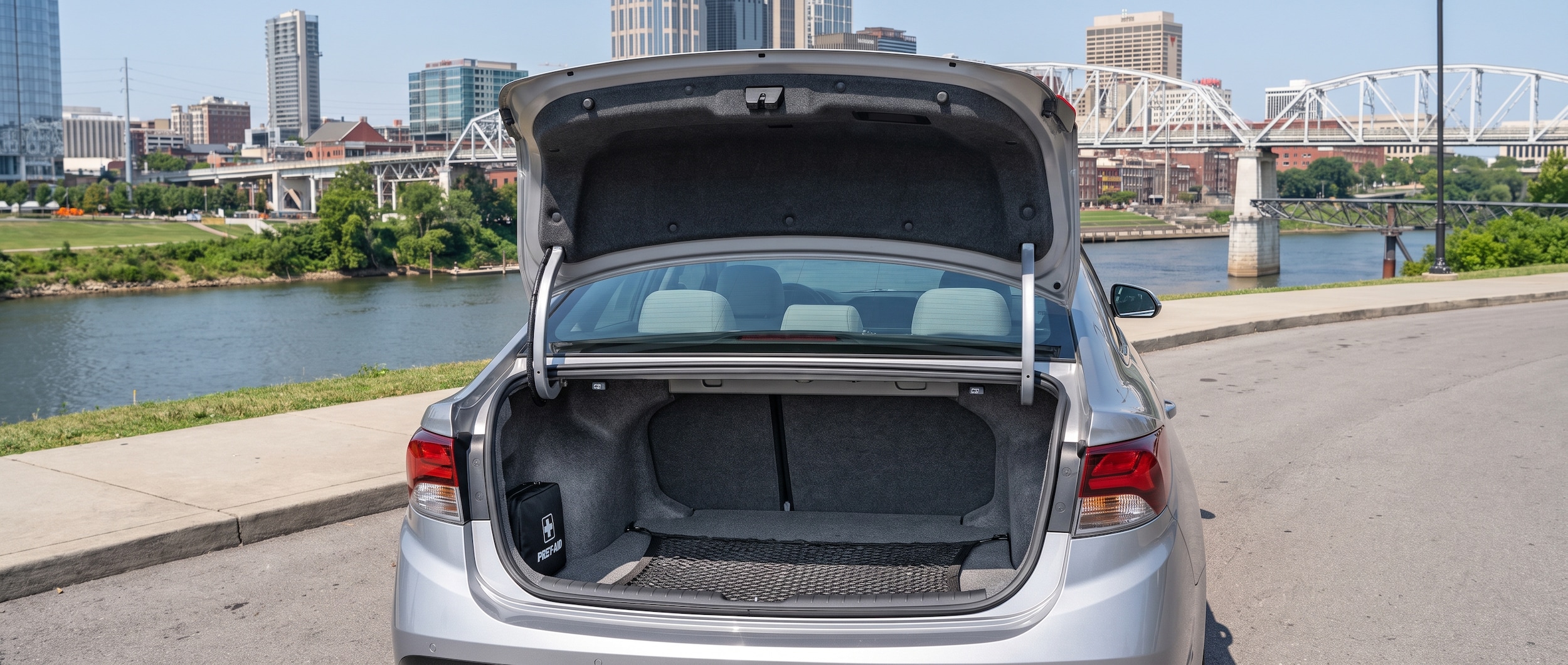
A fair question from used-car shoppers keeps coming up: does the hybrid battery eat the trunk? Plenty of hybrids from an earlier era gave you a lump of battery where your weekend groceries were supposed to go, so the concern makes sense. The Sonata Hybrid isn't that car. Model year still matters, though, and if you're running errands in the Nissan Stadium corridor, crawling through stop-and-go on the East Bank, or looping from South Nashville to the riverfront and back on a Saturday, the year you pick shapes both cargo practicality and peace of mind.
Browse our pre-owned Sonata Hybrid inventory to see what's currently on the lot, then use this guide to know exactly which years are worth chasing.
- The 2024 and 2025 model years are the sweet spot: Hyundai's mid-cycle refresh brought a redesigned interior, a larger curved display, and physical HVAC controls back, all without touching the trunk size.
- Hyundai lists the Sonata Hybrid's cargo volume at 15.6 cubic feet across every hybrid trim and model year from 2020 onward. The battery is under the rear seat, not behind it.
- The 2022 and 2023 model years are solid value if you verify open recalls have been addressed on the specific VIN.
- The 2020 Sonata Hybrid had a documented trunk latch recall; check NHTSA before buying.
- The 2017 Sonata Hybrid had a serious engine bearing recall covering 13,247 vehicles; always verify recall completion on any 2017 you find.
- The 2026 is now on sale new if the used-market selection is thin.
Which years are the sweet spot for a used Sonata Hybrid?
The 2024 and 2025 model years are where we'd point Nashville shoppers first, and here's why the refresh matters beyond aesthetics. Starting with the 2024 model year, Hyundai gave the Sonata a genuine mid-cycle update: the interior got a panoramic curved display, physical buttons came back for climate and audio (a real improvement for distracted errand driving), and the exterior picked up sharper lines. None of that touched the trunk. Hyundai lists the Sonata Hybrid's cargo volume at 15.6 cubic feet across all hybrid trims, confirmed by Hyundai's own specifications. That's the same number as the non-hybrid Sonata. The battery pack sits under the rear seat. You don't lose a cubic foot.
The trunk opening is wide and has a low liftover height, which matters more than raw cubic footage when you're loading heavy grocery bags or a case of water after a quick stop near the Cumberland River. A hands-free smart trunk lid is standard across all hybrid trims, so you're not juggling a key fob with your hands full. The 60/40-split rear seats fold to extend cargo capacity when you need the extra run of space, though a hump in the floor means it's not a flat load surface when the seats are down.
| Model Year | Generation / Notes | Cargo (cu ft) | Verdict | Key Watch Item |
|---|---|---|---|---|
| 2017 | 7th gen (LF) | 15.6 | Proceed with caution | NHTSA recall 21V727: engine bearing/fire risk on 13,247 vehicles |
| 2020 | 8th gen launch (DN8) | 15.6 | Good with VIN check | Trunk latch recall; confirm repair on specific VIN |
| 2021 | 8th gen carryover | 15.6 | Good value | No hybrid-specific open recalls noted |
| 2022 | 8th gen carryover | 15.6 | Good value | Verify no open items on VIN via NHTSA |
| 2023 | 8th gen carryover | 15.6 | Verify ISG pump recall | NHTSA 238523: ISG oil pump overheat risk; confirm repair documented |
| 2024 | Refreshed 8th gen | 15.6 | Sweet spot | No open recalls noted; new interior and display |
| 2025 | Refreshed carryover | 15.6 | Sweet spot | No open recalls noted; lower mileage on used market |
| 2026 | Refreshed + new Blue trim | 15.6 | New, available now | NHTSA 5-star overall; Hyundai-estimated 51 mpg combined (Blue) |
Which years should you watch out for?
Two model years carry documented issues worth knowing before you commit, and they're different enough in character that they deserve separate treatment. Start with 2017. Per NHTSA recall 21V727, Hyundai recalled 13,247 Sonata Hybrid vehicles from the 2017 model year for engine bearing wear that could, in documented cases, cause the engine to stall or catch fire. The fix was an engine inspection plus a Knock Sensor Detection System software update, with engine replacement if bearing damage was found. A 2017 with complete repair documentation is a different vehicle from one that never had the work done. Plug the VIN into NHTSA's free lookup before you commit to any 2017.
The 2020 Sonata Hybrid had a separate, lower-stakes issue: per NHTSA documentation, the trunk latch could become damaged in a way that prevented the trunk from being opened from the inside, a federal safety standard compliance failure. Dealers replaced the trunk latch base at no charge. It's not a powertrain problem, but an unrepaired example still has a documentation gap worth closing. Our service team can run a VIN check and confirm recall status on any vehicle before you decide.
Add a note of caution on the 2023 for the ISG oil pump. NHTSA recall 238523 covered 2023 Sonata models for an idle stop-and-go oil pump controller that could overheat, with fire risk cited. Owners of affected vehicles were advised to park outside and away from structures until the repair was completed. The fix was an inspection and controller replacement, performed free of charge. A 2023 with documented recall completion is a fine car. One without that paperwork deserves scrutiny.
Pros and cons of buying a used Sonata Hybrid
| Pros | Cons |
|---|---|
| Trunk matches the non-hybrid: 15.6 cu ft, no battery intrusion | No AWD option on any hybrid trim (FWD only) |
| 60/40-split rear seats add flexibility on heavy errand days | 2020 and 2023 used market requires careful recall verification |
| EPA-estimated 47 mpg combined (SEL/Limited): stop-and-go is where this pays off | Transmission handoff between gas and electric can feel less smooth than some rivals |
| Wide trunk opening and low liftover height make loading easier | Rear cargo floor has a hump when rear seats are folded down |
| Hands-free smart trunk lid is standard across all hybrid trims | Rear-seat headroom is tighter than a crossover for taller passengers |
| NHTSA 5-star overall safety rating on 2026 model confirmed | Blue trim's mpg gain comes from smaller, lower-resistance tires |
Which year makes sense for which Nashville buyer?
Here's where the local picture matters, and it's worth being straight about the tradeoffs. Nissan Stadium is one of the most compressed driving environments in Nashville on event days. Parking east of the Cumberland River fills fast; a lot of drivers park downtown and walk the Woodland Street Bridge, so your actual errand loop often involves slow stop-and-go movement through the East Nashville approach streets either way. That's exactly the condition where the Sonata Hybrid's city fuel economy earns its keep. At low speeds, the electric motor carries the load; the engine shuts off while you're sitting still. The EPA-estimated 44 mpg city rating on the SEL and Limited trims (47 mpg combined) does its best work in the city, not on the highway. In our experience, customers who put heavy in-town mileage on these cars around South Nashville describe real-world results that track closely with the city rating, and that advantage is tied to how the hybrid system behaves in stop-and-go conditions, not to marketing language.
For the value-focused buyer who has time to do VIN homework: a 2021 or 2022 is a strong pick. Those years missed the serious recall activity on either side of them, they share the full 15.6-cubic-foot trunk, and they carry several years of depreciation. The cargo experience is identical to a 2024. Our financing team can walk you through options on pre-owned Sonata Hybrid models once you've landed on a year.
For the buyer who wants the refreshed interior without recall research: go 2024 or 2025. You get the updated panoramic display, wireless Apple CarPlay and Android Auto standard, and the physical HVAC controls that are genuinely easier to use while navigating a crowded parking lot. Those years are on the used market now with lower miles, and the gap versus a new 2026 is worth calculating before you decide.
For the buyer who just wants the newest version: the 2026 Sonata Hybrid is on sale now, including the new base Blue trim with Hyundai's estimate of 51 mpg combined. Our new Sonata Hybrid inventory is the fastest way to see trim availability.
One tradeoff worth naming directly: the Sonata Hybrid is a sedan. If you regularly haul a large stroller, a full camping kit, or anything that won't fit cleanly through a sedan trunk opening, no model year of this car is the right tool for that job. A Tucson Hybrid or Santa Fe Hybrid gives you a hatch opening and a flatter load floor. For grocery runs, dry-cleaning pickups, a case of water, and the kind of errand loop most Nashvillians actually do around the East Bank and South Nashville corridors, the Sonata Hybrid's trunk handles the job comfortably.
Frequently Asked Questions
How much trunk space does the Sonata Hybrid have compared to the regular Sonata?
Both the Sonata Hybrid and the non-hybrid Sonata offer 15.6 cubic feet of trunk space. Hyundai positioned the hybrid battery pack under the rear seat rather than behind it, so buying the hybrid version costs you nothing in cargo room. The 60/40-split rear seats are standard on all hybrid trims, and a hands-free smart trunk lid is included across the lineup.
Which Sonata Hybrid model years have open or unverified recalls I should check?
The 2017 Sonata Hybrid was subject to NHTSA recall 21V727, covering 13,247 vehicles for an engine bearing wear issue with documented fire risk; always confirm this repair on any 2017. The 2020 model had a trunk latch recall. The 2023 model carried NHTSA recall 238523 for an ISG oil pump controller that could overheat. The 2024 and 2025 model years have no noted open recalls. Always run the specific VIN on NHTSA's website before purchasing any used vehicle.
Is the Sonata Hybrid's stop-and-go fuel economy actually better for Nashville errand driving?
Yes, meaningfully so. The EPA estimates the Sonata Hybrid SEL and Limited trims at 44 mpg city and 51 mpg highway, for a 47 mpg combined figure. The Blue trim is estimated higher at 51 mpg combined by Hyundai. At low speeds and in stop-and-go traffic around areas like the Nissan Stadium corridor, the electric motor carries more of the load and the engine shuts off while the car is stationary, which is where the hybrid efficiency advantage over a conventional engine is most pronounced.


