

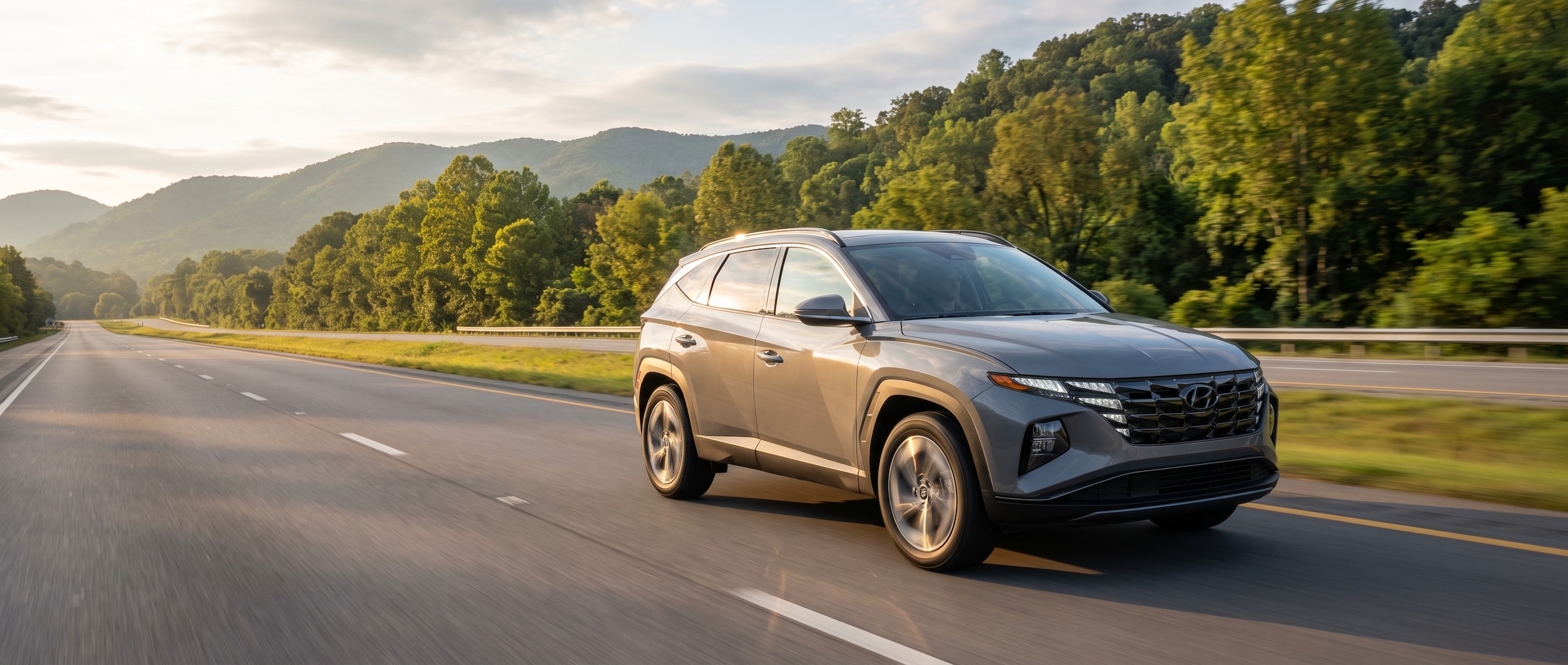
People shopping compact SUVs for an I-65 daily run tend to hear the same three concerns from well-meaning friends: it's too cramped, the hybrid doesn't pay off in Nashville traffic, and a compact can't hold its own on a busy interstate. All three are worth taking seriously. All three are also wrong, and we can walk you through exactly why with verified numbers.
- Myth: The Tucson is too small to be a real family commuter. Reality: It carries 41.2 cubic feet of cargo behind the rear seats (competitive with vehicles a class larger).
- Myth: The Tucson Hybrid wastes its efficiency on highway driving and stop-and-go kills it. Reality: The Hybrid's electric motor shines hardest in the low-speed, brake-heavy conditions that define the Brentwood-to-Nashville stretch of I-65 during rush hour.
- Myth: A compact SUV isn't safe enough for interstate commuting. Reality: The 2026 Tucson earned an IIHS TOP SAFETY PICK+ designation and a 5-star overall NHTSA rating. Every trim ships with seven SmartSense safety features as standard equipment.
- The real tradeoff: ride quality at highway speeds has some firmness, and the Hybrid's fuel numbers are EPA estimates, not guarantees. We'll be straight about that.
Browse the 2026 Hyundai Tucson on our lot
Is the Tucson Really Too Small for a Daily I-65 Run?
No, and the cargo numbers make a clear case on their own. The 2026 Tucson carries 41.2 cubic feet of cargo with all five seats occupied, and fold the rear row flat and that number reaches 80.3 cubic feet, per Hyundai's published specs. That's enough room for a full Costco run, a week of kids' sports gear, or a Brentwood-to-Franklin errand circuit without any cargo Tetris required.
The "too small" label tends to stick because the segment name hasn't kept pace with what these vehicles actually became. Compact SUVs grew significantly with the current Tucson generation, which arrived in 2022 with a longer wheelbase and a taller roofline than its predecessor. "Compact" is now a segment classification. It's not a useful description of interior volume.
| Common Myth | What the Specs Actually Show | Source |
|---|---|---|
| "The Tucson is too cramped for a family" | 41.2 cu ft behind rear seats; 80.3 cu ft seats folded | Hyundai published dimensions |
| "The hybrid battery eats trunk space" | Battery packaged under the rear seats (cargo area identical to gas model) | Hyundai engineering specs |
| "The Tucson Hybrid gets worse MPG in traffic" | EPA-estimated 38 MPG combined on Hybrid Blue SE; electric motor optimized for low-speed operation | EPA via Hyundai |
| "A compact SUV isn't safe on an interstate" | 2026 IIHS TOP SAFETY PICK+; NHTSA 5-star overall rating | IIHS (March 2026), NHTSA |
| "You need adaptive cruise as an add-on package" | Seven SmartSense features standard on every trim, including adaptive cruise | Hyundai Motor America |
One thing worth flagging honestly: rear legroom measures a genuine 41.3 inches, which is comfortable for adults on a commute. What that number isn't is three-row space. If your household regularly runs a carpool of five adults plus gear, that's a real conversation to have before you buy. For a Nashville commuter running two adults and a couple of bags, or a family of four, the Tucson fits without compromise.
See the Palisade if you genuinely need three rows
Stop-and-Go Is Where the Tucson Hybrid Actually Earns Its Keep
This one catches a lot of shoppers off guard, and it's worth explaining why. The assumption is that hybrid powertrains shine only on long highway stretches and get defeated by brake-heavy traffic. For the Tucson Hybrid's architecture, the opposite is true. Its electric motor recaptures energy during braking (regenerative braking) and does the heaviest lifting at low speeds. That's precisely the driving pattern you face on I-65 between Brentwood and downtown Nashville from 7:30 to 9 a.m. and again from 5 to 6:30 p.m., when congestion clusters around the on- and off-ramps through Brentwood and into Davidson County. Stop-and-go is where the Hybrid's advantage actually builds.
The EPA rates the 2026 Tucson Hybrid Blue SE at 38 MPG combined. Move up to the SEL or higher and the figure is 36 MPG combined, per EPA estimates. Compare that to the gas-only Tucson FWD, which the EPA rates at 25 city / 33 highway / 28 combined. You'll feel that gap on a round-trip commute.
The honest caveat is that the EPA combined figure blends city and highway cycles in a controlled test. Your real-world number depends on your specific route, how you drive, and Nashville's summer heat pushing the A/C hard. But the directional math holds up. The Hybrid's advantage grows in stop-and-go conditions.
See the Tucson Hybrid in our new inventory
So What Should You Actually Do Before You Buy?
Test the specific commute scenario, not just the test drive loop. Here's how we'd suggest approaching the decision if you're cross-shopping for a Nashville I-65 daily driver.
- Decide on gas or hybrid first. If your round-trip is under about 30 miles and you're mostly on the highway, the gas Tucson's 33 MPG highway figure is solid and the price-of-entry is lower. If your commute involves meaningful stop-and-go, think the Harding Place on-ramp backup or Concord Road merging traffic, the Hybrid earns back efficiency where it matters.
- Sit in the back seat. That 41.3 inches of rear legroom and 39.5 inches of headroom is the actual test. Bring whoever rides back there with you. Sit in it before you decide.
- Ask about SmartSense in real traffic. Adaptive cruise control on I-65 is a genuine quality-of-life feature during those 45-minute crawl days. It's standard on the Tucson. What varies by trim is Highway Driving Assist, which adds lane-centering to the cruise. Worth asking about if you log heavy interstate miles.
- Consider the PHEV if your commute is short. The Tucson Plug-In Hybrid carries an EPA-estimated 32 miles of all-electric range. If your one-way commute is 15 miles or under, you could realistically run most weekdays on electricity alone. That opens up a different financial and driving conversation than the standard Hybrid.
Frequently Asked Questions
Does the Hyundai Tucson Hybrid's battery take up cargo space?
No. Hyundai packaged the Tucson Hybrid's battery under the rear seats, so the cargo area measures the same as the gas model. You don't sacrifice trunk space for the hybrid powertrain.
Is the 2026 Hyundai Tucson safe enough for regular interstate driving on I-65?
Yes. The 2026 Tucson earned a TOP SAFETY PICK+ from the IIHS and a 5-star overall safety rating from NHTSA. Every trim ships with seven Hyundai SmartSense features as standard equipment, including Forward Collision-Avoidance Assist, Lane Keep Assist, and adaptive cruise control.
What's the real-world fuel economy for the Tucson Hybrid on I-65?
The EPA rates the 2026 Tucson Hybrid Blue SE at 38 MPG combined, with the Hybrid's electric motor delivering the most benefit in the low-speed, stop-and-go conditions that define peak commute hours through Brentwood. Your actual mileage depends on your route, driving habits, and local conditions.


