

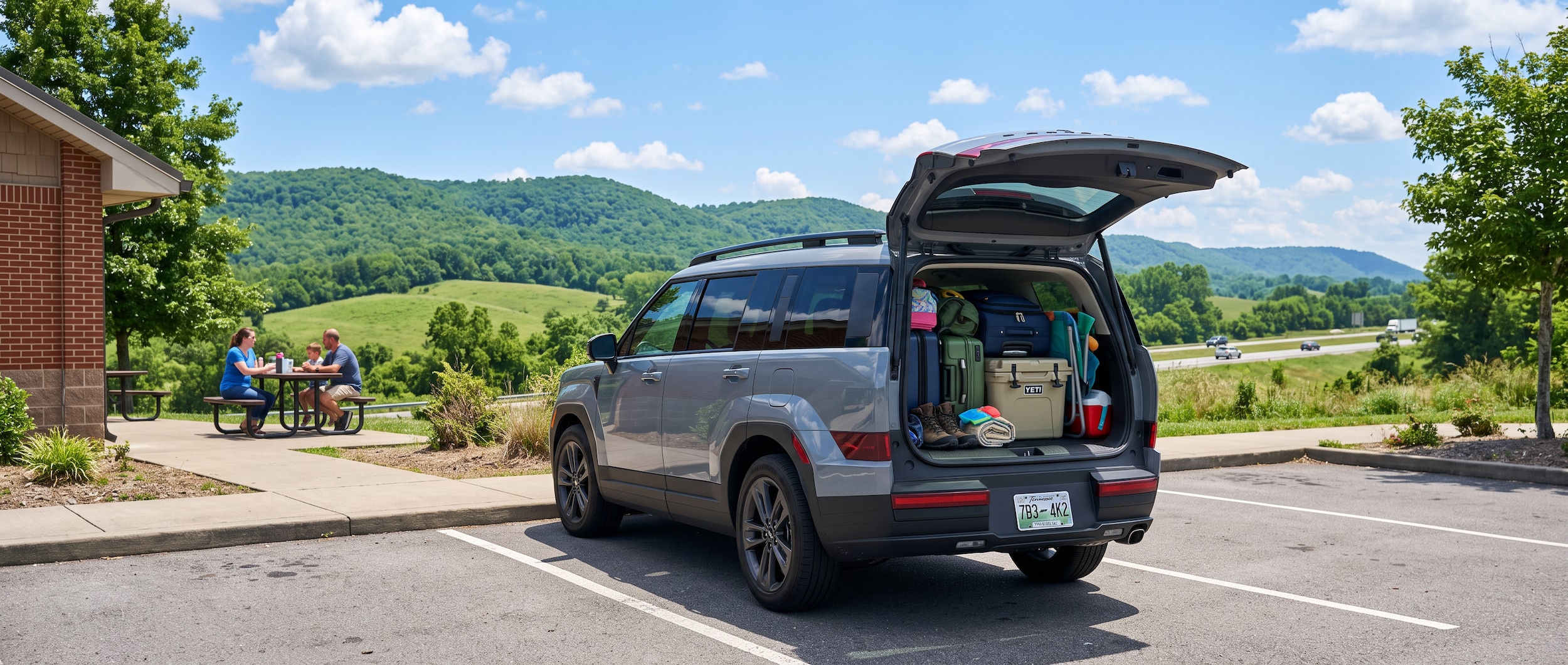
Pull onto I-40 heading east out of Nashville on a July afternoon and you're making a series of quiet demands on whatever you drive. Hold a steady 70 mph in 95-degree heat with the AC maxed, climb the grades up toward the Cumberland Plateau without breaking a sweat, and keep enough cargo room for three kids' worth of weekend gear. The 2026 Hyundai Santa Fe was built with exactly that scenario in mind. It's worth understanding how it handles each demand before you drive one off our lot.
The 2026 Santa Fe comes with a turbocharged 2.5-liter engine producing 277 horsepower and 311 lb-ft of torque, now paired with a new eight-speed torque-converter automatic. That last part matters. The outgoing dual-clutch transmission had a reputation for hesitation at low speeds, and the replacement unit delivers more predictable power on highway merges and on the sustained climbs Tennessee's I-40 puts in front of you.
Why Does the Santa Fe Fit I-40 Family Driving?
For most of what the I-40 corridor throws at a Nashville family, the Santa Fe fits well, with one caveat around cargo once the third row is full. Its powertrain, climate controls, and standard safety tech line up cleanly against Tennessee highway conditions, so let's walk the specifications against those demands one at a time.
| I-40 Driving Condition | Santa Fe Feature That Handles It | Why It Matters for Your Trip |
|---|---|---|
| Nashville metro stop-and-go on I-40 exchanges | Hybrid powertrain: EPA-estimated 37 city / 36 hwy mpg (FWD) | Hybrids recover energy under braking, and city miles are where the gap over a gas engine is biggest |
| Sustained grades toward the Cumberland Plateau | 277 hp / 311 lb-ft torque (gas) or 231 hp / 271 lb-ft (hybrid) | Torque holds highway pace uphill with a full passenger and cargo load |
| Three kids and a weekend's worth of gear | 14.6 cu ft behind 3rd row; expands to 40.5 cu ft with 3rd row folded | Third row up is tight on cargo, so plan the configuration before you pack |
| July heat and the constant AC demand | Standard dual-zone climate, 12.3-inch screen with physical climate buttons | Physical controls mean no menu-diving at 70 mph |
| Lane changes through I-40 construction zones | Blind-Spot Collision Warning, standard on every trim | Active alert, not just a camera to remember to check |
| Long-haul fatigue on Memphis or Knoxville runs | Driver Attention Warning (standard), Highway Driving Assist (upper trims) | Monitors your driving patterns and suggests rest breaks before you need them |
The Hybrid Makes Its Case Here
On the Santa Fe Hybrid, the EPA-estimated highway figure sits nearly level with its city rating, which is unusual for a hybrid and genuinely useful on a mixed I-40 run, though the tradeoff shows up later at the trailer hitch. Hyundai rates the FWD Hybrid at 37 city and 36 highway, EPA-estimated. That near-parity happens because the 1.6-liter turbo and 44.2-kilowatt electric motor work efficiently across a wide speed range, not just at low speeds. On a Nashville I-40 run, you benefit at both ends, the stop-and-go around the Briley Parkway interchange and the open stretch toward Jackson.
The Santa Fe Hybrid also charges itself entirely through regenerative braking and the gas engine, which removes the main friction point for hybrid-curious Nashville buyers who aren't ready for a full EV commitment. No plug, no charging infrastructure to think about.
One tradeoff we're direct about is the Hybrid's towing rating, which sits at 2,000 pounds. The gas Santa Fe handles up to 3,500 pounds with trailer brakes. If you're pulling a pop-up camper or a Jon boat to a lake weekend, the gas model is the right answer. If it's luggage, kids, and zero trailering, the hybrid math wins comfortably on fuel savings over a summer of road trips.
The Cargo and Third-Row Reality
Cargo is where the Santa Fe asks you to make a choice, because with the third row occupied you have 14.6 cubic feet behind it, which handles a weekend but not full luggage for five. Fold that row flat and the number climbs, so the honest answer depends on how you pack.
Behind the third row, 14.6 cubic feet won't hold four adults' roller bags. Two duffel bags and a soft cooler? Yes. Full family luggage for five? No.
Fold that third row flat and you jump to 40.5 cubic feet, which changes the road-trip math considerably. Our read is that the Santa Fe's third row works well for kids under about twelve, and it folds flat for the trips where you need the full cargo bay. The Hyundai Palisade is the right conversation if you need the third row fully occupied by adults AND full luggage capacity at the same time. We'd tell you that directly rather than oversell the Santa Fe's third-row cargo situation.
The hands-free smart liftgate comes standard across the lineup. Small detail. Huge at a rest stop when your arms are full.
Standard Safety Tech on Every Trim
Every 2026 Santa Fe, including the base SE, ships with Hyundai SmartSense as standard equipment, so the core driver aids don't sit behind an upsell, though a couple of the highway-specific features do live on the upper trims. The suite includes Forward Collision-Avoidance Assist with pedestrian and cyclist detection, Lane Keeping Assist, Blind-Spot Collision Warning, Rear Cross-Traffic Collision-Avoidance Assist, and Driver Attention Warning.
On I-40, the Blind-Spot Collision Warning is particularly relevant. I-40 runs east from Nashville toward Knoxville. That corridor carries heavy truck traffic. Merging around tractor-trailers in live construction zones, with a full cabin and kids asking questions, is exactly the condition this system was designed for. Browse our current Santa Fe inventory to see which trims are on the lot today. Higher trims add Highway Driving Assist, which blends adaptive cruise with lane centering and makes the Memphis run less taxing over two or three hours of open road.
Gas or Hybrid for Your I-40 Driving Pattern
For most Nashville families, the choice narrows to two questions, how much of your I-40 driving is in-town versus pure open highway and whether you ever tow, and both push the decision in real ways. The gas Santa Fe FWD is EPA-rated at 20 city / 29 highway, while the Santa Fe Hybrid FWD comes in at 37 city / 36 highway, EPA-estimated. The efficiency gap is real. It accumulates across a summer of I-40 family trips in a way that matters financially, especially if Nolensville Pike and Bell Road are part of your everyday driving before you even reach the interstate.
If your use is entirely long-haul highway with no city miles and you trailer something on weekends, the gas model fits. Its new eight-speed torque-converter automatic is a genuine improvement over the outgoing dual-clutch unit, delivering smoother power under the load of a full family and a highway grade.
The 2026 Santa Fe fits the specific conditions of I-40 family travel from Nashville when you know what its specifications actually do. Verified torque numbers, honest cargo math for the third row, and a safety suite that doesn't require buying up to a higher trim to get the critical features. All of that makes a solid foundation for a Tennessee road-trip vehicle.


