

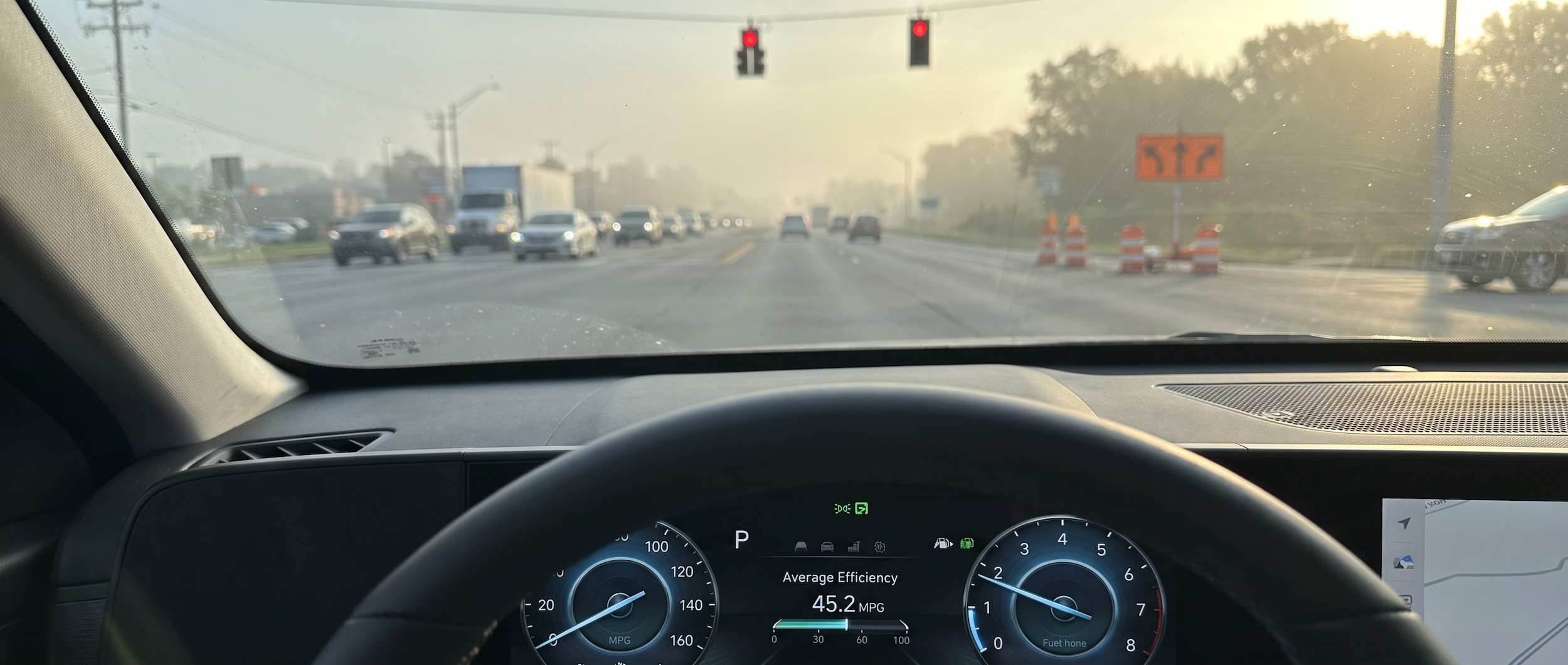
You bought the Kona partly for those EPA numbers. Now you're crawling through the construction between Harding Place and Thompson Lane every morning, and the trip-computer reads noticeably lower than the window sticker promised. Frustrating, sure, and it's worth explaining rather than glossing over.
Stop-and-go traffic is the single biggest enemy of a naturally-aspirated engine paired with a continuously variable transmission (IVT), and Nolensville Pike right now delivers that in quantity. The EPA city figure isn't measured in Nashville construction-zone conditions, so a lower reading there shouldn't shock you. There's usually no mechanical problem at all. But a few real culprits do show up, and at least one of them you can fix without a service visit.
What's Actually Going On?
The 2026 Kona's EPA numbers split cleanly by powertrain, and which engine sits under your hood decides how sensitive the car is to stop-and-go driving, so the same slow morning on Nolensville Pike hits a turbo trim harder than it hits the base 2.0L, even though both cars are working exactly as designed.
| Trim | Engine | EPA City | EPA Hwy | EPA Combined | Stop-and-Go Impact |
|---|---|---|---|---|---|
| SE / SEL Sport (FWD) | 2.0L / IVT | 29 mpg | 34 mpg | 31 mpg | Moderate (IVT recovers reasonably in light grid-lock) |
| SE / SEL Sport (AWD) | 2.0L / IVT | 27 mpg | 29 mpg | 28 mpg | Moderate, with AWD drag overhead |
| SEL Premium / Limited (FWD) | 1.6T / 8-speed | 25 mpg | 28 mpg | 26 mpg | Higher because turbo needs load to hit efficiency |
| SEL Premium / Limited (AWD) | 1.6T / 8-speed | 23 mpg | 27 mpg | 25 mpg | Highest sensitivity in stop-and-go |
All figures are EPA estimates; actual mileage will vary. Source: fueleconomy.gov.
The turbocharged SEL Premium and Limited start from a lower efficiency baseline (26 mpg combined vs. 31 mpg combined for the 2.0L), and they feel that gap most in grid-lock. A turbocharger is built to make power under load. At 15 mph in a construction zone, it's doing neither job efficiently. The 2.0L IVT engine holds closer to peak-efficiency RPM during low-speed crawls, and that's why it carries the better city number.
If you have an FWD SE or SEL Sport and your real-world number in heavy Nolensville Pike traffic is running 24-26 mpg, you're likely in normal territory for current construction conditions. If a 2.0L FWD Kona is delivering consistently below 22 mpg across a full tank, something specific is costing you fuel. Bring it in for a look.
The Most Likely Culprit Is Tire Pressure (Seriously)
Low tire pressure is the first thing worth ruling out on a fuel-economy complaint, and it's also the easiest to fix, so it's a smart place to start before you assume anything mechanical is wrong. Nolensville Pike's surface isn't smooth right now. Construction seams, spread gravel, and the occasional pothole all make small pressure losses more likely than they'd be on a freshly paved road.
The 2026 Kona specifies 35 PSI cold-tire pressure on most trims (check the placard inside your driver's door jamb for your exact spec; it overrides anything you find online). Every 6 PSI drop below spec can cost roughly 1-2% in fuel efficiency, according to the U.S. Department of Energy. On a 31-mpg car, that adds up across a year of driving. Check the tires when they've been sitting for a few hours (cold, before you drive). A gas-station pump reads artificially high on a warm tire after you've just driven.
A second common culprit is a dirty air filter. Nashville's summer air, especially near active construction, carries particulate that clogs filters faster than the maintenance interval assumes. A restricted filter makes the engine work harder per combustion cycle, and the IVT can't fully compensate for that.
DIY Checks vs. What Needs a Service Visit
Some of this you can handle yourself in a driveway this week, and some of it points straight to the service bay, so the smart move is to run the free checks first and only book a visit when the number still won't come up after you've done your part.
Handle yourself first:
- Tire pressure - Check cold, match the door-jamb spec. Takes five minutes.
- Drive mode - The 2026 Kona offers an Eco mode on most trims. It softens throttle response and adjusts climate control output to reduce load on the engine. Using it in slow traffic is not a performance compromise; it's the right tool for the job.
- AC load - Tennessee in July is not the time to turn off the AC, but running the fan on recirculate mode (instead of fresh-air intake) reduces the cooling load on a hot day and recovers a small amount of efficiency.
- Driving pattern - Anticipating traffic flow and coasting to a stop rather than braking hard lets the IVT stay in a more efficient operating range. This is particularly useful on Nolensville Pike's long signal cycles.
Bring it to us when:
- You've checked tire pressure, switched to Eco mode, and the number is still consistently more than 4-5 mpg below your trim's EPA city figure across two full tanks.
- The fuel economy dropped suddenly and noticeably, rather than gradually. A sudden drop often points to an O2 sensor issue, a fuel injector problem, or a spark plug that's past its service life (none of which show a dashboard warning light until they're further along).
- Your engine is running rough at low speeds or you notice the idle isn't smooth when stopped. That points to fuel delivery or combustion issues, not driving conditions.
We don't charge for a tire-pressure and visual inspection check when it's combined with a scheduled service. If there's something mechanical, we'll tell you what it is and what it'll take before any work starts.
Frequently Asked Questions
Does the 2026 Kona's fuel economy actually suffer more in construction-zone traffic than normal stop-and-go?
Yes, for a specific reason. Construction zones create what engineers call "stop-and-creep" patterns (very brief, partial accelerations followed by full stops), which are harder on fuel economy than the rhythmic stop-and-go the EPA city cycle approximates. The Kona's 2.0L IVT handles this better than the 1.6T because the IVT is designed to hold efficient RPM bands during partial-throttle pulls. The 1.6T's turbo doesn't spool efficiently at those speeds. If your commute runs through the TDOT widening zone between Harding Place and Old Hickory Boulevard (a 4.4-mile active construction corridor, per TDOT), expect real-world city numbers to run 2-4 mpg below the EPA estimate until the project wraps.
Is it worth choosing the 2.0L over the 1.6T specifically for Nolensville Pike-style commuting?
For a driver whose primary route is heavy urban stop-and-go, the math favors the 2.0L. The EPA rates the FWD SE at 31 mpg combined versus 26 mpg combined for the FWD SEL Premium (a 5 mpg difference in the combined cycle that widens further in pure city conditions). That gap closes if you do significant highway driving, where the turbo's efficiency is more competitive. But if Nolensville Pike is your daily reality, the naturally-aspirated 2.0L and IVT combination is the more forgiving powertrain for that kind of route.


