

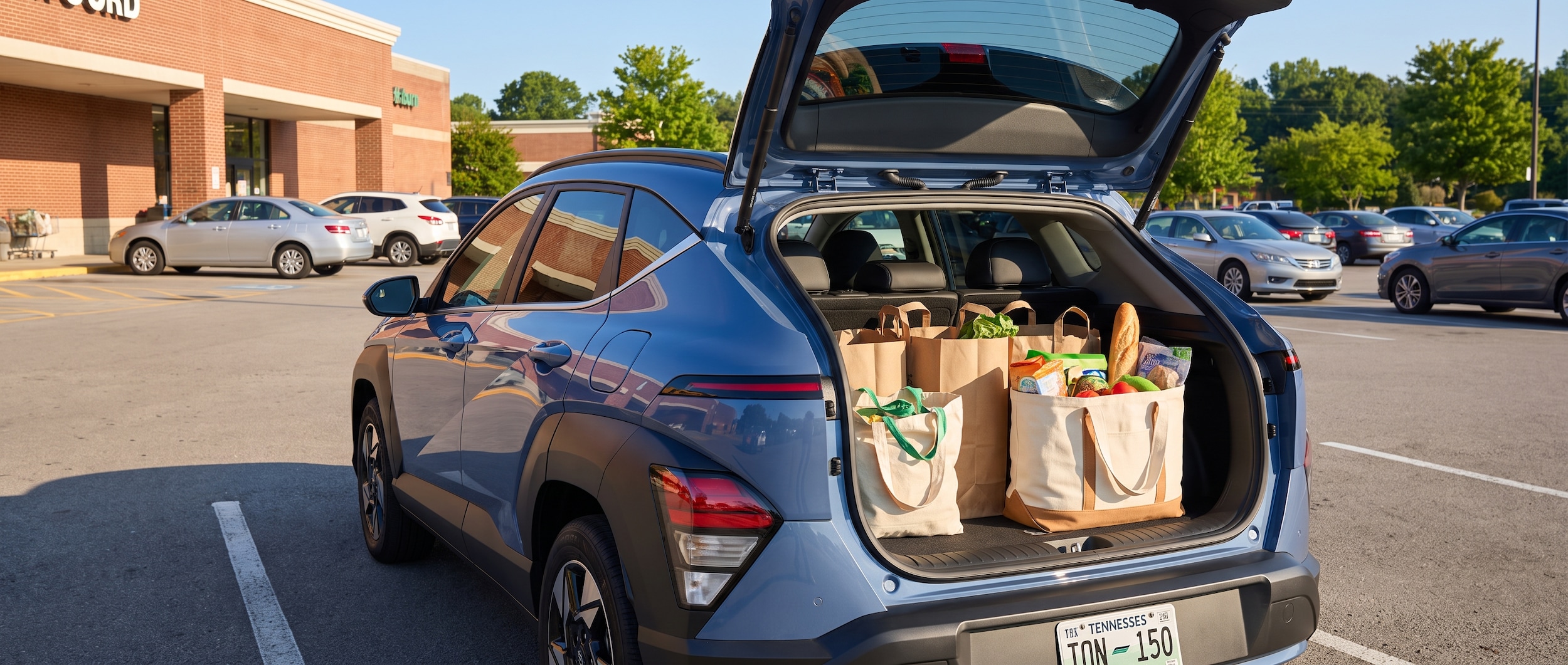
The 2026 Hyundai Kona carries 25.5 cubic feet of cargo behind the rear seats -- more than most sedans and a number of older compact SUVs -- but raw volume only tells part of the story. For a Murfreesboro driver running the usual Tuesday circuit of a big-box store, a grocery pickup, and a home-improvement detour on the way back, three specific features determine whether the Kona actually works: the stowable cargo cover, the dual-level underfloor tray, and the 60/40 split-fold rear seats. Get those right for your load pattern and the Kona handles nearly every errand configuration the South Nashville and Murfreesboro corridor can throw at it. Browse the 2026 Kona lineup
- Light weekly haul (groceries, drugstore, dry cleaning): 25.5 cubic feet with the rear seats up handles a full shopping-cart load with room for a dry-cleaning bag hung from the upper position of the cover.
- Heavy or bulky runs (warehouse club, home goods, mulch bags): fold one or both rear-seat sections with the 60/40 split to access up to 63.7 cubic feet; the squared-off liftgate lets large flat boxes slide straight in.
- Multi-stop day with passengers along: the underfloor storage tray keeps reusable bags, a first-aid kit, or small valuables organized and out of the way while two rear passengers ride comfortably.
- Errand-focused buyers choosing a trim: the SE and SEL Sport handle the cargo side just as well as the higher trims -- the upgrade to SEL Premium adds the turbo engine and ventilated seats, not more cargo volume.
What Actually Determines How Useful the Kona Is for Errands?
Cargo capacity in cubic feet tells you volume. What it does not tell you is whether a flat-pack shelf from a home goods store slides in without tilting, whether a week of warehouse-club groceries forces you to stack bags three high, or whether you can load heavy items without wrenching your back at the bumper. The Kona's 2026 cargo bay addresses all three through its physical design -- and the numbers back that up.
| Cargo Scenario | Seats Up or Folded? | Key Feature That Makes It Work | Real-World Capacity |
|---|---|---|---|
| Weekly grocery run | Seats up (25.5 cu ft) | Squared-off liftgate, no tilting required | 6-8 fully packed bags with room to spare |
| Warehouse club haul | One side folded (partial) | 60/40 split fold keeps one passenger seat | Flat-pack items, large bags alongside a passenger |
| Flat-pack furniture / large boxes | Both sides folded (63.7 cu ft) | 60-inch folded depth, 28.3-inch cargo height | Full flat load, items clear the liftgate frame straight in |
| Multi-stop with kids or a passenger | Seats up + underfloor tray | Dual-level floor, lower tray stores small items | Primary bay for bags, tray for reusable bags and small valuables |
| Bulky garden / home supplies | Both sides folded | Hard floor, stowable cover clips flat vs rear seats | Long/tall items load without removing the cover |
The EPA rates the base Kona SE at 28 city / 35 highway / 31 combined (FWD, 2.0-liter), which matters for Murfreesboro drivers spending real time on I-24 and the Medical Center Parkway corridor -- where stop-and-go conditions are the norm during morning and evening rush windows. The Kona's stop-and-go adaptive cruise control now comes standard on every 2026 trim, including the SE, which reduces the fatigue on those multi-stop days.
The Squared-Off Liftgate Is the Detail Most Buyers Miss
Most subcompact SUVs have a sloped rear roofline that forces you to tilt large boxes or angle items awkwardly across the sill. The 2026 Kona uses a squared-off rear liftgate that creates a nearly vertical opening, so a flat-pack from a home goods store, a case of water, or a large bag of dog food can slide straight in at bumper height without hitting the roof of the cargo opening. See current Kona inventory at Hyundai of South Nashville
The cargo floor also sits at an ergonomic height relative to the rear bumper, which means lifting heavy cases -- think a 40-pound bag of pet food or a full case of water -- does not require stooping. That is a daily-errand detail that does not show up in a spec sheet but matters on the tenth load of the week.
Need more cargo room? The Tucson steps up to compact-SUV space
Murfreesboro's road network is built around a grid of surface streets connecting shopping corridors, and peak rush hour on I-24 runs from 6 to 8 a.m. and again from 4:30 to 6:30 p.m. on weekdays. The Kona's compact footprint -- 171.3 inches long -- makes parking-lot navigation at busy strip malls straightforward, while the standard stop-and-go adaptive cruise control gives you one less thing to manage when traffic bunches heading back toward the highway.
| Feature | SE / SEL Sport | SEL Premium / Limited | Cargo Impact |
|---|---|---|---|
| Cargo volume (seats up) | 25.5 cu ft | 25.5 cu ft | Identical across all trims |
| Cargo volume (seats folded) | 63.7 cu ft | 63.7 cu ft | Identical across all trims |
| Dual-level underfloor tray | Standard | Standard | All trims |
| Stowable cargo cover | Standard | Standard | All trims |
| Hands-free power liftgate | Not available | Limited only | Useful for loaded-hands situations |
| Engine | 2.0L / 147 hp | 1.6L turbo / 190 hp | Turbo adds highway merge confidence, not cargo space |
The trim takeaway: if cargo space is the primary purchase driver, the SE does the identical job as the Limited. The step to SEL Premium makes sense if you want the turbo engine's stronger acceleration for frequent I-24 on-ramps or the Limited's hands-free liftgate for high-frequency loading days. Explore financing options at Hyundai of South Nashville
Matching the Kona's Cargo Tools to How You Actually Drive
The IIHS awarded the 2026 Kona its Top Safety Pick+ designation -- the organization's highest recognition -- and NHTSA testing produced a four-star overall rating. Both matter on Murfreesboro's fast-growing road network, where the city's official transportation page notes more than 30 active road and intersection projects underway. Standard forward collision avoidance with pedestrian and junction-turn detection, blind-spot monitoring, and rear cross-traffic alert come on every trim, so whichever cargo configuration you choose, the safety suite is the same.
Here is a straightforward way to think about which cargo setup matches your actual week:
- Mostly solo runs, 2-4 stops: use the cargo bay as-is with the cover in place. The underfloor tray holds reusable bags, a spare charger, and small odds and ends so the main bay stays clear and organized.
- Regular passenger plus cargo: fold only the 60/40 smaller section behind the driver to create a long narrow load floor while keeping the other rear seat for a passenger. The split works well for Murfreesboro households where one person rides along for warehouse club trips.
- Seasonal hauls (garden center, hardware runs): fold both sections fully for the 63.7-cubic-foot configuration. The 60-inch depth of the flat floor handles long items like fertilizer bags or bundled lumber strips that would never fit in a sedan trunk.
- Frequently loading in tight lots: the Limited's optional hands-free power liftgate is worth the upgrade if you regularly park in tight spaces where reaching behind a loaded vehicle to pull a liftgate handle is awkward.
Pros and Cons: SE/SEL Sport vs. SEL Premium/Limited for Errand-Focused Buyers
| SE / SEL Sport | SEL Premium / Limited | |
|---|---|---|
| Pros | EPA-estimated 31 mpg combined (FWD 2.0L) -- the efficiency leader in the lineup; identical cargo volume to every other trim; lower entry point | 190-hp turbo for confident I-24 merges; hands-free liftgate on Limited; dual 12.3-inch panoramic displays; ventilated front seats for Middle Tennessee summers |
| Cons | 147-hp base engine is adequate for surface streets but can feel light during highway on-ramps in loaded conditions; no hands-free liftgate available | EPA-estimated 28 mpg combined (FWD 1.6T) -- trades about 3 mpg for the turbo; hands-free liftgate is Limited-only, not available on SEL Premium |
The practical read: for a Murfreesboro driver whose errands are mostly surface-street loops with the occasional I-24 run, the SE or SEL Sport handles the cargo side identically to the Limited -- and the EPA efficiency advantage is real across multiple fill-ups per month. If the daily route involves consistent highway merging or you value the hands-free liftgate for loaded-hands situations, the step up to SEL Premium or Limited earns its keep.
Frequently Asked Questions
Does the 2026 Kona have enough cargo space for a weekly Costco or warehouse-club run?
The 2026 Kona offers 25.5 cubic feet of cargo space with the rear seats up, which comfortably holds six to eight fully packed grocery bags without stacking -- enough to manage a full shopping-cart load in a single trip. For a warehouse-club haul with oversized boxes or bulk items, folding one or both rear-seat sections opens the floor to 63.7 cubic feet total, with a 60-inch flat depth and 28.3-inch vertical clearance that lets large flat-pack items slide in straight without tilting.
Does the cargo space or cargo features change from trim to trim on the 2026 Kona?
Cargo volume is identical across all four 2026 Kona trims -- 25.5 cubic feet with seats up and 63.7 cubic feet with the rear seats folded. The dual-level underfloor storage tray and the stowable cargo cover that clips flat against the rear seats are also standard on every trim. The one cargo-specific feature that does vary by trim is the hands-free power liftgate, which is available only on the Limited. Engine, tech, and seat comfort features change across trims, but the actual cargo bay is the same physical space on an SE and a Limited.


