

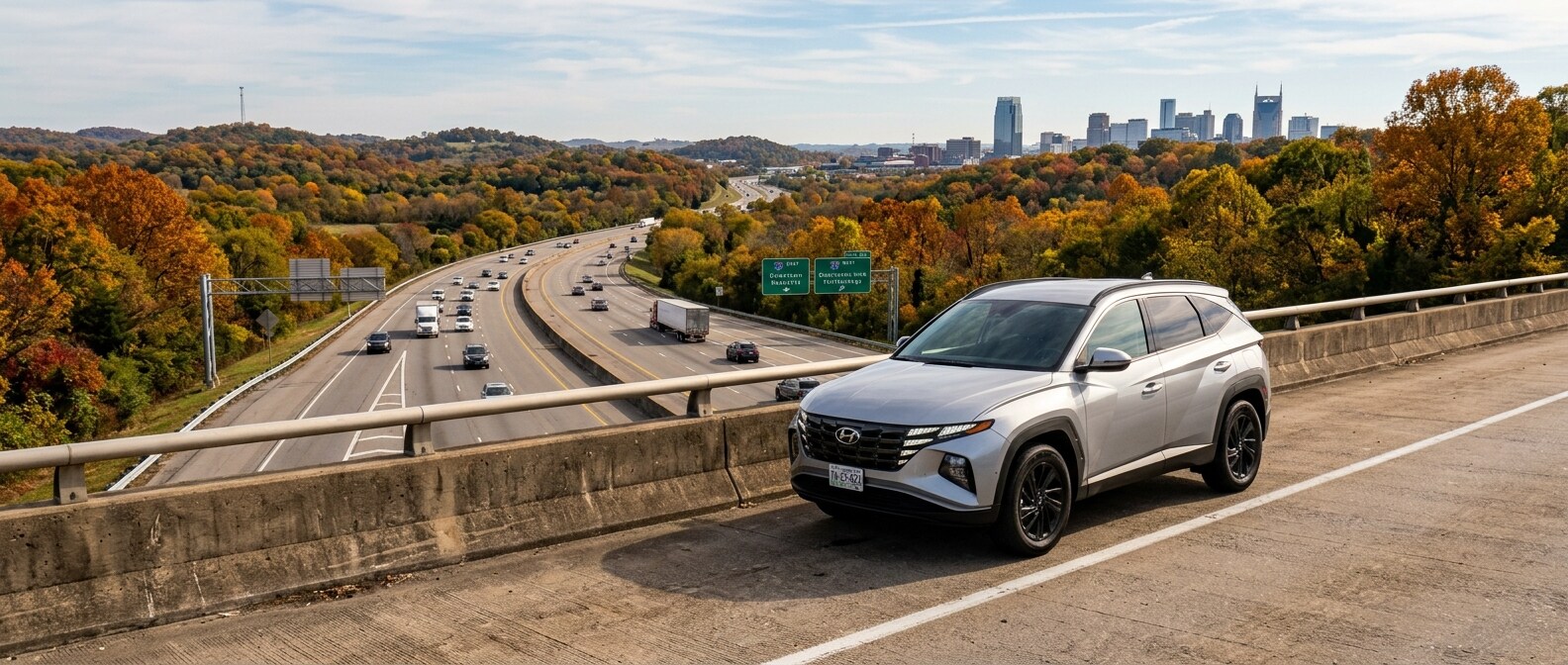
The 2026 Hyundai Tucson Hybrid is a genuinely good fit for the I-24 commute corridor. The EPA rates the Blue SE trim at 38 MPG combined, and the stop-and-go pattern that makes Nashville's southeast corridor so frustrating actually works in the hybrid's favor. We'll walk through which trim fits your drive and where the tradeoffs sit.
Browse the 2026 Tucson Hybrid at Hyundai of South Nashville
How Does the Tucson Hybrid Perform in Nashville's Stop-and-Go Traffic?
The Tucson Hybrid performs best in exactly the traffic that drives everyone crazy, so Nashville's most congested corridor turns out to be where this powertrain does its finest work, a frustrating drive for you that quietly feeds the battery. The I-24 stretch between South Nashville and Murfreesboro is, by TDOT's own traffic analysis, the most congested stretch of highway in Tennessee. A real headache, sure. Mechanically speaking, that crawl is where a hybrid earns its keep.
Hyundai's hybrid system pairs a 1.6-liter turbocharged four-cylinder with a 64-kilowatt electric motor, delivering 231 combined horsepower. The piece that matters for an I-24 commute is regenerative braking. Every time you ease off the throttle or tap the brake pedal in that crawl, the system converts that deceleration back into electricity stored in the battery. The slower and more stop-heavy the traffic, the more the system recaptures, which is why city-heavy drivers frequently meet or beat the EPA estimate in real-world conditions.
The gas-only Tucson, by contrast, produces no energy during braking. It just waits for the light to change.
| Trim | EPA City / Hwy / Combined | Drivetrain | Key Differentiator |
|---|---|---|---|
| Tucson Hybrid Blue SE | 38 / 38 / 38 MPG | AWD standard | Highest EPA rating; 17-inch wheels aid efficiency |
| Tucson Hybrid SEL | 36 / 37 / 36 MPG | AWD standard | 18-inch wheels, 8-way power driver's seat |
| Tucson Hybrid SEL Convenience | 36 / 37 / 36 MPG | AWD standard | Adds wireless charging, heated rear seats |
| Tucson Hybrid Limited | 36 / 37 / 36 MPG | AWD standard | 19-inch wheels, premium audio, panoramic sunroof |
| Tucson Gas (SE, non-hybrid) | 26 / 33 / 29 MPG | FWD standard | Lower entry point; no regen braking |
*All MPG figures are EPA-estimated for 2026 model year.*
There's a tradeoff worth stating plainly. The hybrid adds weight and complexity. At steady 70-plus mph cruise on a clear stretch of I-65 or a weekend run to Chattanooga, the efficiency gap between the hybrid and gas models narrows, at least on open road. The hybrid system does most of its work below 40 mph. So if your drive is overwhelmingly highway-open-road, the math looks different than it does for a 25-mile I-24 slog each way.
Which Trim Makes the Most Sense for a Daily Nashville Commute?
The Blue SE wins on pure efficiency while the SEL Convenience wins on comfort, so the right trim really comes down to whether your I-24 drive is more about saving fuel or staying comfortable across a long crawl. Both start from the same hybrid drivetrain, and both make sense depending on your daily mileage.
See current Tucson Hybrid inventory
The Blue SE's 38 MPG EPA-estimated combined rating comes partly from its 17-inch wheel spec. Smaller wheels mean less rolling resistance, and Hyundai calibrated that trim specifically to maximize the efficiency number. If you're doing 20-plus miles each way on I-24 and fuel savings is the priority, that trim's rating is the right starting point.
The SEL and SEL Convenience hold at 36 MPG combined (EPA-estimated) with 18-inch wheels, and they add meaningful daily-comfort upgrades:
- Eight-way power driver's seat and hands-free smart liftgate on the SEL
- Wireless charging and heated rear seats on the SEL Convenience
- For anyone who spends 45-to-60 minutes each way in Nashville traffic, the cabin comfort case is real
Compare the standard Tucson if you want the gas option
We'll say this plainly. All four hybrid trims come standard with AWD. That matters in November through February, when Middle Tennessee throws an occasional ice event that turns Antioch on-ramps into a guessing game. You're not paying extra for AWD on the hybrid, it's already in the package.
Does the Tucson Hybrid Come Standard With Features That Matter for the Drive?
Yes, the 2026 Tucson Hybrid comes standard with features that genuinely matter on a commute like this, and the full equipment list rewards a careful read rather than a skim, because some of those pairings do more work together than they do on paper. Go through it before you lock in on a single trim.
Read the safety suite line by line before you compare anything else. Every 2026 Tucson Hybrid trim includes Hyundai's Highway Driving Assist suite with the following:
- Forward collision avoidance with pedestrian detection
- Lane-keeping assist and blind-spot warning
- Adaptive cruise control with lane centering
For anyone spending meaningful time on I-24, adaptive cruise control in a hybrid is a specific combination. When traffic slows ahead and you let the system manage the gap, the hybrid's regenerative braking kicks in automatically. The car is recouping energy while the safety system manages your following distance. That's not a feature pairing that gets talked about enough.
The 12.3-inch touchscreen with wireless Apple CarPlay and Android Auto is standard across all hybrid trims, as is Hyundai's Bluelink+ connected services. Navigation, remote start, and vehicle status monitoring all come included.
One limitation worth naming is cargo space. The Tucson Hybrid holds 38.7 cubic feet behind the rear seats. A solid number for the class, but it isn't SUV-large. If you're regularly hauling gear for three kids plus a full weekend, the platform starts to feel tight.
Frequently Asked Questions
Is the 2026 Hyundai Tucson Hybrid actually more efficient in city driving than on the highway?
Yes. The Tucson Hybrid's EPA rating is 38 city / 38 highway for the Blue SE trim, essentially flat across both, but in real-world stop-and-go driving, the regenerative braking system recaptures energy during deceleration. Which means city-heavy commuters frequently report fuel economy at or above the EPA combined estimate. At sustained highway speeds above 70 mph, the gasoline engine carries more of the load and efficiency can dip below the EPA figure.
Does the Tucson Hybrid come with AWD, or do you have to pay extra for it?
AWD comes standard on every trim in the 2026 Tucson Hybrid lineup: Blue SE, SEL, SEL Convenience, and Limited. There is no FWD-only hybrid configuration. A meaningful difference from the gas-only Tucson, where FWD is the base drivetrain.
How does the 2026 Tucson Hybrid handle Middle Tennessee winters?
Middle Tennessee winters are generally mild, but ice events on I-24 (particularly on elevated sections near Antioch and the La Vergne corridor) are real. The Tucson Hybrid's standard AWD handles those conditions with more confidence than a FWD-only configuration. Cold temperatures do reduce hybrid battery efficiency modestly, so expect EPA-estimated figures to run somewhat lower during sustained cold snaps. The system still functions as a full hybrid in cold weather; it just operates closer to the lower end of its range.


