

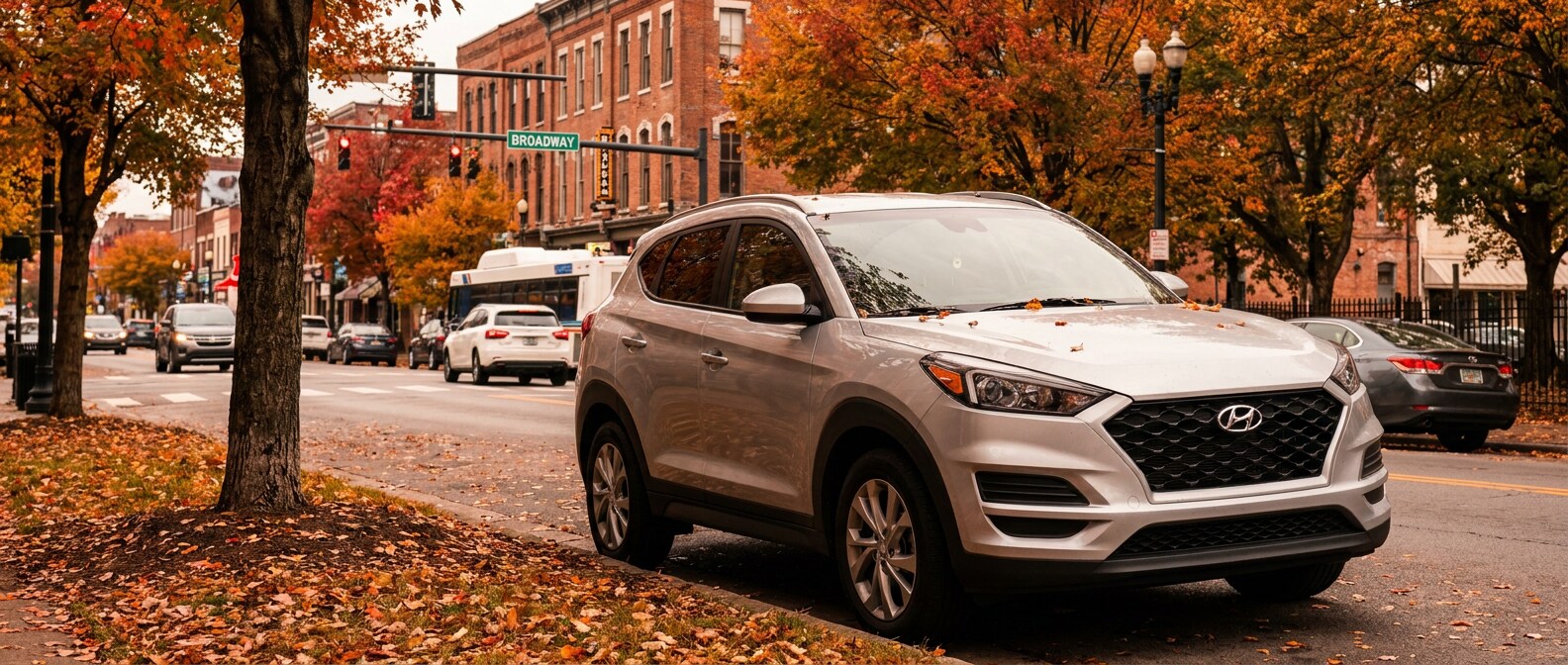
If you're shopping a used Tucson near Bell Road, the year on the window sticker matters more than almost anything else you'll find on the lot. They're not all equal. NHTSA holds more than 6,200 owner complaints across the Tucson's history, and 2,705 of them belong to just 2016 and 2017 alone. Two years, nearly half the total. A number like that'll change how you shop.
The good news is that once you know which generation and specific years to target, you're looking at a genuinely solid compact SUV for the stop-and-go reality of the Bell Road corridor and the I-24 merge every morning. Our team runs through the same short checklist when one rolls onto our lot, and we'll flag anything off.
browse our used Tucson inventory
- Sweet-spot years: 2020 and 2021 (third generation, conventional 6-speed automatic, lowest complaint counts in the generation)
- Also worth considering: 2023 and 2024 (fourth gen, past the launch-year churn)
- Years to approach carefully: 2016 and 2017 (Nu engine recall NHTSA 21V-727; complaint counts nearly 10x the model median)
- Watch the 2022 launch year too: first year of the redesign, 3 recalls and elevated complaint volume
- Always run the VIN through NHTSA.gov before you buy any used Tucson from 2016 through 2022
Which Tucson years are the sweet spot?
For a worry-free used Tucson, the 2020 and 2021 model years are the sweet spot, with the 2021 scoring highest among the modern years we can properly evaluate (1 recall and just 58 owner complaints in NHTSA's database), though the cleanest years rarely sit on a lot for long. So you'll want to move when a good one shows up.
None of it's luck. By 2020-2021, Hyundai had already swapped out the 7-speed dual-clutch transmission that made the 2016-2017 era so problematic, settling into a conventional 6-speed automatic that's proven much more durable in everyday use. NHTSA records show the 2021 Tucson with 79 complaints total, the fewest of any year in that generation.
For the Bell Road commute specifically, that transmission swap matters. The dual-clutch unit that plagued earlier cars was engineered for efficiency on steady-speed driving. It doesn't love the kind of repeated low-speed engagement you'll get sitting through three light cycles at the I-24 interchange at Exit 59. The Bell Road/I-24 junction has earned a reputation among Nashvillians for confusing lane configurations and limited signal coordination, which translates to lots of creeping, stopping, and re-engaging in tight traffic. A conventional torque-converter automatic handles that pattern with far less drama.
You'll find the 2020 nearly as clean as the 2021, and it's a solid buy, especially one with lower mileage. Both share the same third-generation platform and the same 2.0-liter or 2.4-liter naturally aspirated engine lineup, which keeps independent repair costs reasonable.
| Model Year | Generation | Transmission | NHTSA Complaints (approx.) | Recalls | Sweet Spot? |
|---|---|---|---|---|---|
| 2016 | Gen 3 (launch) | 6-spd auto / 7-spd DCT (1.6T) | 1,600+ | 5 | Avoid |
| 2017 | Gen 3 | 6-spd auto / 7-spd DCT (1.6T) | 1,086+ | 3 | Avoid |
| 2018 | Gen 3 | 6-spd auto / 7-spd DCT | 383+ | 1 | Caution |
| 2019 | Gen 3 | 6-spd auto / 7-spd DCT | 349+ | 1 | Caution |
| 2020 | Gen 3 | 6-spd auto | ~90 | 1 | Sweet spot |
| 2021 | Gen 3 | 6-spd auto | ~58-79 | 1 | Sweet spot |
| 2022 | Gen 4 (launch) | 8-spd auto / 6-spd hybrid | 361-433 | 3 | Watch |
| 2023 | Gen 4 | 8-spd auto | ~123-221 | 2 | Acceptable |
| 2024 | Gen 4 | 8-spd auto | Lower (fewer years on road) | TBD | Promising |
Sources: NHTSA complaint database; fueleconomy.gov (EPA ratings).
Which years should you watch out for?
The 2016 and 2017 are the two years we'd steer most used buyers away from without a very specific VIN check, and NHTSA records show 1,619 complaints against the 2016 and 1,086 against the 2017, each running at least twice the model's median complaint rate. It's a documented, officially acknowledged issue underneath the 2017.
NHTSA Recall 21V-727 (Hyundai Recall 209) covers approximately 82,268 model-year 2017 Tucson vehicles equipped with 2.0-liter Nu GDI engines, produced for the U.S. market between May 2016 and October 2017. The recall documents a manufacturing defect in which connecting rod bearings wear prematurely due to metal debris from factory machining. A damaged connecting rod can eventually puncture the engine block and cause oil to leak onto hot engine surfaces. The documented fix, when it's performed, is an engine inspection and replacement at no cost. Whether that repair was actually completed on the specific vehicle in front of you is the question for a used buyer.
On the 2016, you're looking at a similar but broader story. NHTSA's database shows 1,611 complaints against the 2016 Tucson, the highest single-year total in the model's modern history, with 5 documented recall campaigns. Both the 1.6-liter turbocharged trims (dual-clutch shudder and control issues) and the Nu-engine trims generated sustained complaint volume throughout that generation.
What about the 2022? It's not a dealbreaker, but the redesign's launch year earns a closer look.
- Not in the same category as 2016-2017, but it deserves careful scrutiny
- NHTSA records show 361 complaints and 3 recall campaigns
- Powertrain issues lead the complaint categories
- A natural pattern for the first year of a redesigned generation, with some kinks still being worked out
- Early fourth-generation (2022-2024) reports still include engine-related complaints, though analysts note it's not yet a mature long-term pattern
- Give the 2022 a hard VIN check, have an independent mechanic examine the powertrain, and price the remaining uncertainty into your offer
see the current 2026 Tucson lineup
Get Pre-Approved for Financing
Which year fits which buyer?
The commuter who wants a worry-free used buy: 2021 (or 2020). If your morning starts on Bell Road and you'd rather run a used Tucson to 150,000 miles without a prolonged VIN investigation, start here. Nashville commuters on I-65 and I-24 face peak congestion between roughly 7:15 and 8:45 AM and again from 4:30 to 6:00 PM, and reportedly lost 65 hours to traffic in 2025. That daily grind rewards a powertrain with a simple, proven transmission and a naturally aspirated engine. The 2020-2021 Tucson is exactly what you'll want.
The buyer who wants the fourth-generation design and tech: 2023 or 2024. The fourth gen brought a fully redesigned interior with a standard 12.3-inch touchscreen, wireless Apple CarPlay and Android Auto, and much updated safety tech. The 2026 Tucson (the current model) set those as standard features, and the 2023-2024 models carry them too. If those features matter more to you than a squeaky-clean complaint record, 2023 is a sensible entry point into the generation, with 2024 giving you less time on the road and fewer compounding issues documented. Run the VIN, confirm the two recall campaigns are completed, and you're in good shape.
The commuter who wants the hybrid efficiency: A used Tucson Hybrid is worth your time if you're logging significant city miles. The EPA rates the 2026 Tucson Hybrid at 36 mpg combined (36 city / 37 highway), and the 2022-2024 Tucson Hybrid models carry similar EPA-estimated figures. Regenerative braking recaptures energy during exactly the kind of repeated deceleration you get on South Nashville surface streets, so the city number often reflects your real-world driving better than the highway figure does. That hybrid setup also stays separate from the Nu-engine issues that hit the third-gen gas models. You don't inherit them.
The buyer on a tighter budget who wants to understand the risk: If 2016-2019 is the range you're shopping because of the price point, we'd encourage you to do two things before anything else. First, run the VIN on NHTSA.gov to check open recall status (Recall 21V-727 covers many 2017 models, and earlier campaigns covered 2016s). Second, ask the seller for documented proof the recall repair was completed. A 2019 Tucson with a confirmed recall repair and a clean inspection can still be a solid buy. One without that documentation is a gamble, plain and simple.
Frequently Asked Questions
What is the most reliable used Hyundai Tucson year to buy?
Based on NHTSA complaint and recall data, the 2021 Tucson represents the cleanest used buy you'll find in the modern era, with 1 recall and approximately 58-79 owner complaints on file. The 2020 is nearly as strong, and it's close. Both years fall after Hyundai transitioned away from the dual-clutch transmission and before the 2022 redesign's first-year complaint churn. For buyers who want the newer fourth-generation platform, 2023 and 2024 show notably lower complaint counts than the 2022 launch year.
Which Hyundai Tucson years have engine recalls I need to know about?
NHTSA Recall 21V-727 (filed September 17, 2021) covers certain 2017 Hyundai Tucson vehicles equipped with the 2.0-liter Nu GDI engine. The recall documents premature connecting rod bearing wear caused by metal debris from factory machining operations. The 2016 Tucson carried multiple separate recall campaigns as well, including issues linked to the dual-clutch transmission on 1.6T trims. Before buying any 2016 through 2019 Tucson, you'll want to verify the specific VIN at NHTSA.gov for open recall status.
Is the used Tucson Hybrid worth it for a Nashville commute?
The hybrid makes a genuinely strong case for a Nashville commute, and it's an easy one. The EPA rates the 2026 Tucson Hybrid at 36 mpg combined city/highway, with an EPA-estimated total range of 493 miles on a tank. Used Tucson Hybrid models from 2022 onward carry comparable EPA-estimated figures. The hybrid powertrain recaptures energy under braking, which means Nashville's stop-and-go surface streets work in your favor rather than against you. The hybrid also uses a separate powertrain architecture from the Nu GDI engine that generated most of the third-generation complaint volume, so the recall history doesn't carry over.


