

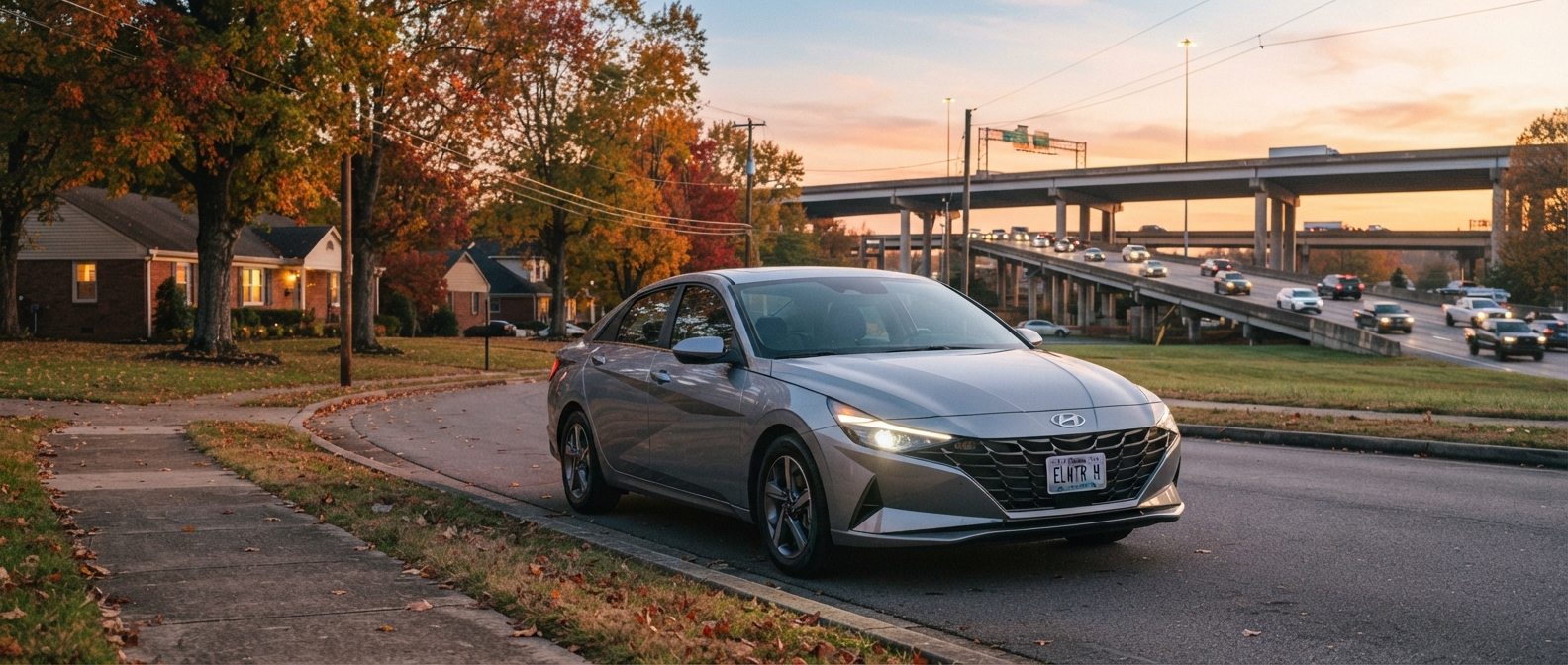
Run I-24 into Nashville five days a week out of La Vergne, and the 2026 Hyundai Elantra Hybrid wins on fuel efficiency. Full stop. Still, the standard 2026 Elantra is the right call for drivers who log lower annual miles, want a lower entry point, or just don't want to think about hybrid tech. We'd walk you through it the same way if you came into Hyundai of South Nashville today.
The 2026 Elantra lineup gives you a real choice between two well-built sedans that share a face, a trunk size, and a full suite of standard safety tech. What they don't share is what matters most to a commuter. Efficiency, torque delivery, and how they feel in stop-and-go traffic.
- The Elantra Hybrid Blue is EPA-estimated at 51 mpg city, 35 combined for the gas SE. That gap is the whole story for I-24 commuters.
- Both gas and Hybrid deliver identical 14.2 cu ft of trunk space. The battery lives under the rear seats, not in your cargo area.
- The Hybrid uses a 6-speed dual-clutch transmission and produces 195 lb-ft of torque; the gas model uses a CVT and produces 132 lb-ft. The Hybrid actually feels quicker in urban traffic.
- The gas Elantra makes sense if your annual mileage is lower or you want the most flexibility in trim selection.
- Both trims include Hyundai SmartSense as standard: forward collision avoidance, lane-keeping assist, blind-spot monitoring, and more.
What's the Real Difference Between the Gas and Hybrid Elantra?
In every way a parking lot cares about, the gas and Hybrid Elantra are the same car, sharing footprint, cabin dimensions, and 14.2 cubic feet of trunk space, so the real split is mechanical, and for a commuter those mechanical differences carry weight. Same face. The money and the feel part is all under the sheet metal.
| Spec | 2026 Elantra SE (Gas) | 2026 Elantra Hybrid Blue |
|---|---|---|
| Engine | 2.0L 4-cyl, 147 hp | 1.6L hybrid system, 139 hp |
| Torque | 132 lb-ft | 195 lb-ft |
| Transmission | CVT (IVT) | 6-speed dual-clutch |
| EPA City MPG | 31 | 51 |
| EPA Highway MPG | 40 | 58 |
| EPA Combined MPG | 35 | 54 |
| Trunk Space | 14.2 cu ft | 14.2 cu ft |
| Estimated Range | ~434 miles | ~594 miles |
| Rear Suspension | Torsion beam | Multi-link |
| SmartSense Standard | Yes | Yes |
A few rows there deserve a direct call-out. The Hybrid produces 195 lb-ft of torque against 132 lb-ft for the gas model, per Hyundai's published specs. That torque arrives early and makes the Hybrid feel more responsive at low speeds, which is exactly where I-24 puts you every morning between Exit 62 and the I-440 split. And the rear suspension difference isn't a footnote. Every Elantra Hybrid gets a multi-link rear setup, while gas trims below the N Line use a torsion beam. On a stretch of interstate that's been under construction in Rutherford County, you feel it.
Does the Hybrid Actually Save Enough Fuel to Matter on a La Vergne Commute?
For an 18-mile commute each way the math is straightforward, and it tilts toward the Hybrid, though the size of that win depends on how much of your route sits in traffic rather than rolling open highway at a steady clip. La Vergne sits about 18 miles from downtown Nashville via I-24, per local routing data. Rush-hour traffic often stretches that to 30-45 minutes of stop-and-go. Hybrids are engineered to shine right there, and the Hybrid Blue is EPA-rated at 51 mpg in the city versus the gas SE's 31 city mpg.
The Elantra Hybrid also comes with an EPA-estimated range of roughly 594 miles per tank (Hybrid Blue). The gas Elantra holds 12.4 gallons, and at the SE's 35 combined mpg you're looking at about 434 miles between fill-ups. That's one more fuel stop every two weeks or so, which adds up in time as much as cost.
Both ratings come from the EPA. The combined figures land at 54 for the Hybrid and 35 for the gas SE.
Now the tradeoff. If you drive less than 8,000 to 10,000 miles per year, or your route runs mostly open highway with minimal stopping (think an evening run down I-24 with light traffic), the gas Elantra is a perfectly rational choice. The efficiency gap narrows at sustained highway speeds. The Hybrid's advantage is specific. It's strongest in the city-heavy, start-and-stop miles that define the I-24 commute.
Explore financing options if you're trying to map out the math on either powertrain before you visit.
Trunk Space, Tech, and What They Actually Share
A fair question before you pick a powertrain is whether the Hybrid steals trunk room, and the answer is no. Both the gas Elantra and the Elantra Hybrid give you exactly the same 14.2 cubic feet of trunk space, because Hyundai positioned the hybrid battery pack beneath the rear seats to protect cargo capacity. You're not giving anything up in the back when you choose the Hybrid.
Both versions also come standard with Hyundai SmartSense, which includes forward collision-avoidance assist with pedestrian detection, blind-spot collision warning, rear cross-traffic collision-avoidance assist, lane-keeping assist, lane-following assist, driver attention warning, and high beam assist. That full suite is on the SE, on the Hybrid Blue, and on every trim between them. You don't have to step up to get it.
Check the spec sheet on legroom and you'll see the cabin dimensions match too, 42.3 inches up front and 38 inches in back. What the Limited Hybrid adds that most gas trims skip is ventilated front seats. Run a commute through a Nashville-area November that can flip from 47 degrees to a humid 70 by afternoon, and those cooled seats earn their keep.
So Which Elantra Should You Pick?
It comes down to how you actually use the car, and both answers are legitimate, so we'd break the Hybrid-versus-gas call down by your miles, your route, and the feel you want behind the wheel. Here is the short version.
Choose the Elantra Hybrid if:
- You're commuting to Nashville from La Vergne regularly and spending time in stop-and-go I-24 traffic, where the city mpg advantage is at its largest.
- You drive 12,000 miles or more per year, since that's where the fuel economy difference compounds most meaningfully.
- You want the multi-link rear suspension on a non-performance trim, which gives the Hybrid a more planted feel over imperfect pavement.
- You prefer longer intervals between fill-ups. The Hybrid Blue's EPA-estimated ~594-mile range means you're stopping for gas far less often.
Choose the gas Elantra if:
- Your annual mileage is on the lower side, where the efficiency difference matters less over a full year.
- Your daily route runs more highway miles with less stop-and-go, where the gas Elantra's 40 mpg highway rating is genuinely competitive.
- You want the widest possible selection of trims or specific feature combinations, including the N Line with its turbocharged 201-hp engine and available dual-clutch transmission.
- The entry-level SE's 35 combined mpg is already well above what you were driving before. That alone is the win.
Both are well-built, competitively equipped compact sedans with standard safety technology most buyers in this class would have paid extra for five years ago. Neither is a compromise. The choice is about matching the powertrain to how you actually drive.
Browse our current Elantra and Elantra Hybrid inventory to see what's in stock right now and find the trim that fits your commute.
By the Hyundai of South Nashville Team | November 2026
Frequently Asked Questions
Is the Elantra Hybrid's trunk smaller than the gas Elantra's?
No. Both the 2026 Elantra gas and the 2026 Elantra Hybrid offer exactly 14.2 cubic feet of trunk space. Hyundai engineers positioned the hybrid battery beneath the rear seats to preserve cargo capacity, so you're not giving up any usable room in the trunk when you choose the Hybrid.
Does the Elantra Hybrid feel slower than the gas model?
Not in everyday driving. The Elantra Hybrid produces 195 lb-ft of torque versus 132 lb-ft for the gas Elantra SE, per Hyundai's published specs, and that electric torque arrives early and responsively. The gas model has a slightly higher peak horsepower figure (147 hp versus 139 hp combined for the Hybrid), but in the stop-and-go traffic that defines a daily commute, the Hybrid's low-end torque advantage makes it feel more immediate, not slower.


