

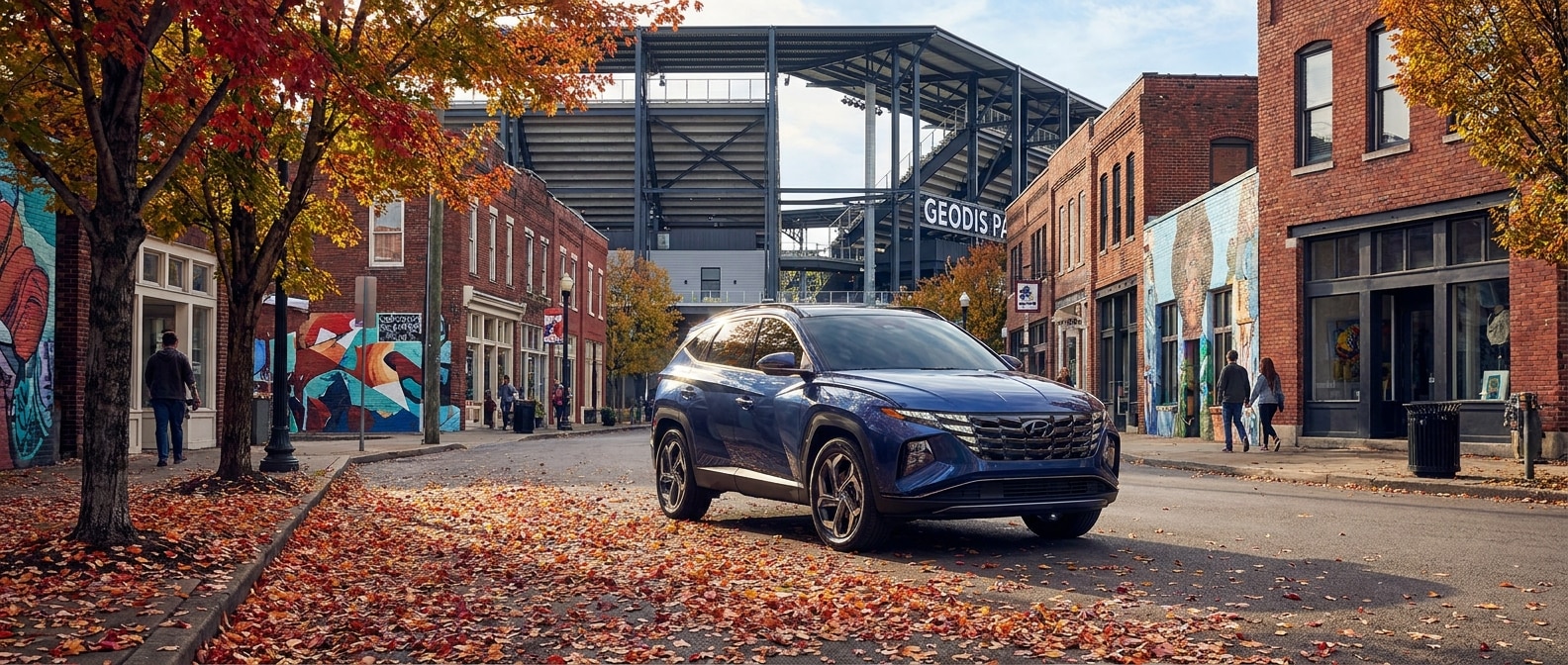
The plan is simple. Take I-65 South to Exit 81 (Wedgewood Avenue), swing east toward Benton Avenue, and roll up to Geodis Park with more fuel than you expected. The 2026 Hyundai Tucson Hybrid earns an EPA-estimated 38 mpg in city traffic, the same number it posts on the open highway. That's not a coincidence.
The Tucson Hybrid turns the drive to Nashville's biggest soccer stadium into a working demonstration of what a hybrid powertrain does once the traffic thickens.
What's the Plan at a Glance?
| Stop | What to Do | Best Time | Parking Note |
|---|---|---|---|
| Hyundai of South Nashville | Pick up your Tucson Hybrid, confirm settings | Before game day | On-site at 1635 Bell Rd |
| I-65 South / Exit 81 | Main freeway approach, least congestion | 90+ min before kickoff | N/A |
| Nolensville Pike corridor | Surface-street alternative; stop-and-go friendly | Any time | Street and lot options nearby |
| GEODIS Park campus lots (Lot 1, Lot 2) | Pre-purchased parking on Wingrove St or Wedgewood Ave | Lots open 3 hours before kickoff | Must buy in advance online |
| WeGo Park-and-Ride (off-campus) | Free fare on Routes 52 and 77 on Nashville SC home match days | Depart early | Rosedale Ave off-campus lots available |
Geodis Park: the Destination That Earns the Drive
GEODIS Park anchors the Wedgewood-Houston neighborhood at 501 Benton Avenue, about two miles south of downtown, and as the largest soccer-specific stadium in the United States and Canada at 30,109 seats, it rewards the trip and tests your patience at once, because 30,000 people funnel onto a tight neighborhood grid at the same moment. So the drive matters as much as the seat.
For drivers coming from South Nashville, the good news is that the stadium sits less than a mile from I-65, and Exit 81 at Wedgewood Avenue drops you almost at the front door. The harder part is post-match traffic on Nolensville Pike and the surrounding surface streets, which barely crawls. A hybrid earns its keep right there.
Prefer the standard Tucson without the hybrid powertrain? It earns an EPA-estimated 25 mpg city and 33 mpg highway. Solid numbers, but the gap between city and highway tells you something. Gas engines lose efficiency every time they slow down, because that braking energy disappears as heat.
The Nolensville Pike Run and Why Stop-and-Go Traffic Actually Helps
Stop-and-go traffic helps the Tucson Hybrid rather than punishing it, which runs against instinct, because the system's built to recoup efficiency in exactly the conditions that drain a conventional engine. The 1.6-liter turbocharged engine pairs with an electric motor, and every time you lift off the gas or press the brake pedal on Nolensville Pike, the electric motor runs in reverse and feeds energy back into the 1.49-kWh battery instead of letting it bleed off as heat. The EPA calls this regenerative braking.
Which is why the EPA rates the Tucson Hybrid Blue SE at 38 mpg city and 38 mpg highway. Identical. A gas engine's city number is almost always lower than its highway number because stop-and-go driving wastes energy with every stop, and the hybrid system flips that relationship so Nashville traffic becomes a feature, not a penalty.
Browse our current Tucson Hybrid inventory to see what trims are on the lot now.
What the Tucson Hybrid Brings to the Wedgewood-Houston Experience
The Wedgewood-Houston neighborhood rewards a nimble powertrain and quietly taxes a thirsty one, which is the whole case for the hybrid here, since the streets around Geodis Park stay dense, creative, and still partly industrial in feel. Parallel parking on brick-paved side streets, quick turns onto Craighead Street, slow crawls past the Nashville Speedway lot. It's the kind of environment where a responsive hybrid powertrain (231 horsepower through AWD on every trim, standard) feels more capable than the number on the spec sheet.
One thing worth naming is the weight tradeoff. The Tucson Hybrid comes standard with AWD on every trim, which adds a bit of mass compared to a front-wheel-drive compact. Higher trims come in at 36 mpg combined (versus the Blue SE's 38 mpg) as they gain weight with added features. If maximum EPA-estimated efficiency's the goal, compare against the Blue SE. If you want the full feature set, the 36 mpg combined of the upper trims still beats the gas model's 26 combined with AWD.
On the I-65 corridor between South Nashville and the Wedgewood-Houston area, a natural hybrid showcase, we pay close attention to how Nashville drivers actually use these. Short freeway runs followed by tight surface-street navigation, repeated stop-and-start as you find your lot, then a slow exit crawl after the match. The hybrid system handles exactly that cycle.
Need more space for a crew of four or more? The Santa Fe Hybrid's worth comparing if you're regularly hauling a full family to match days.
Ready to Make the Drive?
Geodis Park is two miles from downtown and less than a mile from I-65, and the Tucson Hybrid makes the full trip, from Bell Road to Benton Avenue and back, a better fuel story than the gas Tucson can tell on that same route. We're at 1635 Bell Rd in South Nashville, and our team's ready to walk you through the trim lineup.


