

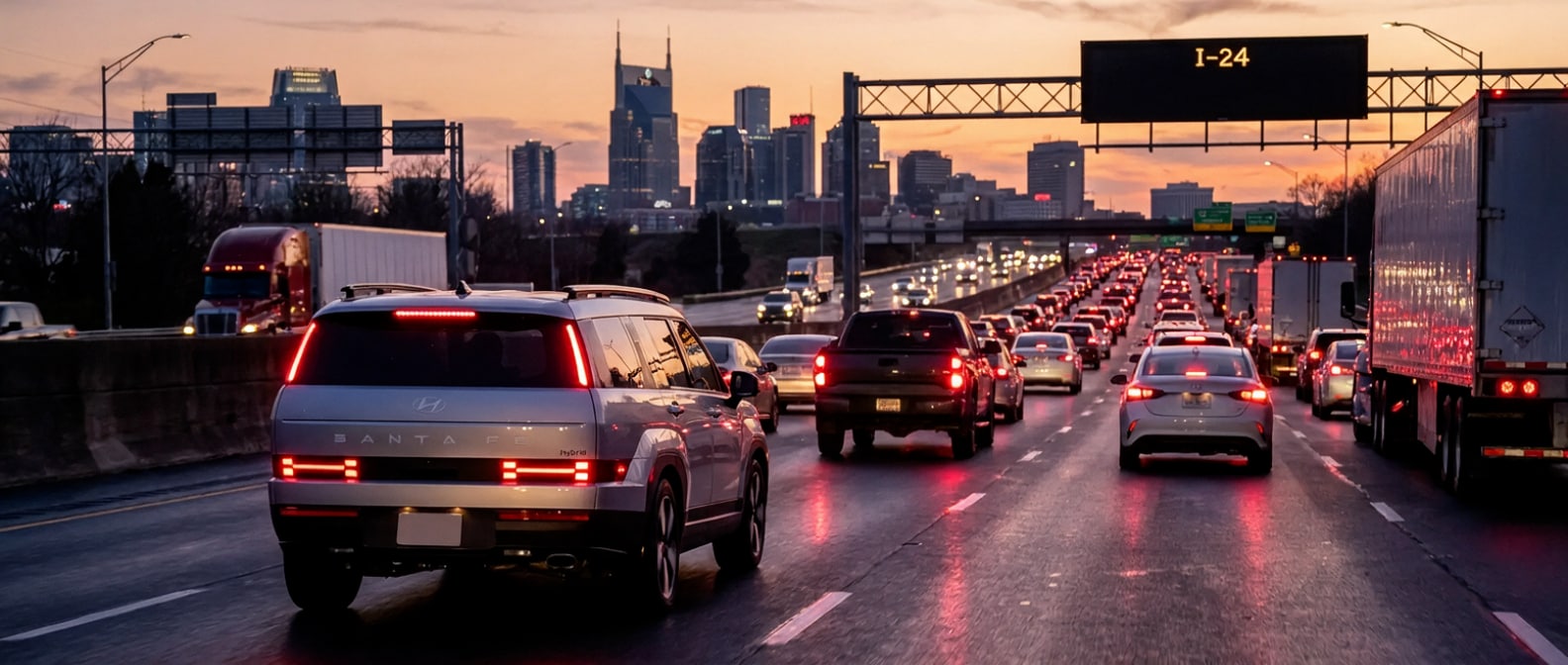
Both versions of the 2026 Hyundai Santa Fe carry the same IIHS Top Safety Pick+ award and the same standard SmartSense driver-assistance suite. For Nashville drivers logging daily miles on I-24, the choice between the Santa Fe Hybrid and the gas-powered Santa Fe comes down to something more specific. It's about how each powertrain behaves in the grinding stop-and-go this corridor delivers every morning and evening.
- Both the 2026 Santa Fe Hybrid and gas Santa Fe earn IIHS Top Safety Pick+ and a 5-star NHTSA overall rating, with Hyundai SmartSense standard on every single trim.
- The Hybrid's regenerative braking system recaptures energy on every I-24 slowdown, making it a natural fit for the corridor's dense stop-and-go pattern.
- Smart Cruise Control with Stop and Go (standard on both) is the feature that makes the most practical difference on heavy commutes.
- The gas Santa Fe's XRT trim adds 3,500-lb towing and all-terrain tires, which the Hybrid lineup does not offer.
- If your week is mostly commuting and family hauling on the Nashville metro grid, the Hybrid is the sharper choice. Tow a boat or want the XRT's rugged capability? The gas model earns the nod.
What's the Real Safety Difference Between the Two?
Both the 2026 Santa Fe Hybrid and the gas Santa Fe ride on the same platform, pass the same crash tests, and arrive with the full Hyundai SmartSense package from the base SE trim upward, so the safety hardware gap between them isn't wide, with the drivetrain doing the differentiating once you hit traffic. The IIHS awarded the 2026 Santa Fe (both powertrains) Top Safety Pick+ with Good scores across small overlap front, moderate overlap front, and side impact testing. NHTSA rates the 2026 Santa Fe 5 stars overall, including 5 stars for frontal crash and 5 stars for side crash, with a 4-star rollover rating.
The safety suite that's standard on every trim deserves a close look, because it's doing real work on a road like I-24.
| Safety Feature | Santa Fe Hybrid (all trims) | Gas Santa Fe (all trims) |
|---|---|---|
| Forward Collision-Avoidance Assist (pedestrian, cyclist, junction) | Standard | Standard |
| Smart Cruise Control with Stop and Go | Standard | Standard |
| Lane Following Assist | Standard | Standard |
| Lane Keeping Assist | Standard | Standard |
| Blind-Spot Collision Warning | Standard | Standard |
| Rear Cross-Traffic Collision-Avoidance Assist | Standard | Standard |
| Safe Exit Assist | Standard | Standard |
| Driver Attention Warning | Standard | Standard |
| Advanced Rear Occupant Alert | Standard | Standard |
| Highway Driving Assist 2 | Limited + Calligraphy trims | Limited + Calligraphy trims |
| Surround View Monitor | SEL and above | SEL and above |
| Blind-Spot View Monitor | SEL and above | SEL and above |
| IIHS Rating | Top Safety Pick+ | Top Safety Pick+ |
| NHTSA Overall | 5 Stars | 5 Stars |
Does the Hybrid's Powertrain Actually Change the Driving Experience on I-24?
Yes, the Hybrid genuinely changes the drive on I-24, though the difference shows up in how it brakes rather than in its horsepower, and for anyone pulling onto the interstate near Bell Road most mornings, that braking behavior is the part that actually pays off in traffic. The stretch between downtown and Murfreesboro is widely documented as the most congested highway corridor in Tennessee, and TDOT data cited by local news has noted the southeast corridor serving up to 174,000 vehicles per day. Congestion is the baseline here, not the exception.
The Hybrid pairs a 1.6-liter turbocharged four-cylinder with an electric motor for 231 combined horsepower. What that means in traffic has little to do with the power figure. Regenerative braking converts every slowdown into a small battery charge, so the system smooths deceleration differently than a gas engine's compression braking does. In stop-and-go conditions, you'll feel the Smart Cruise Control with Stop and Go work with that system to maintain following distance, slow gradually, and restart from a full stop automatically.
The gas Santa Fe's 2.5-liter turbocharged four-cylinder produces 277 horsepower and pairs with a conventional 8-speed automatic. It's meaningfully more powerful for highway merges and feels snappier at on-ramp speeds, noticeably so. That advantage is real. The tradeoff is that in the kind of pack-and-brake rhythm I-24 serves up, every deceleration on the gas model is just braking, with nothing recovered. The Hybrid, rated by the EPA at 37 city and 36 highway MPG (FWD), turns that stop-and-go pattern into a fuel efficiency advantage. In front-wheel drive, the gas SE is EPA-rated at 20 city and 29 highway. Those aren't figures to dismiss. Browse the gas Santa Fe if highway merging power is your priority.
How the Two Models Stack Up on Practicality
With the safety suite equal across both, the practical gaps are where the two models part ways, and they're about trims, towing, and a few standard-equipment choices rather than anything buried in the crash structure.
The Hybrid lineup runs four trims (SE, SEL, Limited, and Calligraphy). The gas Santa Fe adds the XRT, a gas-only offering with all-terrain tires, standard all-wheel drive, terrain modes for snow, mud, and sand, and a tow rating of 3,500 lbs with trailer brakes. By comparison, the Hybrid is rated at 2,000 lbs. If you're towing a boat to Percy Priest Lake or running a utility trailer on weekends, the gas model is the practical choice. Call that a genuine tradeoff, and not a minor one, either.
On the other side, the Hybrid SE starts with dual automatic climate control as standard equipment, whereas the gas SE doesn't include it at that trim level. The Hybrid also replaces the full-size spare with a tire mobility kit to accommodate the hybrid battery, which some drivers prefer to know upfront.
Both seat up to seven in SE and SEL configurations, with 14.6 cubic feet of cargo space behind the third row and 40.5 cubic feet behind the second row, per Hyundai's published specs. See what's on our lot now to check trim availability in real time. The interior structure is shared. Space isn't a differentiator here.
| Dimension | Santa Fe Hybrid | Gas Santa Fe |
|---|---|---|
| EPA City MPG (FWD base trim) | 37 (EPA-estimated) | 20 (EPA-estimated) |
| EPA Highway MPG (FWD base trim) | 36 (EPA-estimated) | 29 (EPA-estimated) |
| Powertrain | 1.6T + electric motor, 231 hp | 2.5T, 277 hp |
| Tow Rating | 2,000 lbs | 3,500 lbs (gas); XRT has standard AWD |
| XRT Trim Available | No | Yes |
| Third-Row Seating | Up to 7 (SE/SEL) | Up to 7 (SE/SEL/XRT) |
| Cargo Behind Row 3 | 14.6 cu ft | 14.6 cu ft |
| IIHS Rating | Top Safety Pick+ | Top Safety Pick+ |
| NHTSA Overall | 5 Stars | 5 Stars |
So Which One Is Right for You?
If your week is mostly Nashville metro commuting, school runs, and the occasional Middle Tennessee road trip, the Santa Fe Hybrid is the more direct fit, since its EPA efficiency edge pays off exactly where I-24 keeps you, in stop-and-go, while the gas model's extra power matters less in that setting. The SmartSense suite is identical, so you're not trading any safety technology to get the efficiency. Highway Driving Assist 2, available on Limited and Calligraphy in both lineups, is the feature that makes longer drives on the corridor noticeably less taxing.
If you tow, want the XRT's ground clearance and all-terrain tires, or simply prefer the 277-horsepower gas engine's character on long highway stretches, the gas Santa Fe is the honest answer. Don't let the fuel number talk you into a Hybrid if the XRT's capability is the thing you're actually going to use. Both give you the same crash-tested safety structure and the same standard driver-assistance technology. The choice is really about what the rest of the vehicle needs to do for your life in Nashville.
Before you decide on trim level, compare the features you'll actually use across the range, because moving from SE to SEL adds Blind-Spot View Monitor and Surround View Monitor, which are worth having on a road where merging happens fast.
Frequently Asked Questions
Does the Santa Fe Hybrid have the same safety features as the regular gas Santa Fe?
Yes. The 2026 Santa Fe Hybrid and the gas-powered Santa Fe share the same Hyundai SmartSense driver-assistance suite standard on every trim, from SE through Calligraphy. Both carry an IIHS Top Safety Pick+ designation with Good ratings across small overlap front, moderate overlap front, and side impact testing, and both receive 5-star overall ratings from NHTSA. The differences between the two come from the powertrain and the gas model's XRT trim, not from the safety technology.
Is Highway Driving Assist 2 standard on the 2026 Santa Fe Hybrid?
No. Highway Driving Assist 2 is available on the Limited and Calligraphy trims of the 2026 Santa Fe Hybrid, not on the base SE or SEL. Those lower trims still include Smart Cruise Control with Stop and Go and Lane Following Assist, which handle the core adaptive-cruise and lane-centering functions. Upgrading to the Limited adds the more advanced Highway Driving Assist 2 capability, which supports lane centering, following distance, and lane-change assistance on highways, along with Navigation-based Smart Cruise Control with Curve Control.


