

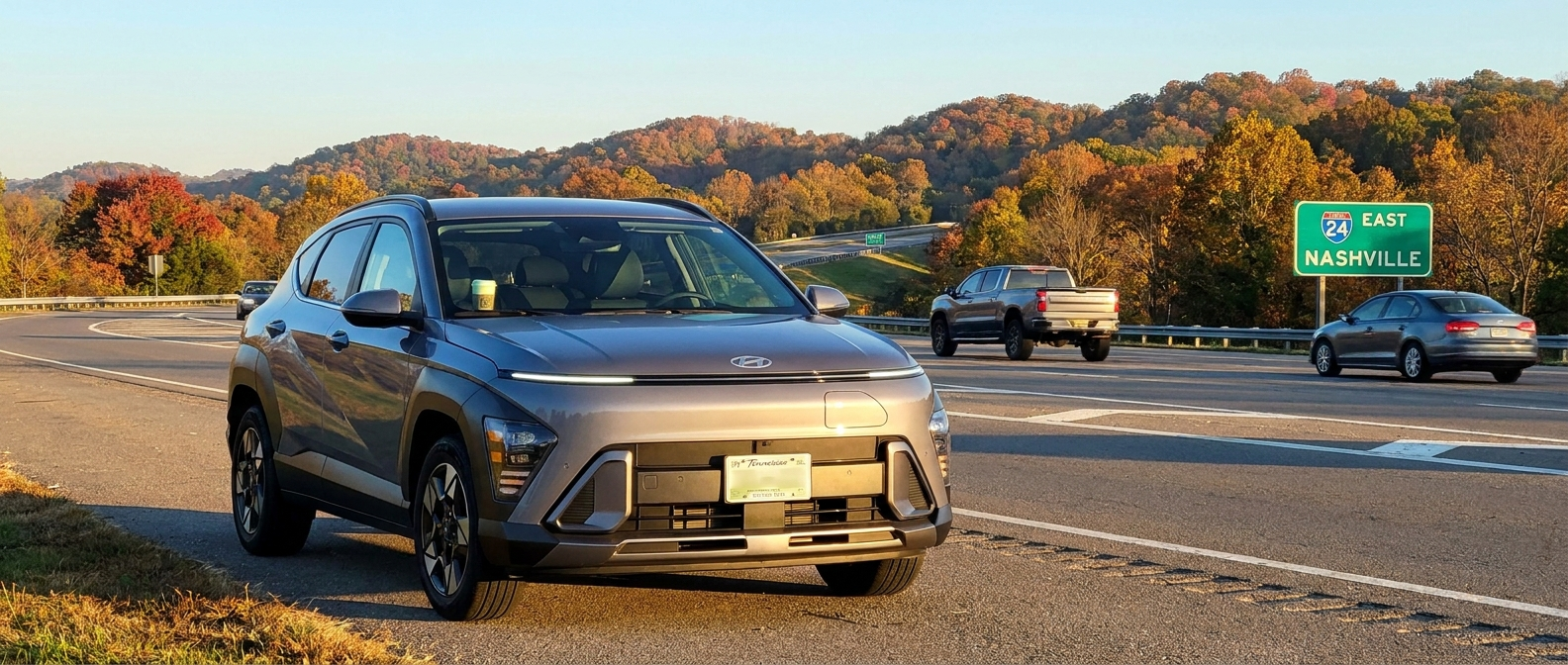
If you're driving I-24 from Smyrna into Nashville every day, a used Kona Electric makes a lot of practical sense on paper. But the used market spans two distinct generations, a set of significant battery recalls, and a lineup change that cut the long-range option entirely in the most recent model years. Picking the wrong year isn't catastrophic. It does mean more VIN homework than you might expect.
Here's what our team at Hyundai of South Nashville actually tells buyers who come in asking about used Kona Electrics. The 2019 and 2020 models carry unresolved risk for anyone who hasn't confirmed the battery recall was completed. The 2022 and 2023 cars are the sweet spot of the first generation. And the 2024 and 2025 cars are a cleaner, redesigned option with faster charging but a shorter standard range that still handles a Smyrna-to-Nashville round trip with room to spare.
Browse our current used inventory to see what's available near Bell Road right now.
- Sweet spot for used buyers: 2022 or 2023 (Gen 1, 258-mile EPA-estimated range, recalls largely resolved, 120 MPGe EPA-combined)
- Strong alternative: 2024 or 2025 (Gen 2, redesigned interior, faster AC charging, choose Long Range if range anxiety is real for you)
- Years to verify carefully: 2019 and 2020 (NHTSA battery fire recalls 20V630 and 21V127; only buy if recall was completed and the battery replaced)
- Year to approach cautiously: 2021 (IEB brake software recall 20V748 covered this model year. Check VIN at NHTSA.gov)
- A Smyrna-to-Nashville round trip runs roughly 55-60 miles on I-24. Every model year in this guide covers that with substantial buffer.
Which Kona Electric Years Are the Sweet Spot?
For a daily commuter buying used, the 2022 and 2023 Kona Electrics are the years we'd look at first, and both land far enough along the first generation that the early battery recalls had been worked through by then. The EPA rates both at 258 miles of range and 120 MPGe combined, using the same 64 kWh lithium-ion battery and 201-horsepower electric motor that carried over unchanged from the original launch. The difference from the 2019 to 2021 cars has less to do with specs and more to do with timing. By 2022, those battery fire recalls had been resolved, and the 2022 model year itself isn't covered under the major battery recall campaigns.
The 2023 brings the same powertrain and lands at a useful point in the used-value curve. The car is old enough to have depreciated meaningfully, yet not so old that battery condition becomes a worry. That balance is the draw.
| Model Year | Generation | EPA Range (est.) | EPA Combined MPGe | Battery | Key Notes |
|---|---|---|---|---|---|
| 2019 | Gen 1 | 258 mi | 120 | 64 kWh | NHTSA recalls 20V630 + 21V127 (battery fire). Verify VIN first. |
| 2020 | Gen 1 | 258 mi | 120 | 64 kWh | Same battery fire recalls. Verify VIN first. |
| 2021 | Gen 1 | 258 mi | 120 | 64 kWh | NHTSA recall 20V748 (IEB brake software). Lower risk, still check VIN. |
| 2022 | Gen 1 | 258 mi | 120 | 64 kWh | Sweet spot. No battery fire recall. Updated interior trim. |
| 2023 | Gen 1 | 258 mi | 120 | 64 kWh | Sweet spot. Final Gen 1, carry-over powertrain, strong used value. |
| 2024 | Gen 2 | 200 mi (SE) / 261 mi (SEL, Ltd) | 118 / 116 MPGe | 48.6 / 64.8 kWh | Full redesign. Dual 12.3" screens. Faster 10.8 kW AC charger. |
| 2025 | Gen 2 | 200 mi (SE) / 261 mi (SEL, Ltd) | 118 / 116 MPGe | 48.6 / 64.8 kWh | Most recent US model year. Identical to 2024 in powertrain. |
Worth naming plainly: the 2024 and 2025 SE trims carry a smaller 48.6 kWh battery with the EPA-estimated 200-mile range. On paper that reads like a step down from 258 miles, and it is. For a 55-to-60-mile daily round trip on I-24, 200 miles is still more than three times your daily need on a full charge. The buyers who actually need the Long Range (261 miles) are the ones running longer errands after work or heading to Murfreesboro and back on the same charge.
See Kona inventory at Hyundai of South Nashville
Which Years Should You Watch Out For?
The 2019 and 2020 Kona Electrics carry the most homework of any year here, because NHTSA opened two separate battery fire recall campaigns over those cars, though plenty of them have since had the remedy completed and drive without issue once the work is confirmed. Campaign 20V630 landed in October 2020, and the follow-up campaign 21V127 in February 2021. Per NHTSA, an electrical short in the lithium-ion battery cells increases the risk of fire while the car is parked, charging, or driving. Hyundai's remedy was a Battery Management System software update and battery inspection, with full battery pack replacement for affected vehicles.
A lot of these cars have had the repair done by now. Confirming it was done on the specific car in front of you is the part that matters. Before you look at a 2019 or 2020 Kona Electric, run the 17-digit VIN through NHTSA.gov/recalls. It flags which campaigns apply and whether the remedies were completed. The whole thing takes two minutes.
The 2021 model year sits in a different situation. It falls under NHTSA recall 20V748, which addressed a brake software issue with the Integrated Electronic Brake system. NHTSA notes the IEB may detect an abnormal sensor signal and sharply reduce braking performance. Hyundai's fix was a software update, simpler than a battery replacement. Still worth confirming via VIN, but the risk profile is lower.
Search pre-owned Kona Electric listings
Explore financing options for used EVs
Does the Range Actually Work for Smyrna Commuters?
Yes, the range works comfortably for this commute, and it holds up even on the smallest battery available in this generation, since a Smyrna-to-Nashville round trip uses only a fraction of what a full charge gives you, and that stays true on a hot Tennessee afternoon. Smyrna to downtown Nashville via I-24 is about 25 to 30 miles one way. A round trip is in the 55-to-60-mile range. Even the smallest battery available in this generation (the 48.6 kWh unit in the 2024-2025 SE, rated by the EPA at 200 miles) leaves you more than three times your daily drive on a single charge. You come home, plug in overnight at Level 1 or Level 2, and you're full by morning.
Tennessee summers do compress EV range. Heat puts a heavier load on the climate system, and that pull comes from the battery.
For a commuter who also runs substantial errands after work or takes regular longer drives on weekends, the Gen 1 models (258 miles) or the Gen 2 Long Range (261 miles) give more buffer on a hot July day. For someone whose daily loop is genuinely 60 miles or fewer, the 200-mile SE isn't a real constraint.
The 2024 and 2025 cars bring one practical edge worth flagging. Hyundai upgraded the onboard AC charger from 7.2 kW (in 2023 and earlier) to 10.8 kW. Per Hyundai's published specs, that trims a Level 2 home charging session from around nine hours to about six. If you're coming home late on a standard home Level 2 setup, that time difference matters.
Which Year Is Right for Which Buyer?
Buy the 2022 or 2023 if: Your daily drive is under 100 miles, you want maximum range buffer on the used market, and you're comfortable doing the VIN check to confirm no open recalls on the specific car.
Buy the 2024 or 2025 SE if: Your commute is straightforwardly 55-60 miles per day, you want the redesigned dual-screen interior, and a shorter EPA range figure doesn't concern you (it shouldn't, for this use case).
Buy the 2024 or 2025 Long Range if: You regularly take the car beyond the commute, you want 261 miles of EPA-estimated range as your buffer for Middle Tennessee heat, and you want the fastest available home charging on this platform.
Approach the 2019 or 2020 only if: The VIN shows recall 21V127 was completed and the battery was replaced. A post-recall car with a new battery pack is a different proposition than one where the work hasn't been done.
The 2021 sits in the middle. Don't skip it outright. Just verify the IEB brake recall 20V748 is closed on that specific VIN.
Explore Financing Options for a Used Kona Electric
Our team on Bell Road can run the VIN check with you, walk through what the recall completion documentation should look like, and help you compare what's in our pre-owned inventory to what you're seeing elsewhere. An EV commuter car should simplify your mornings. Getting the model year right means it will.
Frequently Asked Questions
Is the Hyundai Kona Electric safe to buy used?
Yes, with the right homework. The 2022 and 2023 model years are the most straightforward used purchases in this lineup. Neither is covered under the battery fire recalls that affected 2019 and 2020 cars, and both carry the first-generation 258-mile EPA-estimated range. For 2019 and 2020 cars, the battery fire risk was addressed through NHTSA recalls 20V630 and 21V127, which covered a Battery Management System software update and battery pack inspection or replacement. Before buying any 2019, 2020, or 2021 Kona Electric, check the VIN at NHTSA.gov/recalls to confirm the recall work was completed.
How much range does a used Kona Electric need for a Smyrna-Nashville commute?
The Smyrna-to-Nashville round trip on I-24 runs roughly 55 to 60 miles. Every model year of the Kona Electric covered in this guide offers well more than that on a single charge. The first-generation cars (2019-2023) carry an EPA-estimated 258-mile range, and the 2024-2025 SE Standard Range is EPA-estimated at 200 miles. Even the smaller battery handles more than three times a typical commuter's daily round trip. The buyers who want more cushion are those running extended errands or weekend trips beyond the commute, in which case the Gen 2 Long Range option (261 miles EPA-estimated) or the Gen 1 cars make the most sense.
What changed between the first-generation and second-generation Kona Electric?
The first generation (2019-2023) used a 64 kWh battery and 201-horsepower motor, with an EPA-estimated 258-mile range. The second generation (2024-2025) was a full redesign with two battery options. The Standard Range uses a 48.6 kWh pack (EPA-estimated 200 miles, 133 hp), and the Long Range uses a 64.8 kWh pack (EPA-estimated 261 miles, 201 hp). The 2024 redesign also brought a dual 12.3-inch screen setup, a faster 10.8 kW onboard AC charger (versus 7.2 kW in the 2023 and earlier cars), and a more open center console layout. Hyundai confirmed no 2026 model year was produced for the US market; the most recent Kona Electric available new or nearly-new is the 2025.


