

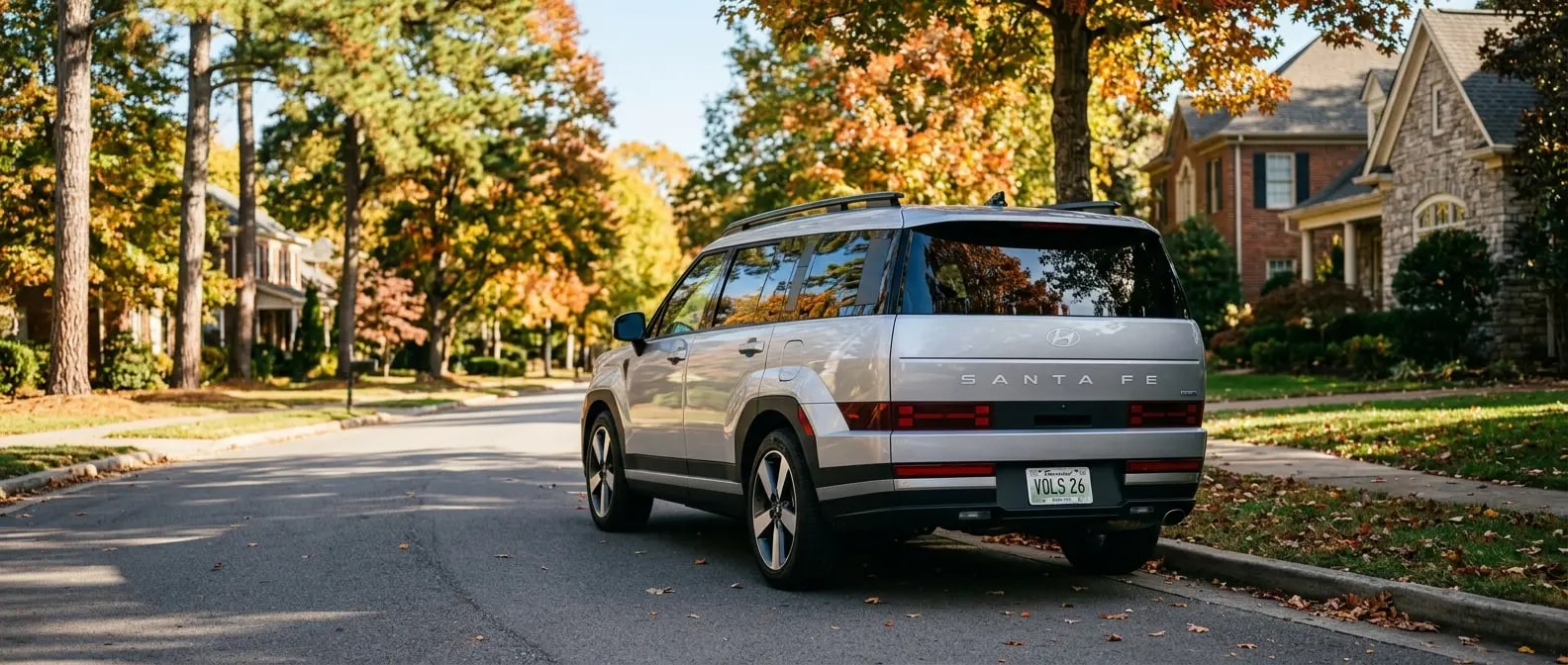
Three meaningfully different configurations make up the 2026 Santa Fe lineup, and the fuel economy gap between them is not subtle. The EPA rates the gas FWD model at 24 mpg combined. The Hybrid FWD lands at 36. Call it roughly a 50 percent difference, and it isn't theoretical. On any weekday, it shows up on I-65 between Franklin and downtown Nashville. Pick the wrong version and you don't just pay more at the pump. You carry capability you never use, or you miss efficiency you could've had.
Here's how to think through it.
- The Santa Fe Hybrid FWD (EPA-estimated 36 mpg combined) is the strongest pick for daily Franklin-to-Nashville commuters who want to minimize fuel stops.
- The gas Santa Fe FWD (EPA-estimated 24 mpg combined) costs less upfront and gives you 277 horsepower; it makes sense if you rarely drive over 15,000 miles a year.
- The Santa Fe XRT (EPA-estimated 21 mpg combined) is AWD-only with all-terrain tires; it earns its fuel penalty only if you genuinely use the off-road profile.
- The Hybrid recharges its own battery through the engine and regenerative braking. No plug required. Just regular gas.
- Stop-and-go driving on I-65 is where the Hybrid's gap widens most: hybrids recover energy braking into each congestion pocket that gas engines waste as heat.
Browse 2026 Santa Fe Hybrid inventory at Hyundai of South Nashville
How Do the Three Santa Fe Options Compare?
All three Santa Fe variants share the same body and three-row packaging, so what you're really choosing between is the powertrain, the drivetrain, and what you get back per gallon. The table below pulls EPA-published figures for the 2026 model year. The gas versions seat seven, and the Hybrid seats up to six or seven depending on your second-row setup.
| Variant | EPA City | EPA Hwy | EPA Combined | Drivetrain | Engine | Best For |
|---|---|---|---|---|---|---|
| Santa Fe Gas FWD | 20 mpg | 29 mpg | 24 mpg | FWD standard | 2.5L turbo, 277 hp | Lower-mileage drivers; weekend road trips |
| Santa Fe Gas AWD | 20 mpg | 28 mpg | 23 mpg | HTRAC AWD | 2.5L turbo, 277 hp | All-weather grip without hybrid premium |
| Santa Fe XRT | 19 mpg | 25 mpg | 21 mpg | AWD only | 2.5L turbo, 277 hp | Off-road capability; trail or gravel use |
| Santa Fe Hybrid FWD | 37 mpg | 36 mpg | 36 mpg | FWD standard | 1.6L turbo hybrid, 231 hp | High-mileage commuters; I-65 stop-and-go |
| Santa Fe Hybrid AWD | 35 mpg | 34 mpg | 34 mpg | HTRAC AWD | 1.6L turbo hybrid, 231 hp | All-weather commuters; efficiency + grip |
*EPA estimates; actual mileage varies. All figures from fueleconomy.gov for the 2026 model year.*
Does the Hybrid Actually Save More on the Franklin Commute?
It does, and the reason comes down to how you're truly driving that route. Franklin sits about 20 to 22 miles from downtown Nashville via I-65, and that stretch is rarely a free-flowing cruise. When traffic stacks up, as it does on weekday mornings between Brentwood and downtown, the Santa Fe Hybrid does something a gas-only Santa Fe physically cannot. Every time you lift off the accelerator or squeeze the brakes, the hybrid system turns that kinetic energy back into electricity through regenerative braking. Compare gas Santa Fe trims in our inventory That stored energy charges the small onboard battery, which then powers the electric motor at low speeds and assists the 1.6-liter turbo during acceleration. A gas engine burns fuel the whole time.
The EPA numbers back this up. The Santa Fe Hybrid FWD is rated at 37 mpg in city driving, which is its strongest environment. Sustained highway cruising above 65 or 70 mph is where the hybrid advantage narrows, since the turbo engine carries most of the load and regenerative chances drop off. So if your commute is mostly I-65 stop-and-go with some local errands, the EPA's 36 combined estimate should track close to what you see. If you're mostly running highway miles at 70-plus, the gap between Hybrid and gas tightens, though the Hybrid still leads.
What About the XRT? Is the Fuel Penalty Worth It?
The XRT earns an EPA-estimated 21 mpg combined, three mpg below the standard AWD gas Santa Fe and fifteen below the Hybrid FWD. That gap exists for concrete mechanical reasons. The XRT comes exclusively with AWD, a raised ride height, and standard all-terrain tires. Those tires carry more rolling resistance than the street rubber on other trims, and the AWD system adds drivetrain drag. The XRT is the thirstiest Santa Fe on the lot, and a daily commute won't soften that. See current XRT availability
On a daily Franklin-to-Nashville run of 40 to 44 round-trip miles, the fuel difference between an XRT and a Hybrid FWD adds up across a year. That's a genuine cost. But if you're running gravel access roads near Natchez Trace or heading to the Cumberland Plateau for weekend camping, the XRT's dedicated off-road calibration, hill-descent control, and terrain modes make it a different vehicle for a different purpose. Our take is simple. The XRT's fuel penalty earns its keep only when you're truly using what it brings. If your "off-road" is wet grass at a soccer field, you're paying for capability you won't touch.
- The XRT is AWD-only; no FWD option exists in this trim
- All-terrain tires are the primary source of the efficiency penalty
- Ride height is raised versus the standard Santa Fe gas trim
- Hill-descent control and terrain modes are XRT-specific
- Towing capacity is 3,500 lbs for the gas AWD; the Hybrid is rated at 2,000 lbs
Which Santa Fe Makes Sense for Your Situation?
The right Santa Fe depends on how you actually drive, so we walk customers through it by pattern rather than by the badge on the tailgate. We'll start with the miles you log, where you log them, and what you tow.
You're a daily commuter putting 12,000-plus miles a year on I-65. The Hybrid FWD is the clear pick. EPA's 36 combined against 24 for the gas FWD is a genuine, calculable difference over a year of driving. You never plug it in. You fill it with regular gas. Pair that 17.7-gallon tank with the 36 mpg figure and you get an EPA-estimated range of around 637 miles per fill, which means fewer pump stops on both ends of the commute.
You drive fewer miles, prioritize cargo, or tow on weekends. The gas Santa Fe is the more sensible answer here. Its 2.5-liter turbo makes 277 horsepower (versus 231 for the Hybrid), and it tows up to 3,500 lbs with AWD. If you're pulling a boat up to Percy Priest Lake or hauling a trailer south toward Lewisburg, the gas model isn't giving anything up where it counts. The Hybrid's 2,000-lb tow rating is modest by comparison.
You spend weekends on unpaved roads or genuinely varied terrain. The XRT is the only Santa Fe with a dedicated off-road package. Accept the 21 mpg combined as the cost of that capability, the same way you'd accept the tradeoff on any purpose-built spec. What you shouldn't do is buy an XRT for daily I-65 commuting and then ignore everything that makes it different. You'd be paying extra for capability you park in a garage.
Not sure if you need three rows? Compare the Tucson Hybrid for a two-row option with up to 38 mpg combined EPA-estimated on the Blue SE trim.
Frequently Asked Questions
Does the 2026 Santa Fe Hybrid require a plug to charge?
No. The Santa Fe Hybrid is a conventional hybrid, not a plug-in. It charges its small onboard battery through two sources: the gasoline engine and regenerative braking, which captures energy when you decelerate or brake. You fill it with regular unleaded gasoline at any station. There is no home charger required, no charging cable, and no plug-in step in your routine. If you want plug-in capability in the Santa Fe family, the PHEV (plug-in hybrid) is a separate model and a separate purchase decision.
Does AWD on the Santa Fe Hybrid hurt fuel economy much?
Yes, but the real-world difference is meaningful without being dramatic. The EPA rates the Santa Fe Hybrid FWD at 36 mpg combined and the HTRAC AWD version at 34 mpg combined. That two-mpg gap is consistent with how HTRAC all-wheel drive works: the system adds weight and some mechanical drag from the rear drive components. For Franklin-area drivers who want all-weather confidence through Middle Tennessee's occasional ice events or wet-road mornings, the 34 mpg AWD Hybrid is still far more efficient than the 23 mpg gas AWD Santa Fe. The AWD penalty on the Hybrid is real; it's also small relative to what the Hybrid delivers over the gas model either way.


