

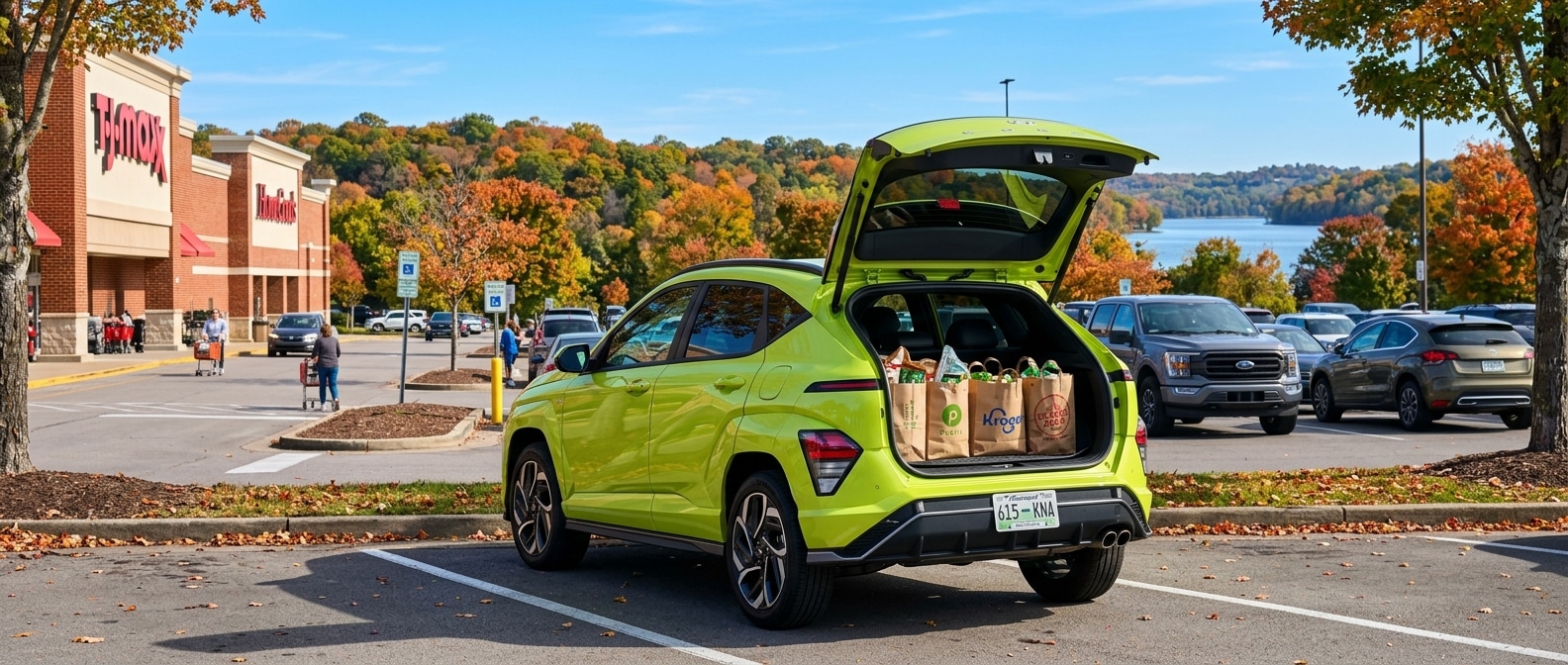
If you've been searching the Kona and hit reviews that call the cargo space "a joke," we understand the skepticism. Those older reviews aren't wrong. They're describing a different car. The Kona that launched in 2018 shipped with roughly 19 cubic feet of cargo room, and people noticed. Forum threads said so at volume. That reputation lingered online long after Hyundai redesigned the whole vehicle for 2024, and it still steers buyers away from a Kona that no longer earns the criticism.
The 2026 Kona carries 25.5 cubic feet behind the rear seats and expands to 63.7 cubic feet with the seats folded. The jump isn't marginal. You're looking at a different class of practical.
- The old Kona (pre-2024) had roughly 19 cu ft of cargo space. The 2026 model has 25.5 cu ft with seats up.
- Fold the 60/40 rear seats flat and you're at 63.7 cu ft. Enough for a full Costco run, a hiking pack, or a weekend's worth of gear for Long Hunter State Park.
- The 2026 Kona is 171.3 inches long. It fits tight parking lots without drama.
- The EPA rates the FWD 2.0L at 29 city / 34 highway, so those errands around Stewarts Ferry Pike don't cost you much at the pump either.
- The real tradeoff is rear legroom for taller passengers, not cargo space. That's the honest limit.
Is the Kona's "No Cargo" Reputation Actually True for 2026?
It was a fair complaint on the old car, and on the 2026 Kona it simply doesn't hold anymore, since the 2024 redesign grew the body, raised the roofline, and reworked the load floor, and the cargo numbers moved up right along with all three.
| What People Claim | What the 2026 Kona Actually Delivers | Source |
|---|---|---|
| "The Kona trunk is tiny. Barely fits groceries" | 25.5 cu ft behind rear seats; Hyundai lists this as roughly 6-8 packed grocery bags with room to spare | Hyundai / Edmunds verified specs |
| "You can't haul anything real in it" | 63.7 cu ft with 60/40 seats folded flat. Flat load floor, no step-up lip | Hyundai spec sheet |
| "It's smaller than the Honda HR-V" | The Kona actually beats the 2026 HR-V's 24.4 cu ft (seats up) and 55.1 cu ft (seats folded) in both configurations | Published 2026 specs |
| "The footprint is too big to park easily" | At 171.3 inches long with a 34.8-foot turning diameter, it's shorter than a Camry and turns tighter than you'd expect | Hyundai / KBB dimensions |
| "Gas mileage suffers if you're hauling stuff" | EPA rates the FWD 2.0L at 29 city / 34 highway / 31 combined. Errand-loop efficiency is genuinely good | EPA estimate |
On a run to the big-box stores out on Bell Road, the flat load floor is the detail that never shows up in the cubic-foot numbers, but it's the one that changes how the car loads. With no pronounced step from the cargo sill to the floor, heavy bags and coolers slide straight in. No lip to clear.
What 25.5 Cubic Feet Looks Like on an Actual Errand Loop
The 25.5 cubic feet translates to a usable errand bay, though the number alone won't tell you what fits, which is the part most spec sheets skip and the part that decides whether the car works for you.
On the lot, we tend to size it up this way. With the seats up, the Kona's cargo bay handles a week of groceries for two people. Comfortably. Add the 12-inch cargo floor depth, the roughly 41-inch pass-through width, and the flat load floor, and you'll fit a few flat-pack items without folding a thing.
Fold one side of the 60/40 split and you've got a long flat lane on the driver's side for a kayak paddle, a camp chair, or a rolled-up blanket, while a passenger still rides on the other side. That configuration earns its keep on a Saturday that starts with a Costco stop on Murfreesboro Pike and ends at a boat ramp on Percy Priest Lake.
Fold both sides and you're at 63.7 cubic feet, enough for two large suitcases, a full week of camping gear, or the bulk haul from a warehouse club without stacking bags in the passenger seat. The rear becomes one flat rectangle.
The Honest Tradeoff You Should Know Before You Decide
Yes, the 2026 Kona fixes the cargo story, but it carries one genuine limit you'll want to weigh first, and it lives in the back seat rather than the trunk, since the extra room mostly favored cargo over rear legroom.
We won't pretend the Kona is a Tucson. There's one true limit, and it lives in the rear seat.
Rear legroom sits at 38.2 inches. Most adults will find that comfortable. If your passengers are consistently over six feet tall, or you're often running three adults in back for a longer haul out to Long Hunter State Park, they'll feel it after 45 minutes. A longer haul like that is where you'll want to step up to the Hyundai Tucson or even the Hyundai Santa Fe, both of which give rear passengers meaningfully more stretch room.
The Kona earns its spot when your priority list runs parking ease first, then fuel efficiency, cargo flexibility, and value. In that order. If rear-seat comfort sits near the top instead, be clear-eyed about it before you've fallen for the color options.
Around Stewarts Ferry Pike, the Donelson shopping corridor, and the access roads near Percy Priest Lake, you're not dealing with wide-open boulevard driving. You get tight turn lanes, packed weekend parking lots, and the occasional narrow marina access road. A 171.3-inch vehicle with a 34.8-foot turning diameter threads through all of it without the mental load a larger SUV brings. It matters on a Saturday when you're squeezing three stops in before noon.
So What Should You Actually Do Before Deciding?
The most useful move is to come look at the cargo bay in person rather than trusting a number on a screen, because the specs will get you close but you'll only know for sure once you're standing behind an open hatch with your own gear.
We know that sounds simple, but it's a case where the flat-floor impression, the cargo cover that tucks away when you need height clearance, and the way the 60/40 seats fold all click differently in person than on a spec sheet.
Our team is at 1635 Bell Rd, in the South Nashville corridor that sits a short drive from Percy Priest Lake, Donelson, Hermitage, and the shopping strip on Bell Road. Bring your usual errand haul in mind. Load in the dog crate, the folding chair, and the reusable grocery bags, and if the Kona swallows them with room to spare, you'll know. If it doesn't, we'll tell you and point you toward a better fit.
The 2026 Kona's cargo story is a correction, not a comeback. That reputation hasn't caught up yet.
Frequently Asked Questions
How much cargo space does the 2026 Hyundai Kona have compared to older models?
The 2026 Kona carries 25.5 cubic feet of cargo behind the rear seats, which expands to 63.7 cubic feet with the 60/40 split-folding seats folded flat. The pre-2024 generation sat at roughly 19 cubic feet with seats up, so the current model represents a meaningful jump in usable space, driven by the larger body and reworked load floor introduced with the 2024 redesign.
Is the 2026 Hyundai Kona a good choice for weekly errands and occasional outdoor trips around Nashville?
For buyers who want a compact footprint for South Nashville and Donelson-area parking, solid fuel efficiency (the EPA rates the FWD 2.0L at 29 city / 34 highway), and enough cargo flexibility to handle a grocery run and a gear-loaded trip to Percy Priest Lake in the same weekend, the 2026 Kona is a genuinely practical choice. The honest limit is rear legroom for tall adult passengers on longer drives; if that's a regular situation, a Tucson or Santa Fe is worth a look.


